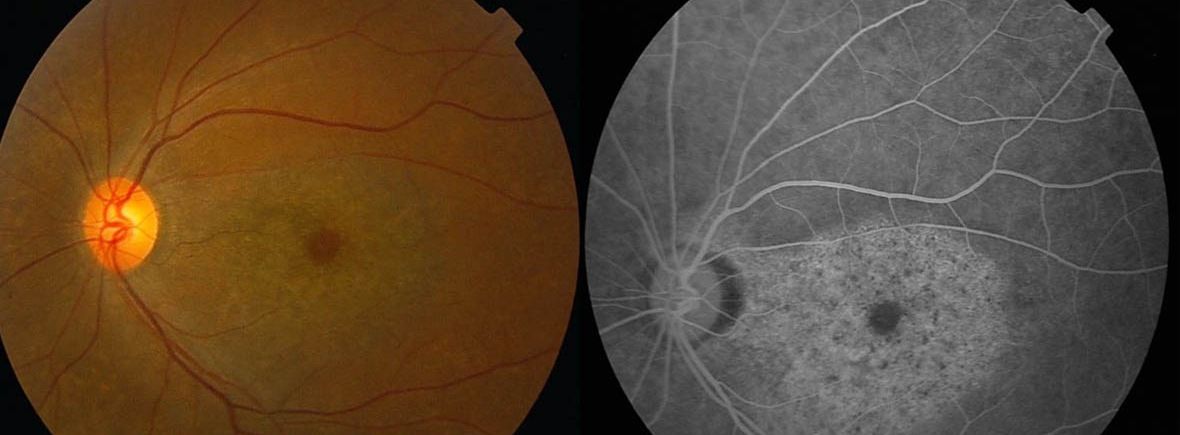
A maculopatia tóxica por fármacos antimaláricos é uma doença ocular rara e adquirida, decorrente da exposição em longo prazo à cloroquina (CQ) ou à hidroxicloroquina (HCQ). É caracterizada pelo desenvolvimento lentamente progressivo, e habitualmente não reversível, de maculopatia atrófica bilateral em olho de boi (perda progressiva da acuidade visual central, visão de cores reduzida e escotoma central). Em casos graves, a alteração pode se espalhar por todo o fundo ocular, levando a atrofia retiniana generalizada e perda visual.
Introdução
O que você precisa saber de cara
Visão geral
A maculopatia tóxica por fármacos antimaláricos é uma doença ocular adquirida rara, causada pelo uso prolongado de cloroquina ou hidroxicloroquina. Ela se caracteriza pelo desenvolvimento lento e geralmente irreversível de uma mácula em olho de boi bilateral (atrofia da mácula), levando à perda progressiva da acuidade visual central, redução da visão de cores e escotoma central. Em casos graves, a atrofia pode se espalhar por todo o fundo do olho, resultando em perda visual extensa.[1]
Sinais e sintomas
Os principais sintomas incluem perda progressiva da visão central, dificuldade para enxergar cores e presença de uma mancha escura no centro do campo visual (escotoma central). Esses sintomas geralmente aparecem de forma lenta e afetam ambos os olhos. Em estágios avançados, a visão pode ser gravemente comprometida devido à atrofia generalizada da retina.[1]
Causas genéticas
Diagnóstico
O diagnóstico é baseado na história de uso prolongado de cloroquina ou hidroxicloroquina, associado aos achados oftalmológicos característicos, como a mácula em olho de boi bilateral. Exames de imagem da retina e testes de campo visual e visão de cores auxiliam na confirmação. Não há testes genéticos específicos para esta condição, pois não é uma doença hereditária.[1][2]
Tratamento e manejo
O manejo da maculopatia tóxica por fármacos antimaláricos foca na interrupção do medicamento causador assim que possível, para evitar a progressão do dano. Não há tratamento específico para reverter a perda visual já instalada. O acompanhamento oftalmológico regular é essencial para monitorar a evolução. A decisão sobre a suspensão ou substituição do antimalárico deve ser tomada pelo médico prescritor, considerando os riscos e benefícios para a condição de base do paciente.[1]
Tratamentos citados na literatura
Não há tratamentos específicos listados na literatura científica para esta condição. As informações disponíveis referem-se apenas aos medicamentos associados ao desenvolvimento da doença, como cloroquina e hidroxicloroquina, e não a terapias para tratá-la.[1]
Prognóstico e qualidade de vida
O prognóstico visual é geralmente reservado, pois as alterações na mácula são frequentemente irreversíveis. A qualidade de vida pode ser impactada pela perda progressiva da visão central, afetando atividades como leitura, reconhecimento facial e direção. O diagnóstico precoce e a interrupção do medicamento são as principais medidas para limitar a progressão e preservar a visão restante.[1]
Conteúdo informativo gerado e mantido automaticamente a partir de fontes oficiais (Orphanet, HPO, OMIM, SUS). Não substitui avaliação médica.
A maculopatia tóxica por antimaláricos é uma complicação rara na retina decorrente do uso contínuo e prolongado de remédios como a cloroquina ou a hidroxicloroquina. Essa condição provoca um dano gradual na visão central dos dois olhos, causando manchas escuras no campo visual, dificuldade para enxergar cores e queda da acuidade visual. Na maioria dos casos, as alterações visuais geradas são irreversíveis, tornando o rastreamento oftalmológico essencial para prevenir perdas graves. No Brasil, não existe um protocolo clínico específico no SUS para esta enfermidade rara, cabendo à rede geral de saúde prover o suporte assistencial necessário.
A maculopatia tóxica por fármacos antimaláricos é uma doença ocular rara e adquirida, decorrente da exposição em longo prazo à cloroquina (CQ) ou à hidroxicloroquina (HCQ). É caracterizada pelo desenvolvimento lentamente progressivo, e habitualmente não reversível, de maculopatia atrófica bilateral em olho de boi (perda progressiva da acuidade visual central, visão de cores reduzida e escotoma central). Em casos graves, a alteração pode se espalhar por todo o fundo ocular, levando a atrofia retiniana generalizada e perda visual.
Tem tratamento?
Escala de raridade
<1/50kMuito rara
1/20kRara
1/10kPouco freq.
1/5kIncomum
1/2k
Encontrou um erro ou informação desatualizada? Sugira uma correção →
Entender a doença
Do básico ao detalhe, leia no seu ritmo
Preparando trilha educativa...
Sinais e sintomas
O que aparece no corpo e com que frequência cada sintoma acontece
Linha do tempo da pesquisa
Encontrou um erro ou informação desatualizada? Sugira uma correção →
Genética e causas
O que está alterado no DNA e como passa nas famílias
Nenhum gene associado encontrado
Os dados genéticos desta condição ainda estão sendo catalogados.
Diagnóstico
Os sinais que médicos procuram e os exames que confirmam
Tratamento e manejo
Remédios, cuidados de apoio e o que precisa acompanhar
Onde tratar no SUS
Hospitais de referência no Brasil e o protocolo oficial do SUS (PCDT)
🇧🇷 Atendimento SUS — Maculopatia tóxica por fármacos antimaláricos
Selecione um estado ou use sua localização para ver resultados.
Dados de DATASUS/CNES, SBGM, ABNeuro e Ministério da Saúde. Sempre confirme a disponibilidade diretamente com o estabelecimento.
Pesquisa ativa
Ensaios clínicos abertos e novidades científicas recentes
Pesquisa e ensaios clínicos
Nenhum ensaio clínico registrado para esta condição.
Publicações mais relevantes
CLINICAL CHARACTERISTICS OF FOUR CASES OF PRESUMED CHLOROQUINE RETINOPATHY.
Chloroquine (CQ), primarily used in the management of malaria and autoimmune diseases, has long been known to cause retinal toxicity. However, modern literature with multimodal fundus imaging findings remains limited. This retrospective study explores presumed CQ retinopathy cases at a tertiary US referral center with an emphasis on multimodal fundus imaging characteristics. This was a retrospective series of cases of presumed CQ toxicity seen at the Emory Eye Center between 2015 and 2022. Four men were identified with presumed CQ retinopathy, with a median age of 57 years (range 50-59 years). Chloroquine use occurred in malaria-endemic regions in each case, and the medication was self-administered in three cases. Optical coherence tomography consistently revealed outer band loss and varying degrees of foveal sparing. Fundus autofluorescence imaging demonstrated symmetric a bull's-eye pattern of autofluorescence abnormality with hyperautofluorescence along the rim of the diseased tissue. One case exhibited paravascular hyperautofluorescence in the setting of repeated intravenous CQ exposure. Multimodal retinal imaging revealed distinct yet diverse patterns of degeneration not readily visible on clinical examination. More generally, these findings raise public health concerns regarding self-administration of CQ in malaria-endemic regions.
[Hydroxychloroquine in systemic lupus erythematosus: Key updates].
Hydroxychloroquine (HCQ) is a cornerstone treatment for systemic lupus erythematosus (SLE). Despite its long-standing use, recent studies have refined recommendations on dosage, toxicity, adherence, and benefits. The 2023 EULAR and 2024 KDIGO guidelines recommend a dose of 5mg/kg/day, with adjustments for renal impairment. However, reducing HCQ dose to≤5mg/kg/day increases the risk of moderate-to-severe flares (OR=6.04 [1.71-21.3]) and lupus-related hospitalizations (aOR=4.2 [1.45-12.19]). The prevalence of HCQ-related retinopathy reaches 8.6-11.5% after 15 years of use. Established risk factors include high daily doses, prolonged treatment, renal impairment, tamoxifen use, and pre-existing maculopathy. Recent studies have identified additional risks, including female sex (HR=3.83 [95% CI, 1.86-7.89]), darker skin phototypes (OR=5.5 [1.4-26.5]), serotonin-norepinephrine reuptake inhibitors (OR=6.6 [1.2-40.9]), an [HCQ]/[DCQ] ratio<7.2 (OR=8.4 [2.7-30.8]), and antiphospholipid syndrome (OR=8.9 [2.2-41.4]). The 2024 PNDS recommends annual ophthalmologic screening after five years of treatment. HCQ withdrawal significantly increases relapse risk, with severe flares occurring up to six times more frequently. A study on patients discontinuing HCQ due to retinopathy found a higher relapse rate compared to adherent patients (31.3 vs. 12.5%, OR=3.1 [1.2-8.2]). An algorithm for interpreting HCQ blood levels has been proposed, identifying levels below 200ng/mL as markers of poor adherence, correlating with an 80% missed-dose rate. Moreover, several studies confirm that HCQ is safe during pregnancy and does not increase the risk of congenital malformations. Finally, HCQ has been associated with a reduced risk of cardiovascular events in SLE. A study involving 52,883 patients found that HCQ use significantly lowered the incidence of cardiovascular events (OR=0.63 [0.57-0.69]). Recent evidence reinforces HCQ's essential role in SLE. Careful dose management, adherence monitoring, and ophthalmologic screening are crucial for optimizing treatment outcomes.
HYDROXYCHLOROQUINE CAN BE RESUMED WITH CLOSE MONITORING AFTER RETINOPATHY HAS DEVELOPED, WITHOUT MAJOR VISUAL LOSS: CASE REPORT.
The aim of this study was to present a patient with systemic lupus erythematosus on longstanding hydroxychloroquine (HCQ) use for whom HCQ was stopped because of signs of toxicity and then resumed four years later because of dire systemic need. This is a long-term retrospective study. Humphrey visual fields (10-2 and 24-2), fundus autofluorescence imaging, and spectral domain optical coherence tomography (OCT) were used to follow progression over time. The patient was on HCQ for 26 years, with a cumulative dose over 3,000 g. HCQ was stopped in 2011 because of macular toxicity. She remained off HCQ for four years, during which time she developed type 1 diabetes due to an immunologic attack on the pancreas and then JC (John Cunningham) viremia after a period of treatment with mycophenolate, which put her at risk for progressive multifocal leukoencephalopathy. Mycophenolate was discontinued, and HCQ was resumed with careful follow-up over the next 7 years. The toxic maculopathy showed only mild slow progression since HCQ was resumed. Careful annual monitoring using Humphrey visual field 10-2 and spectral domain OCT imaging remains the standard of care for the patients on HCQ. However, it may be possible with close monitoring when there is compelling systemic need to resume HCQ after it has been stopped, with only slow progression of the retinopathy. This allowed the patient to have an improved quality of life and reduced the risk of severe morbidity and mortality.
Mimickers of hydroxychloroquine retinal toxicity.
Hydroxychloroquine (HCQ) retinal toxicity is an important entity that can be challenging to differentiate from its mimickers. Bull's eye maculopathy is the classical presentation of HCQ retinopathy; however, its differential includes several drug-related retinal toxicities, inherited retinal disorders, and systemic conditions with associated retinopathies. Given the similarities in clinical presentation, imaging findings, and other diagnostic data, it can be quite challenging for all but the retina specialists to successfully identify retinal toxicity from HCQ. This review summarises HCQ retinopathy and its mimickers of with a special emphasis on key clinical and ancillary distinctions that can help comprehensive ophthalmologists and primary care offices in clenching this diagnosis.
Artificial intelligence for detection of retinal toxicity in chloroquine and hydroxychloroquine therapy using multifocal electroretinogram waveforms.
Chloroquine and hydroxychloroquine, while effective in rheumatology, pose risks of retinal toxicity, necessitating regular screening to prevent visual disability. The gold standard for screening includes retinal imaging and automated perimetry, with multifocal electroretinography (mfERG) being a recognized but less accessible method. This study explores the efficacy of Artificial Intelligence (AI) algorithms for detecting retinal damage in patients undergoing (hydroxy-)chloroquine therapy. We analyze the mfERG data, comparing the performance of AI models that utilize raw mfERG time-series signals against models using conventional waveform parameters. Our classification models aimed to identify maculopathy, and regression models were developed to predict perimetric sensitivity. The findings reveal that while regression models were more adept at predicting non-disease-related variation, AI-based models, particularly those utilizing full mfERG traces, demonstrated superior predictive power for disease-related changes compared to linear models. This indicates a significant potential to improve diagnostic capabilities, although the unbalanced nature of the dataset may limit some applications.
Publicações recentes
Mast cell mediators in hereditary angioedema.
Prenatal Molecular Diagnosis of COL2A1-Associated Stickler Syndrome: Genotype-Phenotype Correlation in a Resource-Limited Healthcare Setting.
🥉 Relato de casoPlatelet gene signatures detecting pulmonary artery stenosis in patients with pulmonary hypertension.
The global impact of imiglucerase therapy in children with Gaucher disease types 1 and 3: a real-world analysis from the International Collaborative Gaucher Group Gaucher Registry.
Monogenic lupus with SLC7A7 mutations: a retrospective study from a Chinese center.
📚 EuropePMCmostrando 60
CLINICAL CHARACTERISTICS OF FOUR CASES OF PRESUMED CHLOROQUINE RETINOPATHY.
Retinal cases & brief reports[Hydroxychloroquine in systemic lupus erythematosus: Key updates].
La Revue de medecine interneMimickers of hydroxychloroquine retinal toxicity.
Clinical & experimental ophthalmologyArtificial intelligence for detection of retinal toxicity in chloroquine and hydroxychloroquine therapy using multifocal electroretinogram waveforms.
Scientific reportsElucidating the mechanisms and efficacy of antimalarial drugs in systemic lupus erythematosus.
Expert opinion on pharmacotherapy[Chloroquine and hydroxychloroquine maculopathy: a review of diagnostic and therapeutic guidelines in Hungarian and international clinical practice].
Orvosi hetilapDecreased peri-parafoveal RPE, EZ and ELM intensity: A novel predictive biomarker for hydroxychloroquine retinal toxicity.
Graefe's archive for clinical and experimental ophthalmology = Albrecht von Graefes Archiv fur klinische und experimentelle OphthalmologieINTRAVITREAL DEXAMETHASONE FOR THE TREATMENT OF MACULAR EDEMA SECONDARY TO HYDROXYCHLOROQUINE TOXICITY.
Retinal cases & brief reportsHYDROXYCHLOROQUINE CAN BE RESUMED WITH CLOSE MONITORING AFTER RETINOPATHY HAS DEVELOPED, WITHOUT MAJOR VISUAL LOSS: CASE REPORT.
Retinal cases & brief reportsEffect of antimalarials on clinical outcomes in lupus nephritis.
Rheumatology (Oxford, England)CHLOROQUINE-INDUCED MACULAR TOXICITY IN A PATIENT LATER DEVELOPING SECTOR RETINITIS PIGMENTOSA: A CASE REPORT.
Retinal cases & brief reportsDecreased perifoveal ganglion cell complex thickness - a first sign for macular damage in patients using hydroxychloroquine.
Romanian journal of ophthalmologyThe HIT Study-The Hydroxychloroquine Effect in the Treatment of Patients with Age-Related Macular Degeneration: A Randomized Controlled Trial.
Medicina (Kaunas, Lithuania)Early onset monocular hydroxychloroquine maculopathy in a systemic lupus erythematosus patient with history of central retinal artery occlusion: a case report.
BMC ophthalmologyExtreme Interocular Asymmetry in an Atypical Case of a Hydroxychloroquine-Related Retinopathy.
Medicina (Kaunas, Lithuania)Unusual Presentation of Acute Hydroxychloroquine Retinopathy.
Ocular immunology and inflammationA Rare Case of Didanosine-Induced Mid-Peripheral Chorioretinal Atrophy Identified Incidentally 11 Years after the Drug Cessation.
Medicina (Kaunas, Lithuania)Rapid Macular Thinning Is an Early Indicator of Hydroxychloroquine Retinal Toxicity.
OphthalmologyHydroxychloroquine Causes Early Inner Retinal Toxicity and Affects Autophagosome-Lysosomal Pathway and Sphingolipid Metabolism in the Retina.
Molecular neurobiologyMicroperimetry in hydroxychloroquine macular toxicity.
Romanian journal of ophthalmologyEffect of spatial averaging on the amplitude ring ratio in multifocal electroretinography.
Documenta ophthalmologica. Advances in ophthalmologyRetinal toxicity caused by hydroxychloroquine in patients with systemic lupus erythematosus: A case report.
MedicineAn objective method of diagnosing hydroxychloroquine maculopathy.
Eye (London, England)Spectral-Domain Optical Coherence Tomography Is More Sensitive for Hydroxychloroquine-Related Structural Abnormalities Than Short-Wavelength and Near-Infrared Autofluorescence.
Translational vision science & technologyIs Ocular Toxicity Expected in Chloroquine/Hydroxychloroquine Prescription as a Therapeutic or Prophylactic Option in COVID-19?
Recent patents on anti-infective drug discoveryDiscontinuation of hydroxychloroquine in older patients with systemic lupus erythematosus: a multicenter retrospective study.
Arthritis research & therapyThe ICMR bulletin on targeted hydroxychloroquine prophylaxis for Covid-19: Need to interpret with caution.
Indian journal of medical ethicsCurrent opinion on hydroxychloroquine-related retinal toxicity screening: where do we stand now?
LupusOcular involvement in systemic lupus erythematosus patients: a paradigm shift based on the experience of a tertiary referral center.
LupusElectrophysiological and SD-OCT findings in patients receiving chloroquine therapy in relation to cumulative dosage and duration of treatment.
Documenta ophthalmologica. Advances in ophthalmologyEvaluation of Maculopathy in Patients Using Hydroxychloroquine.
Turkish journal of ophthalmologyEvaluation of toxic retinopathy caused by antimalarial medications with spectral domain optical coherence tomography.
Arquivos brasileiros de oftalmologiaRepurposing antimalarial aminoquinolines and related compounds for treatment of retinal neovascularization.
PloS oneEarly morpho-functional changes in patients treated with hydroxychloroquine: a prospective cohort study.
Graefe's archive for clinical and experimental ophthalmology = Albrecht von Graefes Archiv fur klinische und experimentelle OphthalmologieOcular Involvement in Systemic Lupus Erythematosus: The Experience of Two Tertiary Referral Centers.
Ocular immunology and inflammationTreating lupus patients with antimalarials: analysis of safety profile in a single-center cohort.
LupusGlucocorticoids and antimalarials in systemic lupus erythematosus: an update and future directions.
Current opinion in rheumatologyCase Report: Hydroxychloroquine Retinopathy.
Optometry and vision science : official publication of the American Academy of Optometry[Variability of chloroquine and hydroxychloroquine retinopathy among various ethnicities].
Journal francais d'ophtalmologie[Antimalarial drug retinopathy].
La Revue de medecine internePerifoveal interdigitation zone loss in hydroxychloroquine toxicity leads to subclinical bull's eye lesion appearance on near-infrared reflectance imaging.
Documenta ophthalmologica. Advances in ophthalmology[Update on recommendations for screening for hydroxychloroquine retinopathy].
Journal francais d'ophtalmologieDelayed progression of bull's eye maculopathy.
BMJ case reportsArtemisinin Protects Retinal Neuronal Cells against Oxidative Stress and Restores Rat Retinal Physiological Function from Light Exposed Damage.
ACS chemical neuroscienceScreening for chloroquine maculopathy in populations with uncertain reliability in outcomes of automatic visual field testing.
Indian journal of ophthalmologyMefloquine-associated dizziness, diplopia, and central serous chorioretinopathy: a case report.
Journal of medical case reportsFUNDUS AUTOFLUORESCENCE FINDINGS IN EARLY CHLOROQUINE MACULOPATHY.
Retinal cases & brief reportsRecommendations on Screening for Chloroquine and Hydroxychloroquine Retinopathy (2016 Revision).
OphthalmologyA possible early sign of hydroxychloroquine macular toxicity.
Documenta ophthalmologica. Advances in ophthalmologyRetinal toxicity of high-dose hydroxychloroquine in patients with chronic graft-versus-host disease.
Canadian journal of ophthalmology. Journal canadien d'ophtalmologieEvaluation of a follow-up protocol for patients on chloroquine and hydroxychloroquine treatment.
Archivos de la Sociedad Espanola de OftalmologiaDetection of Hydroxychloroquine Retinal Toxicity by Automated Perimetry in 60 Rheumatoid Arthritis Patients with Normal Fundoscopic Findings.
Global journal of health scienceNonleaking Cystoid Macular Edema as a Presentation of Hydroxychloroquine Retinal Toxicity.
OphthalmologyRecessive Stargardt disease phenocopying hydroxychloroquine retinopathy.
Graefe's archive for clinical and experimental ophthalmology = Albrecht von Graefes Archiv fur klinische und experimentelle OphthalmologieVolumetric ellipsoid zone mapping for enhanced visualisation of outer retinal integrity with optical coherence tomography.
The British journal of ophthalmologyAssessment of hydroxychloroquine maculopathy after cessation of treatment: an optical coherence tomography and multifocal electroretinography study.
Drug design, development and therapyAssessment of parafoveal cone density in patients taking hydroxychloroquine in the absence of clinically documented retinal toxicity.
Acta ophthalmologica[Clinical evaluation of the new screening procedures for hydroxychloroquine retinopathy, according to the American Academy of Ophthalmology guidelines. Prospective study of 184 patients].
Journal francais d'ophtalmologieCommon synonymous variants in ABCA4 are protective for chloroquine induced maculopathy (toxic maculopathy).
BMC ophthalmologyMultimodal imaging in a severe case of hydroxychloroquine toxicity.
Ophthalmic surgery, lasers & imaging retinaAssociações
Organizações que acompanham esta doença — pra ter apoio e orientação
Ainda não temos associações cadastradas para Maculopatia tóxica por fármacos antimaláricos.
É de uma associação que acompanha esta doença? Fale com a gente →
Doença com base genética
Um médico geneticista pode ajudar no diagnóstico de Maculopatia tóxica por fármacos antimaláricos e no aconselhamento genético da família.
Doenças relacionadas
Doenças com sintomas parecidos — ajudam quem ainda está buscando diagnóstico
Ainda não achamos doenças com sintomas parecidos o suficiente.
Perguntas frequentes
O que as famílias mais perguntam sobre esta doença — cada resposta com a fonte de onde saiu
Ela é causada pela exposição prolongada e contínua a medicamentos antimaláricos, principalmente a cloroquina ou a hidroxicloroquina. Não se trata de uma doença hereditária ou congênita, mas de uma lesão adquirida decorrente da toxicidade crônica nos olhos.
Referências
Fontes citadas no texto, publicações do grafo e bases de dados usadas neste verbete
3 fontes citadas no texto · 10 publicações do grafo RarasNet (PubMed) · 3 bases de dados. Títulos, periódicos e PMIDs vêm direto da fonte, sem intermediação de IA.
Dados compilados pelo RarasNet a partir de fontes abertas (Orphanet, OMIM, MONDO, PubMed/EuropePMC, ClinicalTrials.gov, DATASUS, PCDT/MS). Este conteúdo é informativo e não substitui avaliação médica.
Citar este verbete
Raras. (2026). Maculopatia tóxica por fármacos antimaláricos. Em Raras — Enciclopédia de Doenças Raras do Brasil. https://raras.org/doenca/maculopatia-toxica-por-farmacos-antimalaricos
Formato APA. Conteúdo sob CC BY 4.0 — reuso livre com atribuição.
Conteúdo mantido por Agente Raras · Médicos e pesquisadores podem colaborar
Maculopatia tóxica por fármacos antimaláricos
📋 Origem dos dados
Esta página agrega dados de fontes públicas e oficiais. Dados sobre cobertura no SUS (PCDT, CEAF) são verificados ativamente por agente proativo (ver badge no infobox). Demais dados têm atribuição de fonte + data da última sincronização — clique para abrir o original.
- Doença rara (ontologia)
- fonte: Orphanet
- Identificador unificado
- fonte: MONDO
- Codificação WHO/SUS
- fonte: WHO ICD-10 / DATASUS
- CID-11 (futuro)
- fonte: WHO ICD-11
- Dado público estruturado
- fonte: Wikidata
- Reposicionamento
- fonte: Drug Repurposing Hub

