
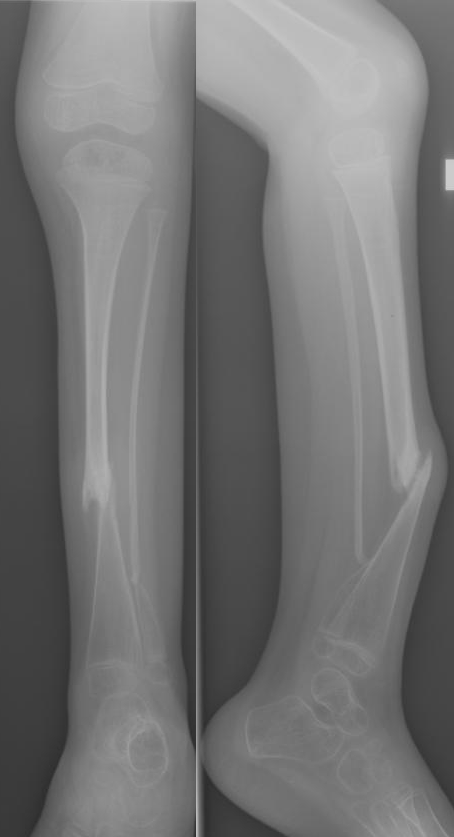
A pseudartrose congênita da tíbia (PCT) é uma doença pediátrica rara que se apresenta com uma deformidade em arqueamento da tíbia ao nascimento ou na primeira década de vida. Está mais comumente associada à neurofibromatose tipo 1 (NF-1). Em crianças com PCT, ocorre eventualmente uma fratura patológica da tíbia, resultando em não união persistente do local da fratura. Se não tratada, deformidades nas pernas, rigidez articular, discrepância no comprimento das pernas e dor persistirão. O diagnóstico é feito clinicamente e por meio de exames de imagem radiográficos, com inúmeras classificações baseadas na gravidade do arqueamento e na presença de fratura ou lesão intraóssea.
Introdução
O que você precisa saber de cara
Visão geral
A pseudoartrose congênita do rádio é uma condição rara caracterizada pela formação anormal do osso rádio (um dos dois ossos do antebraço) já presente ao nascimento, levando a uma falha na consolidação óssea (pseudoartrose). A doença pode causar deformidade e limitação funcional do membro superior afetado.[1]
Sinais e sintomas
Os principais sinais incluem deformidade visível do antebraço, encurtamento do membro, mobilidade anormal no local da pseudoartrose e dificuldade para movimentar o punho ou a mão. A condição geralmente é identificada na infância, podendo estar associada a outras manifestações esqueléticas.[1]
Causas genéticas
Diagnóstico
O diagnóstico é baseado em exames de imagem (radiografias) que mostram a falha de consolidação óssea no rádio. Exames genéticos podem ser solicitados para investigar síndromes associadas, como cariótipo com bandas G, Q ou R, pesquisa de microdeleções/microduplicações por FISH, sequenciamento completo do exoma (WES) e dosagem de alfa-fetoproteína. O aconselhamento genético é recomendado para as famílias.[1][3]
Tratamento e manejo
O manejo é multidisciplinar e pode incluir acompanhamento ortopédico, fisioterapia e, em alguns casos, cirurgia para correção da deformidade. O tratamento visa melhorar a função do membro e prevenir complicações. No Brasil, o Sistema Único de Saúde (SUS) oferece cobertura mínima para procedimentos como atendimento em reabilitação para doenças raras.[1]
Prognóstico e qualidade de vida
O prognóstico varia conforme a gravidade da pseudoartrose e a resposta ao tratamento. Com intervenção adequada, muitas crianças conseguem melhorar a função do braço afetado, embora possam persistir limitações. O suporte psicológico e a reabilitação são importantes para a qualidade de vida.[1]
Conteúdo informativo gerado e mantido automaticamente a partir de fontes oficiais (Orphanet, HPO, OMIM, SUS). Não substitui avaliação médica.
A pseudartrose congênita da tíbia (PCT) é uma doença pediátrica rara que se apresenta com uma deformidade em arqueamento da tíbia ao nascimento ou na primeira década de vida. Está mais comumente associada à neurofibromatose tipo 1 (NF-1). Em crianças com PCT, ocorre eventualmente uma fratura patológica da tíbia, resultando em não união persistente do local da fratura. Se não tratada, deformidades nas pernas, rigidez articular, discrepância no comprimento das pernas e dor persistirão. O diagnóstico é feito clinicamente e por meio de exames de imagem radiográficos, com inúmeras classificações baseadas na gravidade do arqueamento e na presença de fratura ou lesão intraóssea.
Encontrou um erro ou informação desatualizada? Sugira uma correção →
Entender a doença
Do básico ao detalhe, leia no seu ritmo
Preparando trilha educativa...
Sinais e sintomas
O que aparece no corpo e com que frequência cada sintoma acontece
Visão geral
A pseudoartrose congênita do rádio é uma condição rara caracterizada pela formação anormal do osso rádio (um dos dois ossos do antebraço) já presente ao nascimento, levando a uma falha na consolidação óssea (pseudoartrose). A doença pode causar deformidade e limitação funcional do membro superior afetado.[1]
Sinais e sintomas
Os principais sinais incluem deformidade visível do antebraço, encurtamento do membro, mobilidade anormal no local da pseudoartrose e dificuldade para movimentar o punho ou a mão. A condição geralmente é identificada na infância, podendo estar associada a outras manifestações esqueléticas.[1]
Causas genéticas
Diagnóstico
O diagnóstico é baseado em exames de imagem (radiografias) que mostram a falha de consolidação óssea no rádio. Exames genéticos podem ser solicitados para investigar síndromes associadas, como cariótipo com bandas G, Q ou R, pesquisa de microdeleções/microduplicações por FISH, sequenciamento completo do exoma (WES) e dosagem de alfa-fetoproteína. O aconselhamento genético é recomendado para as famílias.[1][3]
Tratamento e manejo
O manejo é multidisciplinar e pode incluir acompanhamento ortopédico, fisioterapia e, em alguns casos, cirurgia para correção da deformidade. O tratamento visa melhorar a função do membro e prevenir complicações. No Brasil, o Sistema Único de Saúde (SUS) oferece cobertura mínima para procedimentos como atendimento em reabilitação para doenças raras.[1]
Prognóstico e qualidade de vida
O prognóstico varia conforme a gravidade da pseudoartrose e a resposta ao tratamento. Com intervenção adequada, muitas crianças conseguem melhorar a função do braço afetado, embora possam persistir limitações. O suporte psicológico e a reabilitação são importantes para a qualidade de vida.[1]
Conteúdo informativo gerado e mantido automaticamente a partir de fontes oficiais (Orphanet, HPO, OMIM, SUS). Não substitui avaliação médica.
Linha do tempo da pesquisa
Encontrou um erro ou informação desatualizada? Sugira uma correção →
Genética e causas
O que está alterado no DNA e como passa nas famílias
Nenhum gene associado encontrado
Os dados genéticos desta condição ainda estão sendo catalogados.
Diagnóstico
Os sinais que médicos procuram e os exames que confirmam
Tratamento e manejo
Remédios, cuidados de apoio e o que precisa acompanhar
Onde tratar no SUS
Hospitais de referência no Brasil e o protocolo oficial do SUS (PCDT)
🇧🇷 Atendimento SUS — Pseudoartrose congênita do rádio
Centros de Referência SUS
24 centros habilitados pelo SUS para Pseudoartrose congênita do rádio
Centros para Pseudoartrose congênita do rádio
Detalhes dos centros
Hospital Universitário Prof. Edgard Santos (HUPES)
R. Dr. Augusto Viana, s/n - Canela, Salvador - BA, 40110-060 · CNES 0003808
Serviço de Referência
Hospital Infantil Albert Sabin
R. Tertuliano Sales, 544 - Vila União, Fortaleza - CE, 60410-794 · CNES 2407876
Serviço de Referência
Hospital de Apoio de Brasília (HAB)
AENW 3 Lote A Setor Noroeste - Plano Piloto, Brasília - DF, 70684-831 · CNES 0010456
Serviço de Referência
Hospital Estadual Infantil e Maternidade Alzir Bernardino Alves (HIABA)
Av. Min. Salgado Filho, 918 - Soteco, Vila Velha - ES, 29106-010 · CNES 6631207
Serviço de Referência
Hospital das Clínicas da UFG
Rua 235 QD. 68 Lote Área, Nº 285, s/nº - Setor Leste Universitário, Goiânia - GO, 74605-050 · CNES 2338424
Serviço de Referência
Hospital Universitário da UFJF
R. Catulo Breviglieri, Bairro - s/n - Santa Catarina, Juiz de Fora - MG, 36036-110 · CNES 2297442
Atenção Especializada
Hospital das Clínicas da UFMG
Av. Prof. Alfredo Balena, 110 - Santa Efigênia, Belo Horizonte - MG, 30130-100 · CNES 2280167
Serviço de Referência
Hospital Universitário Julio Müller (HUJM)
R. Luis Philippe Pereira Leite, s/n - Alvorada, Cuiabá - MT, 78048-902 · CNES 2726092
Atenção Especializada
Hospital Universitário João de Barros Barreto
R. dos Mundurucus, 4487 - Guamá, Belém - PA, 66073-000 · CNES 2337878
Serviço de Referência
Hospital Universitário Lauro Wanderley (HULW)
R. Tabeliao Estanislau Eloy, 585 - Castelo Branco, João Pessoa - PB, 58050-585 · CNES 0002470
Atenção Especializada
Instituto de Medicina Integral Prof. Fernando Figueira (IMIP)
R. dos Coelhos, 300 - Boa Vista, Recife - PE, 50070-902 · CNES 0000647
Serviço de Referência
Hospital Pequeno Príncipe
R. Des. Motta, 1070 - Água Verde, Curitiba - PR, 80250-060 · CNES 3143805
Serviço de Referência
Hospital Universitário Regional de Maringá (HUM)
Av. Mandacaru, 1590 - Parque das Laranjeiras, Maringá - PR, 87083-240 · CNES 2216108
Atenção Especializada
Hospital de Clínicas da UFPR
R. Gen. Carneiro, 181 - Alto da Glória, Curitiba - PR, 80060-900 · CNES 2364980
Serviço de Referência
Hospital Universitário Pedro Ernesto (HUPE-UERJ)
Blvd. 28 de Setembro, 77 - Vila Isabel, Rio de Janeiro - RJ, 20551-030 · CNES 2280221
Serviço de Referência
Instituto Nacional de Saúde da Mulher, da Criança e do Adolescente Fernandes Figueira (IFF/Fiocruz)
Av. Rui Barbosa, 716 - Flamengo, Rio de Janeiro - RJ, 22250-020 · CNES 2269988
Serviço de Referência
Hospital São Lucas da PUCRS
Av. Ipiranga, 6690 - Jardim Botânico, Porto Alegre - RS, 90610-000 · CNES 2232928
Serviço de Referência
Hospital de Clínicas de Porto Alegre (HCPA)
Rua Ramiro Barcelos, 2350 Bloco A - Av. Protásio Alves, 211 - Bloco B e C - Santa Cecília, Porto Alegre - RS, 90035-903 · CNES 2237601
Serviço de Referência
Hospital Universitário da UFSC (HU-UFSC)
R. Profa. Maria Flora Pausewang - Trindade, Florianópolis - SC, 88036-800 · CNES 2560356
Serviço de Referência
Hospital das Clínicas da FMUSP
R. Dr. Ovídio Pires de Campos, 225 - Cerqueira César, São Paulo - SP, 05403-010 · CNES 2077485
Serviço de Referência
Hospital de Base de São José do Rio Preto
Av. Brg. Faria Lima, 5544 - Vila Sao Jose, São José do Rio Preto - SP, 15090-000 · CNES 2079798
Atenção Especializada
Hospital de Clínicas da UNICAMP
R. Vital Brasil, 251 - Cidade Universitária, Campinas - SP, 13083-888 · CNES 2748223
Serviço de Referência
Hospital de Clínicas de Ribeirão Preto (HCRP-USP)
R. Ten. Catão Roxo, 3900 - Vila Monte Alegre, Ribeirão Preto - SP, 14015-010 · CNES 2082187
Serviço de Referência
UNIFESP / Hospital São Paulo
R. Napoleão de Barros, 715 - Vila Clementino, São Paulo - SP, 04024-002 · CNES 2688689
Serviço de Referência
Dados de DATASUS/CNES, SBGM, ABNeuro e Ministério da Saúde. Sempre confirme a disponibilidade diretamente com o estabelecimento.
Pesquisa ativa
Ensaios clínicos abertos e novidades científicas recentes
Pesquisa e ensaios clínicos
Nenhum ensaio clínico registrado para esta condição.
Publicações mais relevantes
Congenital Pseudoarthrosis of the Femur Managed with Masquelet Technique.
Congenital pseudoarthrosis is a rare disorder, and mostly occurs in the radius, ulna, tibia, and fibula, but is not reported in the femur. Congenital cases that were reported in the literature, most were associated with neurofibromatosis, cleidocranial dysostosis, congenital constriction band syndrome and fibrous dysplasia and the acquired cases followed fractures of bones or tuberculosis. Since the life span of the patient is affected rarely, clinical examination of these patients and serial radiographs can give us plenty of information about the limb abnormality, its clinical course, and the nature of the underlying disturbance of growth. A 3 year female child presents to the outpatient department of a tertiary care hospital with complaints of pain, swelling and deformity thigh region right side for 5 months. On examination, Swelling was present [2x2 cm] at the junction of the mid and distal thigh, smooth surface, ill defined edges, soft and non tender. There was abnormal mobility which was noted at the right thigh at the junction of the middle and distal 1/3 right femurMRI reported circumferential periosteal reaction with cortical surface irregularity of the right femoral shaft was also noted. The findings were reported to be concerning for chronic osteomyelitis with non-united fracture & cortical resorption/chronic bone loss. Histopathological sections showed multiple bits of viable bony trabeculae with surrounding fibro-collagenous tissue displaying significant proliferation of fibroblasts, slit-like blood vessels, arterioles and moderate mixed inflammatory infiltrate of plasma cells, few neutrophils, lymphocytes, histiocytes and few multinucleated histiocytes.She was managed with resection of pseudoarthrosis and masquelet procedure stage 1 and later masquelet stage 2 (cement spacer removal, ipsilateral ileac crest bone grafting with fixation with 7-hole distal fibular anatomical plate and bone graft substitute placement [ChronOs]). Idiopathic or primary congenital pseudoarthrosis can involve the femur as well as other long bones. It may or may not be associated with hip dysplasia and the outcome may not be as bad as previously reported in the pseudoarthrosis of other long bones.
Free fibula flap to achieve bone union after congenital pseudoarthrosis of the forearm in neurofibromatosis: Technical report based on 3 cases, and literature review.
Congenital pseudarthrosis of the forearm bones (CPFBs) is rare, with only 106 reported cases, and is frequently associated with neurofibromatosis (NF). Approximately 5% of patients with NF develop pseudarthrosis, and 50% of patients with pseudarthrosis have NF. Achieving bone union is difficult in congenital pseudarthrosis. Many methods have been attempted, including casting, internal fixation with or without grafting, and electrical stimulation, but failure is frequent. Free vascularized fibular flaps (FVFs) have been used to bridge long bone defects since 1975 and in tibial pseudarthrosis since 1979. In CPFB, FVF is more successful than other methods in achieving union and is the current treatment of choice. Here, we presented three cases of forearm pseudarthrosis treated with FVF, reviewed the literature on CPFB, and discussed some technical aspects of FVF treatment. Three cases of congenital pseudoarthrosis were treated with free fibula flaps, diagnosed at ages of 7 years (ulna), 15 months (radius), and 9 years (radius and ulna). Two flaps were stabilized with intramedullary wires and latterly, one with compression plates. One persistent nonunion received revision nonvascularized bone grafting and plating. All patients achieved union by 11 months after index surgery. Reconstruction with vascularized fibula is the treatment of choice because it offers the highest published union rates and good functional results. Complete resection of the affected bone and stable fixation, latterly with compression plates are critical to success. Surgery is technically demanding, and complications are common. Secondary surgery may be required, but outcomes are favorable. LEVEL OF EVIDENCE: IV.
Reconstruction of congenital pseudarthrosis of the radius with a vascularized tibial periosteal transplant: A case report.
Congenital pseudarthrosis of the forearm poses a considerable challenge because of its rarity. The objective of this report is to introduce a novel surgical technique for its treatment. Here, we document a case of congenital pseudarthrosis of the radius in a 3-year-old boy diagnosed with type-1 neurofibromatosis. The surgical treatment involved the excision of approximately 9 cm of native radial periosteum and a bifocal radius osteotomy, which was supplemented with a vascularized tibial periosteal transplant to facilitate bone healing. Anastomosis between the anterior tibial vessels and radial vessels was performed. No immediate or late postoperative complications were observed. After 3 weeks, a robust callus formation was observed, and during a follow-up examination 3 years and 4 months later, a wide range of active forearm rotation was noted. This report suggests that vascularized periosteal flaps show promise as a viable treatment option for congenital pseudarthrosis of the forearm. They offer an alternative to vascularized fibular grafts or single-bone forearm constructs.
Traumatic Radius Pseudoarthrosis in Neurofibromatosis Type 1: All Treatment Options in One Patient.
Although congenital pseudoarthrosis of the radius is a rare case, it has been reported many times in the literature in the past and it has been shown that it can be associated with neurofibromatosis type 1. However, traumatic radius pseudoarthrosis has never been reported before. In this case report, all treatment options were applied to the same patient over a four-year period and the results were reported. A two-year-old boy had a left radius diaphysis fracture after a simple fall, and bone union could not be achieved despite the application of cast immobilization, internal fixation grafting, and electrical stimulation in an external center. He was admitted to our hospital when he was six years old. A plain X-ray image and computed tomography scan showed that he had radius pseudoarthrosis and also he was diagnosed with neurofibromatosis type 1 on genetic analysis. The patient underwent wide resection of the segment with pseudoarthrosis and free vascularized fibula grafting. Bone union was achieved in the third postoperative month.
Ipsilateral vascularized ulnar graft to treat congenital radial pseudoarthrosis.
Publicações recentes
Tibial lengthening in congenital pseudoarthrosis of the tibia: a scoping review.
Development of the Extended Lane and Sandu Score to Assess Osseous Repair.
Unraveling the molecular landscape of congenital pseudoarthrosis of the tibia: insights from a comprehensive analysis of 159 probands.
Vascularized Periosteal Grafts for Bone Union in Children: A Systematic Review.
Paley cross union protocol for congenital pseudoarthrosis of the tibia.
📚 EuropePMC2 artigos no totalmostrando 10
Congenital Pseudoarthrosis of the Femur Managed with Masquelet Technique.
Journal of orthopaedic case reportsFree fibula flap to achieve bone union after congenital pseudoarthrosis of the forearm in neurofibromatosis: Technical report based on 3 cases, and literature review.
Journal of plastic, reconstructive & aesthetic surgery : JPRASReconstruction of congenital pseudarthrosis of the radius with a vascularized tibial periosteal transplant: A case report.
MicrosurgeryIpsilateral vascularized ulnar graft to treat congenital radial pseudoarthrosis.
The Journal of hand surgery, European volumeTraumatic Radius Pseudoarthrosis in Neurofibromatosis Type 1: All Treatment Options in One Patient.
CureusTreatment of Recalcitrant Nonunion of the Radius With Posterior Interosseous Bone Flap in Children.
Journal of pediatric orthopedicsCongenital pseudarthrosis of the forearm as a single manifestation of neurofibromatosis type 1 at birth: A case report.
Clinical imagingCongenital pseudoarthrosis of the radius in Neurofibromatosis Type 1: An entity not to be missed!
Journal of orthopaedicsCongenital Pseudoarthrosis of the Distal Radius Treated With Physeal-Sparing Double-Barrel Vascularized Free Fibula Transfer: A Case Report.
Hand (New York, N.Y.)[Versatility of the microvascular fibular flap in limb reconstruction].
Cirugia y cirujanosAssociações
Organizações que acompanham esta doença — pra ter apoio e orientação
Ainda não temos associações cadastradas para Pseudoartrose congênita do rádio.
É de uma associação que acompanha esta doença? Fale com a gente →
Comunidades
Grupos ativos de quem convive com esta doença aqui no Raras
Ainda não existe comunidade no Raras para Pseudoartrose congênita do rádio
Pacientes, familiares e cuidadores se organizam em comunidades pra compartilhar experiências, fazer perguntas e se apoiar. Você pode ser o primeiro.
Tire suas dúvidas
Perguntas, dicas e experiências compartilhadas aqui na página
Participe da discussão
Faça login para postar dúvidas, compartilhar experiências e interagir com especialistas.
Fazer loginDoenças relacionadas
Doenças com sintomas parecidos — ajudam quem ainda está buscando diagnóstico
Ainda não achamos doenças com sintomas parecidos o suficiente.
Referências e fontes
Bases de dados externas citadas neste artigo
Publicações científicas
Artigos indexados no PubMed ligados a esta doença no grafo RarasNet — título, periódico e PMID direto da fonte, sem intermediação de IA.
- Congenital Pseudoarthrosis of the Femur Managed with Masquelet Technique.
- Free fibula flap to achieve bone union after congenital pseudoarthrosis of the forearm in neurofibromatosis: Technical report based on 3 cases, and literature review.
- Reconstruction of congenital pseudarthrosis of the radius with a vascularized tibial periosteal transplant: A case report.
- Traumatic Radius Pseudoarthrosis in Neurofibromatosis Type 1: All Treatment Options in One Patient.
- Ipsilateral vascularized ulnar graft to treat congenital radial pseudoarthrosis.
- Tibial lengthening in congenital pseudoarthrosis of the tibia: a scoping review.
- Development of the Extended Lane and Sandu Score to Assess Osseous Repair.
- Unraveling the molecular landscape of congenital pseudoarthrosis of the tibia: insights from a comprehensive analysis of 159 probands.
- Vascularized Periosteal Grafts for Bone Union in Children: A Systematic Review.
- Paley cross union protocol for congenital pseudoarthrosis of the tibia.
Bases de dados e fontes oficiais
Identificadores e referências canônicas usadas para montar este verbete.
- ORPHA:295024(Orphanet)
- MONDO:0017465(MONDO)
- GARD:21206(GARD (NIH))
- Busca completa no PubMed(PubMed)
- Q55787074(Wikidata)
Dados compilados pelo RarasNet a partir de fontes abertas (Orphanet, OMIM, MONDO, PubMed/EuropePMC, ClinicalTrials.gov, DATASUS, PCDT/MS). Este conteúdo é informativo e não substitui avaliação médica.
Conteúdo mantido por Agente Raras · Médicos e pesquisadores podem colaborar
Pseudoartrose congênita do rádio
📋 Origem dos dados
Esta página agrega dados de fontes públicas e oficiais. Dados sobre cobertura no SUS (PCDT, CEAF) são verificados ativamente por agente proativo (ver badge no infobox). Demais dados têm atribuição de fonte + data da última sincronização — clique para abrir o original.
- Doença rara (ontologia)
- fonte: Orphanet
- Identificador unificado
- fonte: MONDO
- Codificação WHO/SUS
- fonte: WHO ICD-10 / DATASUS
- CID-11 (futuro)
- fonte: WHO ICD-11
- NIH/GARD
- fonte: GARD (NIH)
- Dado público estruturado
- fonte: Wikidata