
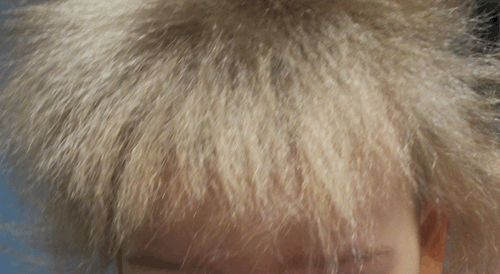
A síndrome do cabelo não penteável (SHU), ou pili trianguli et canaliculi, é uma displasia rara da haste capilar do couro cabeludo.
Introdução
O que você precisa saber de cara
A síndrome do cabelo não penteável (SHU), ou pili trianguli et canaliculi, é uma displasia rara da haste capilar do couro cabeludo.
Escala de raridade
<1/50kMuito rara
1/20kRara
1/10kPouco freq.
1/5kIncomum
1/2k
Encontrou um erro ou informação desatualizada? Sugira uma correção →
Entender a doença
Do básico ao detalhe, leia no seu ritmo
Preparando trilha educativa...
Sinais e sintomas
O que aparece no corpo e com que frequência cada sintoma acontece
Partes do corpo afetadas
Características mais comuns
Os sintomas variam de pessoa para pessoa. Abaixo estão as 12 características clínicas mais associadas, ordenadas por frequência.
Linha do tempo da pesquisa
Encontrou um erro ou informação desatualizada? Sugira uma correção →
Genética e causas
O que está alterado no DNA e como passa nas famílias
Genes associados
3 genes identificados com associação a esta condição. Padrão de herança: Autosomal recessive.
Catalyzes the deimination of arginine residues of proteins
Cytoplasm
Uncombable hair syndrome 1
A form of uncombable hair syndrome, a condition characterized by scalp hair that is impossible to comb due to the haphazard arrangement of the hair bundles. A characteristic morphologic feature is a triangular to reniform to heart shape on cross-sections, and a groove, canal or flattening along the entire length of the hair. Most individuals are affected early in childhood and the hair takes on a spun-glass appearance with the hair becoming dry, curly, glossy, lighter in color, and progressively uncombable. The hair growth rate can range from slow to normal, and the condition improves with age. UHS1 inheritance is autosomal dominant.
Catalyzes the calcium-dependent formation of isopeptide cross-links between glutamine and lysine residues in various proteins, as well as the conjugation of polyamines to proteins. Involved in the formation of the cornified envelope (CE), a specialized component consisting of covalent cross-links of proteins beneath the plasma membrane of terminally differentiated keratinocytes. Catalyzes small proline-rich proteins (SPRR1 and SPRR2) and LOR cross-linking to form small interchain oligomers, whic
Cytoplasm
Uncombable hair syndrome 2
A form of uncombable hair syndrome, a condition characterized by scalp hair that is impossible to comb due to the haphazard arrangement of the hair bundles. A characteristic morphologic feature is a triangular to reniform to heart shape on cross-sections, and a groove, canal or flattening along the entire length of the hair. Most individuals are affected early in childhood and the hair takes on a spun-glass appearance with the hair becoming dry, curly, glossy, lighter in color, and progressively uncombable. The hair growth rate can range from slow to normal, and the condition improves with age.
Intermediate filament-associated protein that associates in regular arrays with keratin intermediate filaments (KIF) of the inner root sheath cells of the hair follicle and the granular layer of the epidermis. It later becomes cross-linked to KIF by isodipeptide bonds. It may serve as scaffold protein, together with involucrin, in the organization of the cell envelope or even anchor the cell envelope to the KIF network. It may be involved in its own calcium-dependent postsynthetic processing dur
Uncombable hair syndrome 3
A form of uncombable hair syndrome, a condition characterized by scalp hair that is impossible to comb due to the haphazard arrangement of the hair bundles. A characteristic morphologic feature is a triangular to reniform to heart shape on cross-sections, and a groove, canal or flattening along the entire length of the hair. Most individuals are affected early in childhood and the hair takes on a spun-glass appearance with the hair becoming dry, curly, glossy, lighter in color, and progressively uncombable. The hair growth rate can range from slow to normal, and the condition improves with age.
Variantes genéticas (ClinVar)
71 variantes patogênicas registradas no ClinVar.
Classificação de variantes (ClinVar)
Distribuição de 13 variantes classificadas pelo ClinVar.
Vias biológicas (Reactome)
3 vias biológicas associadas aos genes desta condição.
Diagnóstico
Os sinais que médicos procuram e os exames que confirmam
Tratamento e manejo
Remédios, cuidados de apoio e o que precisa acompanhar
Onde tratar no SUS
Hospitais de referência no Brasil e o protocolo oficial do SUS (PCDT)
🇧🇷 Atendimento SUS — Síndrome cabelo impenteável
Selecione um estado ou use sua localização para ver resultados.
Dados de DATASUS/CNES, SBGM, ABNeuro e Ministério da Saúde. Sempre confirme a disponibilidade diretamente com o estabelecimento.
Pesquisa ativa
Ensaios clínicos abertos e novidades científicas recentes
Pesquisa e ensaios clínicos
Nenhum ensaio clínico registrado para esta condição.
Publicações mais relevantes
Genome-Wide Association Study Identifies Genes for Hair Growth and Patterning are Associated With Pilonidal Disease.
Pilonidal sinus disease is a highly morbid condition characterized by the formation of chronic sinus tracts throughout the sacrococcygeal region. Despite its commonality and strong association with family history, no prior investigation of genetic risk factors for pilonidal sinus disease exists. To identify genetic risk factors for pilonidal sinus disease. A genome-wide association study. The United Kingdom Biobank, FinnGen Biobank, and Penn Medicine BioBank. There were 772,072 participants. Genome-wide significant variants ( p < 5 × 10 -8 ) were mapped to genes using physical distance and gene expression in skin. Genetic correlation between pilonidal sinus disease and morphometric, androgen-driven, and hair phenotypes was estimated with linkage disequilibrium score regression. Finally, a genome-first approach to rare predicted deleterious variants in hair shaft genes TCHH , PADI3 , and TGM3 was conducted for association with pilonidal sinus disease via the Penn Medicine BioBank. A genome-wide association study comprising 2835 individuals with pilonidal sinus disease identified 5 genome-wide significant loci, prioritizing HDAC9, TBX15, WARS2, RP11-293M10.1 , PRKAR1B , TWIST1, GPATCH2L, NEK9 , and EIF2B2 , as putative causal genes; several of these genes have known roles in balding and hair patterning. There was a significant correlation between the genetic background of pilonidal sinus disease and the androgen-driven hair traits of male pattern baldness and young age at first facial hair. In a candidate analysis of genes associated with syndromic hair disorders, rare coding variants in TCHH , a monogenic cause of uncombable hair syndrome, were associated with increased prevalence of pilonidal sinus disease (OR 4.81 [95% CI, 2.06-11.2]). This study is limited to European ancestry. However, because there is a higher incidence of pilonidal sinus disease in men of European ancestry, this analysis is focused on the at-risk population. Genetic analysis of pilonidal sinus disease identified shared genetic architecture with hair biology and androgen-driven traits. As the first study investigating the genetic basis of pilonidal sinus disease, this provides biological insight into the long-appreciated connection between the disease state, male sex, and hair. See Video abstract. ANTECEDENTES:La enfermedad del seno pilonidal es una condición muy mórbida caracterizada por la formación de tractos sinusales crónicos en toda la región sacrococcígea. A pesar de su frecuencia y su fuerte asociación con los antecedentes familiares, no se han investigado previamente los factores de riesgo genéticos de la enfermedad sinusal pilonidal.OBJETIVO:Identificar factores genéticos de riesgo para la enfermedad del seno pilonidal.DISEÑO:Estudio de asociación de genoma completo.CONJUNTOS:Biobanco del Reino Unido, Biobanco FinnGen y Biobanco PennMedicine.PACIENTES:772.072 participantes.MEDIDA DE RESULTADO PRINCIPAL:Las variantes significativas en todo el genoma (p < 5x10⁻⁸) se asignaron a genes utilizando la distancia física y la expresión génica en la piel. La correlación genética entre la enfermedad del seno pilonidal y los fenotipos morfométricos, androgénicos y de cabello se estimó con regresión de puntuación LD. Por último, se realizó una aproximación genómica a variantes deletéreas raras predichas en los genes del tallo piloso TCHH, PADI3 y TGM3 para su asociación con la enfermedad del seno pilonidal a través del Biobanco PennMedicine.RESULTADOS:El estudio de asociación de todo el genoma, que incluyó a 2.835 individuos con enfermedad del seno pilonidal, identificó 5 loci significativos en todo el genoma, dando prioridad a HDAC9, TBX15, WARS2, RP11-293M10.1, PRKAR1B, TWIST1, GPATCH2L, NEK9 y EIF2B2, como genes causales putativos; varios de estos genes tienen funciones conocidas en la calvicie y el patrón del cabello. Se observó una correlación significativa entre los antecedentes genéticos de la enfermedad del seno pilonidal y los de los rasgos calvicie de patrón masculino y edad temprana del primer vello facial impulsados por andrógenos. En un análisis de genes candidatos asociados a trastornos capilares sindrómicos, las variantes raras de codificación en TCHH, una causa monogénica del síndrome capilar incombustible, se asociaron a una mayor prevalencia de la enfermedad del seno pilonidal (OR 4,81 [IC del 5%, 2,06-11,2]).LIMITACIONES:Este estudio se limita a la ascendencia europea. Sin embargo, debido a que hay una mayor incidencia de la enfermedad sinusal pilonidal en los hombres de ascendencia europea, este análisis se centra en la población de riesgo.CONCLUSIÓN:El análisis genético de la enfermedad del seno pilonidal identificó una arquitectura genética compartida con la biología del cabello y los rasgos impulsados por andrógenos. Siendo el primer estudio que investiga las bases genéticas de la enfermedad del seno pilonidal, esto proporciona una visión biológica de la conexión, apreciada desde hace tiempo, entre el estado de la enfermedad, el sexo masculino y el cabello. (Traducción-Dr. Aurian Garcia Gonzalez ).
Two siblings with uncombable hair syndrome: A new pathogenic variant.
Two siblings presented with straw-colored, frizzy, and wiry hair. They had no associated abnormalities and no family history of abnormal hair. Trichoscopy showed the longitudinal groove in the hair shafts, characteristic of uncombable hair syndrome. Molecular genetic analysis revealed a new pathogenic variant (c.1374dup; p. Val459ArgfsTer15) in PADI3, not previously described.
[Translated article] Uncombable Hair Syndrome Type 1.
First East Asian case of uncombable hair syndrome.
Uncombable hair syndrome: burdensome or captivating?
Publicações recentes
[Translated article] Uncombable Hair Syndrome Type 1.
First East Asian case of uncombable hair syndrome.
Genome-Wide Association Study Identifies Genes for Hair Growth and Patterning are Associated With Pilonidal Disease.
Uncombable hair syndrome: burdensome or captivating?
Two siblings with uncombable hair syndrome: A new pathogenic variant.
📚 EuropePMC50 artigos no totalmostrando 31
[Translated article] Uncombable Hair Syndrome Type 1.
Actas dermo-sifiliograficasFirst East Asian case of uncombable hair syndrome.
Journal der Deutschen Dermatologischen Gesellschaft = Journal of the German Society of Dermatology : JDDGGenome-Wide Association Study Identifies Genes for Hair Growth and Patterning are Associated With Pilonidal Disease.
Diseases of the colon and rectumUncombable hair syndrome: burdensome or captivating?
Clinical and experimental dermatologyTwo siblings with uncombable hair syndrome: A new pathogenic variant.
Pediatric dermatologyDeimination in epidermal barrier and hair formation.
Philosophical transactions of the Royal Society of London. Series B, Biological sciencesUncombable Hair in a Case of Zellweger Syndrome - A New Association.
Indian dermatology online journalUncombable hair syndrome due to maternal uniparental disomy of chromosome 1.
American journal of medical genetics. Part AAssessment of the Genetic Spectrum of Uncombable Hair Syndrome in a Cohort of 107 Individuals.
JAMA dermatologyUncombable hair syndrome and beyond.
Acta dermatovenerologica Alpina, Pannonica, et AdriaticaA girl with unruly locks: molecular genetics makes a diagnosis of uncombable hair syndrome.
Lancet (London, England)Localized uncombable hair syndrome: Non-invasive imaging with high-resolution videodermoscopy.
Skin research and technology : official journal of International Society for Bioengineering and the Skin (ISBS) [and] International Society for Digital Imaging of Skin (ISDIS) [and] International Society for Skin Imaging (ISSI)Vitamins A, B, C, and D: A Short Review for the Dermatologist.
Alternative therapies in health and medicineHair cross-sectioning in uncombable hair syndrome: An epoxy embedding technique.
Journal of cutaneous pathologyPili trianguli et canaliculi as a phenotypic subtype in patients with central centrifugal cicatricial alopecia: A scanning electron microscopy study.
Journal of the American Academy of DermatologyDiagnosis of pili trianguli et canaliculi by frozen section: A rapid and inexpensive method of diagnosis.
Pediatric dermatologyA girl with loose anagen hair syndrome and concurrent uncombable hair syndrome.
JAAD case reportsDeimination and Peptidylarginine Deiminases in Skin Physiology and Diseases.
International journal of molecular sciences[A girl with unruly hair].
Nederlands tijdschrift voor geneeskundeSpontaneous Quick Resolution of Uncombable Hair Syndrome-Like Disease.
Skin appendage disordersHypothesis: Folklore perpetuated expression of moon-associated bipolar disorders in anecdotally exaggerated werewolf guise.
Medical hypothesesTransglutaminase diseases: from biochemistry to the bedside.
FASEB journal : official publication of the Federation of American Societies for Experimental BiologyHair cross-sectioning in uncombable hair syndrome: An easy tool for complex diagnosis.
Journal of the American Academy of DermatologyHair That Is Difficult to Manage in a Hispanic Girl.
Skin appendage disordersTransglutaminases in autoimmune and inherited skin diseases: The phenomena of epitope spreading and functional compensation.
Experimental dermatologyAdolescent girl with frizzy hair knotted in a bundle.
International journal of dermatologyCongenital Anonychia and Uncombable Hair Syndrome: Coinheritance of Homozygous Mutations in RSPO4 and PADI3.
The Journal of investigative dermatology[Uncombable hair syndrome: Association of wrongdoers].
Annales de dermatologie et de venereologieMutations in Three Genes Encoding Proteins Involved in Hair Shaft Formation Cause Uncombable Hair Syndrome.
American journal of human geneticsUncombable hair syndrome with a woolly hair nevus.
Indian journal of dermatology, venereology and leprologyThe heat shrink tube technology--a simple method for making hair cross sections.
Journal der Deutschen Dermatologischen Gesellschaft = Journal of the German Society of Dermatology : JDDGAssociações
Organizações que acompanham esta doença — pra ter apoio e orientação
Ainda não temos associações cadastradas para Síndrome cabelo impenteável.
É de uma associação que acompanha esta doença? Fale com a gente →
Comunidades
Grupos ativos de quem convive com esta doença aqui no Raras
Ainda não existe comunidade no Raras para Síndrome cabelo impenteável
Pacientes, familiares e cuidadores se organizam em comunidades pra compartilhar experiências, fazer perguntas e se apoiar. Você pode ser o primeiro.
Tire suas dúvidas
Perguntas, dicas e experiências compartilhadas aqui na página
Participe da discussão
Faça login para postar dúvidas, compartilhar experiências e interagir com especialistas.
Fazer loginDoenças relacionadas
Doenças com sintomas parecidos — ajudam quem ainda está buscando diagnóstico
Referências e fontes
Bases de dados externas citadas neste artigo
Publicações científicas
Artigos indexados no PubMed ligados a esta doença no grafo RarasNet — título, periódico e PMID direto da fonte, sem intermediação de IA.
- Genome-Wide Association Study Identifies Genes for Hair Growth and Patterning are Associated With Pilonidal Disease.
- Two siblings with uncombable hair syndrome: A new pathogenic variant.
- [Translated article] Uncombable Hair Syndrome Type 1.
- First East Asian case of uncombable hair syndrome.Journal der Deutschen Dermatologischen Gesellschaft = Journal of the German Society of Dermatology : JDDG· 2024· PMID 39092871mais citado
- Uncombable hair syndrome: burdensome or captivating?
Bases de dados e fontes oficiais
Identificadores e referências canônicas usadas para montar este verbete.
- ORPHA:1410(Orphanet)
- MONDO:0008621(MONDO)
- GARD:5404(GARD (NIH))
- Variantes catalogadas(ClinVar)
- Busca completa no PubMed(PubMed)
- Artigo Wikipedia(Wikipedia)
- Q541852(Wikidata)
Dados compilados pelo RarasNet a partir de fontes abertas (Orphanet, OMIM, MONDO, PubMed/EuropePMC, ClinicalTrials.gov, DATASUS, PCDT/MS). Este conteúdo é informativo e não substitui avaliação médica.
Conteúdo mantido por Agente Raras · Médicos e pesquisadores podem colaborar
Síndrome cabelo impenteável
📋 Origem dos dados
Esta página agrega dados de fontes públicas e oficiais. Dados sobre cobertura no SUS (PCDT, CEAF) são verificados ativamente por agente proativo (ver badge no infobox). Demais dados têm atribuição de fonte + data da última sincronização — clique para abrir o original.
- Doença rara (ontologia)
- fonte: Orphanet
- Identificador unificado
- fonte: MONDO
- Codificação WHO/SUS
- fonte: WHO ICD-10 / DATASUS
- CID-11 (futuro)
- fonte: WHO ICD-11
- NIH/GARD
- fonte: GARD (NIH)
- Indexação biomédica
- fonte: MeSH (NLM)
- Dado público estruturado
- fonte: Wikidata