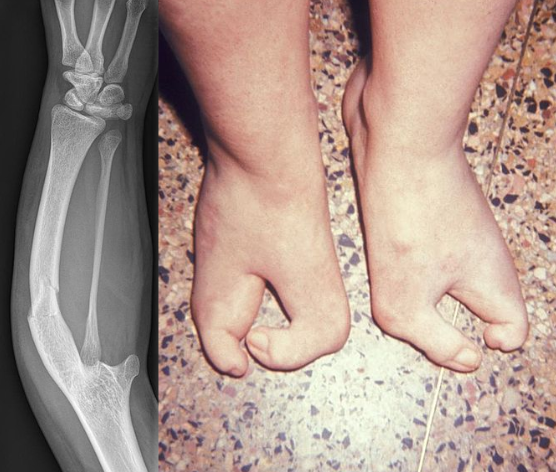
A síndrome do pé dividido por hipoplasia ulnar é caracterizada pela associação de hipoplasia ulnar grave, ausência de dois a cinco dedos e pé dividido. Foi descrito em quatro homens pertencentes a duas gerações da mesma família. Sugere-se herança recessiva ligada ao X, mas a transmissão autossômica dominante não pode ser excluída.
Introdução
O que você precisa saber de cara
A **Síndrome de hipoplasia cubital-ectrodactilia dos pés** é uma condição genética congênita muito rara que altera a formação dos ossos do antebraço e das extremidades dos pés e das mãos. Ao nascer, a família percebe alterações visíveis, como braços com ossos encurtados ou ausentes e fendas centrais nos pés ou nas mãos com ausência de alguns dedos. Não existem remédios específicos dispensados para curar essa alteração anatômica, pois o quadro é estrutural. No SUS, o acompanhamento é centrado na reabilitação física e funcional, além de exames genéticos como o exoma para investigar o quadro.
A síndrome do pé dividido por hipoplasia ulnar é caracterizada pela associação de hipoplasia ulnar grave, ausência de dois a cinco dedos e pé dividido. Foi descrito em quatro homens pertencentes a duas gerações da mesma família. Sugere-se herança recessiva ligada ao X, mas a transmissão autossômica dominante não pode ser excluída.
Escala de raridade
<1/50kMuito rara
1/20kRara
1/10kPouco freq.
1/5kIncomum
1/2k
Encontrou um erro ou informação desatualizada? Sugira uma correção →
Entender a doença
Do básico ao detalhe, leia no seu ritmo
Preparando trilha educativa...
Sinais e sintomas
O que aparece no corpo e com que frequência cada sintoma acontece
Características mais comuns
Os sintomas variam de pessoa para pessoa. Abaixo estão as 4 características clínicas mais associadas, ordenadas por frequência.
Linha do tempo da pesquisa
Encontrou um erro ou informação desatualizada? Sugira uma correção →
Genética e causas
O que está alterado no DNA e como passa nas famílias
Nenhum gene associado encontrado
Os dados genéticos desta condição ainda estão sendo catalogados.
Diagnóstico
Os sinais que médicos procuram e os exames que confirmam
Tratamento e manejo
Remédios, cuidados de apoio e o que precisa acompanhar
Onde tratar no SUS
Hospitais de referência no Brasil e o protocolo oficial do SUS (PCDT)
🇧🇷 Atendimento SUS — Síndrome de hipoplasia cubital-ectrodactilia dos pés
Selecione um estado ou use sua localização para ver resultados.
Dados de DATASUS/CNES, SBGM, ABNeuro e Ministério da Saúde. Sempre confirme a disponibilidade diretamente com o estabelecimento.
Pesquisa ativa
Ensaios clínicos abertos e novidades científicas recentes
Pesquisa e ensaios clínicos
Nenhum ensaio clínico registrado para esta condição.
Publicações mais relevantes
Clinical outcomes of isolated ulnar shortening osteotomy for ulnar impaction syndrome with concomitant distal radioulnar joint instability.
This study aimed to evaluate the clinical outcomes and changes in distal radioulnar joint (DRUJ) stability in patients with ulnar impaction syndrome (UIS) combined with DRUJ instability, treated with ulnar shortening osteotomy (USO) without concomitant triangular fibrocartilage complex (TFCC) repair. Between November 2017 and December 2024, a total of 16 patients (7 males, 9 females; mean age, 40 ± 12 years) underwent USO combined with wrist arthroscopy, followed by structured rehabilitation and regular follow-up. Clinical outcomes were assessed using ulnar variance, the Ballottement test, visual analog scale (VAS) for pain, Disabilities of the Arm, Shoulder, and Hand (DASH) score, modified Mayo wrist score, Patient-Rated Wrist Evaluation (PRWE), grip strength, and wrist range of motion. Preoperatively, all patients had positive Ballottement tests, and TFCC injuries were confirmed by arthroscopy. At the final follow-up (mean, 31 months), ulnar variance was significantly reduced, and VAS, DASH, modified Mayo wrist score, PRWE, and grip strength all showed marked improvement. DRUJ stability was restored in all patients, with the Ballottement test converting to negative. These findings suggest that isolated USO effectively treats UIS with concurrent DRUJ instability and achieves satisfactory clinical outcomes without the need for simultaneous TFCC repair. Therapeutic, Level IV.
The CoULD Ulnar Polydactyly Classification: A Multicenter Analysis.
The Temtamy-McKusick classification defines ulnar/postaxial polydactyly with a well-developed accessory digit as type A and cases with a rudimentary pedunculated digit as type B. Surgeons widely agree on type B treatment, but type A cases present more diverse phenotypes and reconstructive challenges. The authors developed an expanded classification based on radiographic morphology that may help guide surgical treatment. The multicenter cohort included all type A ulnar polydactyly cases in the Congenital Upper Limb Differences (CoULD) database and additional cases from the Children's Hospital of Philadelphia. Morphologic themes were determined from preoperative radiographs. Clinical relevance was evaluated by discussion and analysis of operative notes to confirm that each subtype carries distinct considerations for reconstruction. Four attending pediatric hand surgeons classified radiographs. Interrater and intrarater reliability were determined by the Cohen κ. The cohort included 125 type A hands from 84 patients (49% bilateral). Fifteen cases (18%) were syndromic and 37 (44%) reported a family history. Six subtypes emerged from radiographic analysis. Our classification is based on the proximal extent of the skeletal "duplication," comprising A1-hypoplastic, A2-phalangeal, A3-divergent metacarpophalangeal, A4-bifid metacarpal, A5-duplicated metacarpal, and A6-complex types. The authors propose a reconstructive plan for each subtype to aid surgical decision-making. Interrater and intrarater reliability were almost perfect. Raters agreed that all cases were classifiable, achieving 97% initial agreement. The CoULD Ulnar Polydactyly classification is feasible, comprehensive, and relevant to surgical management. The CoULD Study Group voted to adopt the classification after careful review, reinforcing its potential to frame the care pathway. Overview of Stress Reactions and Fractures Stress injuries range from periostitis—an inflammatory reaction of the periosteum—to a complete stress fracture involving a full cortical break (see Image. Stress Reaction). These injuries result from repetitive submaximal loading of bone over time and were first documented in the mid-19th century among military recruits, described as “March Fractures” (see Image. March Fracture of Second Metatarsal). Julius Wolff’s theory (1836–1902) holds that bones remodel in response to mechanical loads. When repetitive loading surpasses the bone’s adaptive capacity, osteoclast activity outpaces osteoblasts, leading to progressive microdamage and, ultimately, a stress fracture. Patients typically notice symptom onset 2 to 3 weeks after an increase in training volume or intensity, with pain that initially occurs after activity and later persists at rest. Stress injuries occur most commonly in the lower extremities (eg, tibia, femur, metatarsals) and are seen frequently in running and jumping sports. Upper extremity stress injuries (eg, ulnar fractures) are less common but occur in specific populations. Diagnosis requires a high index of suspicion, a detailed history, physical examination, and imaging. Plain radiographs may remain normal for 2 to 4 weeks; thus, advanced imaging such as magnetic resonance imaging (MRI) is often necessary. Most stress fractures respond to conservative management, but high-risk fractures (eg, tension-sided femoral neck or anterior tibial cortex) may require surgical intervention. Early recognition and preventive strategies (eg, gradual increases in training) remain critical to avoiding complications. Lower Extremity Stress Fractures The following conditions are various types of injuries affecting lower extremity bones: Tibia The tibia is the most frequently affected site of stress reactions and fractures. Medial tibial stress syndrome (MTSS): Also known as shin splints, MTSS can be difficult to distinguish from medial tibial stress fractures. MTSS pain worsens with exertion, whereas stress fracture pain often persists even during daily activities. Anterior cortex tibial stress fractures: These are less common and affect jumping or leaping athletes. They may present radiographically as a “dreaded black line” and carry a high risk of nonunion. Aggressive conservative measures or surgical fixation with intramedullary rods or flexible plates may be necessary. Medial tibial plateau stress fractures: These are rare, often mistaken for meniscal injuries or pes anserine bursitis, and require a high index of suspicion. Femur: Femoral neck stress fractures: These constitute approximately 11% of stress injuries in athletes and predominantly affect runners. Two subtypes exist: 1. Tension-type (distraction) fractures: Involve the superior-lateral femoral neck and present the highest risk for complete fracture. Early detection is paramount. 2. Compression-type fractures: Involve the inferior-medial femoral neck and occur more often in younger athletes. If no fracture line is visible, nonsurgical management may suffice. Femoral shaft stress fractures: These account for 22.5% of stress fractures in military recruits. Patients report vague, insidious leg pain. The “fulcrum test” may help localize pain. Nondisplaced lesions often respond well to conservative care. Fibula Fibular stress fractures usually occur in the distal third of the fibula, proximal to the tibiofibular ligament. Pain is reproducible on palpation. Patella Rare patellar stress fractures can be transverse or vertical. Transverse fractures carry a greater risk of displacement, often requiring immobilization or surgical fixation. Medial Malleolus Vertical stress fractures at the junction of the medial malleolus and tibial plafond appear in running and jumping athletes. Full cortical disruption usually necessitates surgical intervention. Pelvis Pelvic stress fractures can present vaguely, often mimicking adductor strains, osteitis pubis, or sacroiliitis. Common sites include the ischiopubic ramus and sacrum, especially in runners. Foot and Ankle: Calcaneus: Patients show tenderness posterior to the talus and a positive squeeze test. Navicular: Common in runners and basketball players, these fractures carry a high risk of nonunion due to poor blood supply. Tenderness over the navicular is a key clinical clue. Metatarsals: Represent about 9% of stress fractures in athletes, usually occurring in the second or third metatarsal. Swelling, point tenderness, and pain exacerbated by weight-bearing are typical. A “dancer’s fracture” occurs at the base of the second metatarsal, while fractures distal to the tuberosity of the fifth metatarsal are called “Jones fractures.”. Sesamoids: Stress fractures of the great toe sesamoids present with gradual unilateral plantar pain, commonly affecting the medial sesamoid (see Image. Sesamoid Stress Fracture). Upper Extremity and Rib Stress Fractures Upper extremity stress fractures are uncommon and most often occur in the ulna. Rib stress fractures, though rare, can be seen in specific groups: First rib: Seen in pitchers, basketball players, weightlifters, and ballet dancers. Ribs 4 to 9: Common in competitive rowers; posteromedial fractures can occur in golfers.
PMP22-Related Neuropathies: A Systematic Review.
Background. PMP22-related neuropathies comprise a spectrum of predominantly demyelinating disorders, most commonly Charcot-Marie-Tooth type 1A (CMT1A; 17p12 duplication) and hereditary neuropathy with liability to pressure palsies (HNPP; 17p12 deletion), with rarer phenotypes due to PMP22 sequence variants (CMT1E, Dejerine-Sottas syndrome [DSS]). Methods. We conducted a PRISMA-compliant systematic review (PROSPERO ID: 1139921) of PubMed and Scopus (January 2015-August 2025). Eligible studies reported genetically confirmed PMP22-related neuropathies with clinical and/or neurophysiological data. Owing to heterogeneous reporting, we synthesized pooled counts and proportions without meta-analysis, explicitly tracking missing denominators. Results. One hundred twenty-seven studies (n = 4493 patients) were included. Sex was available for 995 patients (males 53.8% [535/995]; females 46.2% [460/995]); mean age at onset was 23.7 years in males and 16.4 years in females. Phenotypic classification was reported for 4431/4493 (75.4% CMT1A, 20.9% HNPP, 2.6% CMT1E, 1.2% DSS). Across phenotypes, weakness/foot drop was the leading presenting symptom when considering only cohorts that explicitly reported it (e.g., 65.3% in CMT1A; 76.0% in HNPP); sensory complaints (numbness, paresthesia/dysesthesia) were variably documented. Neurophysiology consistently showed demyelinating patterns, with median and ulnar nerves most frequently abnormal among assessed nerves; in HNPP, deep peroneal and sural involvement were also common in evaluated subsets. Comorbidities clustered by phenotype: orthopedic/neuromuscular features (pes cavus/hammer toes, scoliosis/kyphosis, tremor) in CMT1A and DSS; broader metabolic/autoimmune and neurodevelopmental associations in HNPP; and higher syndromic/ocular/hearing involvement in CMT1E. Genetically, 75.6% (3241/4291) had 17p12 duplication, 19.6% (835/4291) 17p12 deletion, and 4.8% (215/4291) PMP22 sequence variants with marked allelic heterogeneity. Among 2571 cases with available methods, MLPA was most used (41.9%), followed by NGS (20.4%) and Sanger sequencing (17.8%). Main limitations include heterogeneous and incomplete reporting across studies (especially symptoms and nerve-specific data) and the absence of a formal risk-of-bias appraisal, which preclude meta-analysis and may skew phenotype proportions toward more frequently reported entities (e.g., CMT1A). Conclusions. Recent literature confirms that PMP22 copy-number variants account for the vast majority of cases, while sequence-level variants underpin a minority with distinct phenotypes (notably CMT1E/DSS). Routine MLPA, complemented by targeted/NGS, optimizes diagnostic yield. Standardized reporting of nerve-conduction parameters and symptom denominators is urgently needed to enable robust cross-study comparisons in both pediatric and adult populations.
Ulnar nerve double crush by entrapment of a peri-cubital tunnel ganglion cyst and cubital tunnel: a case report.
Double crush syndrome (DCS) is a relatively rare nerve compression syndrome among peripheral nerve compression diseases. However, ulnar nerve double entrapment caused by peri-cubital tunnel ganglion cysts has been rarely reported. Here, we present a case of a 54-year-old woman who experienced occasional pain, numbness and paralysis in her right half hand for 1 year. A B-ultrasound of the right elbow initially revealed cubital tunnel syndrome only. Further Magnetic Resonance Imaging (MRI) showed a ganglion cyst near the cubital tunnel. After evaluation, we performed open surgery to excise the cyst and incise the cubital tunnel, completely decompressing the ulnar nerve entrapment. Ulnar nerve anterior transposition was also performed simultaneously. The patient was followed up for 1 month, and she experienced a complete recovery with no functional limitations. Not applicable.
Multiple schwannomas of bilateral posterior tibial nerves - A case report and review of literature.
Schwannoma is a type of slow growing benign nerve sheath tumor arising from Schwann cells. Peripherally, they are found in association with the ulnar, sciatic and posterior tibial nerves. Peripheral schwannomas, neurofibromas and malignant PNSTs are collectively grouped as peripheral nerve sheath tumors. We report a case of a 35-year-old male, without clinical features of NF2, presenting with 2 painful lumps around the ankle, and was incidentally found to have multiple lumps in both lower limbs. MR imaging, surgical excision and histology revealed multiple bilateral posterior tibial nerve schwannomas. Schwannomas usually occur as a solitary mass or sometimes multiple. Multiple schwannomas are seen in association with type 2 neurofibromatosis and Schwannomatosis. Schwannomatosis is a separate clinical entity with considerable overlap both in phenotype and presentation with NF2 but that can be distinguished from NF2 based on clinical diagnostic criteria. Peripheral schwannoma is a differential diagnosis for painful lumps with positive Tinel's sign in close association to peripheral nerves, mainly posterior tibial, sciatic and ulnar nerve. Surgical excision can be safely performed with preservation of the nerve using meticulous technique. Schwannomas of the posterior tibial nerve (PTN) and its medial and lateral plantar branch have been described as a cause of tarsal tunnel syndrome and foot pain. Although multiple reports of solitary PTN schwannomas exist, only 4 cases of multiple PTN schwannomas have been reported in literature, with no reports of cases involving bilateral PTN.
Publicações recentes
A modified partial wedge-shaped metaphyseal ulnar osteotomy for the treatment of ulnar impaction syndrome with reverse oblique sigmoid notch.
Laurin-Sandrow Syndrome: A Case Report and Review of Literature.
Hypothenar hammer syndrome: long-term follow-up after ulnar artery reconstruction with the lateral circumflex femoral artery.
Oculodentodigital dysplasia: ulnar-sided syndactyly and its associated disorders.
A boy with Weyers-like ulnar ray/oligodactyly reduction limb defects and split hand malformation: case report.
📚 EuropePMCmostrando 38
Clinical outcomes of isolated ulnar shortening osteotomy for ulnar impaction syndrome with concomitant distal radioulnar joint instability.
Journal of plastic surgery and hand surgeryPMP22-Related Neuropathies: A Systematic Review.
GenesThe CoULD Ulnar Polydactyly Classification: A Multicenter Analysis.
Plastic and reconstructive surgeryUlnar nerve double crush by entrapment of a peri-cubital tunnel ganglion cyst and cubital tunnel: a case report.
BMC musculoskeletal disordersMultiple schwannomas of bilateral posterior tibial nerves - A case report and review of literature.
International journal of surgery case reportsCubital Tunnel Syndrome Due to Intraneural Ganglion Cysts of the Ulnar Nerve With Joint-Cyst Connection at the Elbow.
NeurosurgeryApplication of Osborne's Ligament Suspension and Ulnar Nerve Anterior Transposition in Conjunction with Transcutaneous Electrical Nerve Stimulation for Managing Cubital Tunnel Syndrome: A Retrospective Study.
Annali italiani di chirurgiaCommon sports-related nerve injuries seen by the electrodiagnostic medical consultant.
Muscle & nerveCentral Tetrapolydactyly With Atrial Septal Defect and Facial Nerve Palsy in a 15-Month-Old Female Child.
CureusA modified partial wedge-shaped metaphyseal ulnar osteotomy for the treatment of ulnar impaction syndrome with reverse oblique sigmoid notch.
The Journal of hand surgery, European volumeMechanomyography as a Surgical Adjunct for Treatment of Chronic Entrapment Neuropathy: A Case Series.
Operative neurosurgery (Hagerstown, Md.)[Application of ulnar nerve diameter changes examined by HRUS in patients with cubital tunnel syndrome].
Zhongguo gu shang = China journal of orthopaedics and traumatologyIs metaphyseal ulnar shortening osteotomy superior to diaphyseal ulnar shortening osteotomy in the treatment of ulnar impaction syndrome? A meta-analysis.
World journal of clinical casesHypereosinophilic Syndrome Following the BNT162b2 (BioNTech/Pfizer) Vaccine Successfully Treated with Mepolizumab: A Case Report and Review of the Literature.
Journal of clinical medicineA review of polydactyly and its inheritance: Connecting the dots.
MedicineMyeloid sarcoma with ulnar nerve entrapment: A case report.
World journal of clinical casesLaurin-Sandrow Syndrome: A Case Report and Review of Literature.
The journal of hand surgery Asian-Pacific volume"Laurin-Sandrow Syndrome - a review of the literature and classification system".
Clinical dysmorphologyEvaluating Immediate and Short-Term Postoperative Clinical Outcomes of Patients Undergoing Ulnar Shortening for Ulnar Impaction Syndrome Using PROMIS.
Journal of wrist surgeryDigital Transfer for Hand Reconstruction in Cleft Hand and Foot Differences.
Journal of reconstructive microsurgeryUtility of Neuropathy Screening for Wild-Type Transthyretin Amyloidosis Patients.
The Canadian journal of neurological sciences. Le journal canadien des sciences neurologiquesUlna shortening osteotomy versus arthroscopic wafer procedure in the treatment of ulnocarpal impingement syndrome.
Hand surgery & rehabilitationTreatment of Mild Ulnar Longitudinal Deficiency with a Z-Shaped Ulna Lengthening Osteotomy: A Report of 2 Cases.
JBJS case connectorTemporary epiphysiodesis in adolescent patients with ulnocarpal impaction syndrome: a preliminary case series of seven wrists.
Journal of pediatric orthopedics. Part BAcute compartment syndrome secondary to anterolateral thigh flap harvesting in a pediatric patient: A case report.
MedicinePeripheral Nerve Compression Syndromes in Children.
The Journal of hand surgeryThe functional effect of 3D-printing individualized orthosis for patients with peripheral nerve injuries: Three case reports.
MedicineTreatment of Common Congenital Hand Conditions.
Clinics in plastic surgeryA rare disease with a rare presentation: hemi-atrophy caused by fibromuscular dysplasia in a 27 month old girl.
ReumatismoCongenital Malformations Attributed to Prenatal Exposure to Cyclophosphamide.
Anti-cancer agents in medicinal chemistryAnomalous abductor digiti minimi in Guyon canal: A cadaver study.
JAAPA : official journal of the American Academy of Physician AssistantsUltrasonic Observation and Clinical Application of Arcade of Struthers in the Mid-Arm.
World neurosurgeryNovel frameshift variant in gene SALL4 causing Okihiro syndrome.
European journal of medical geneticsHypothenar hammer syndrome: long-term follow-up after ulnar artery reconstruction with the lateral circumflex femoral artery.
The Journal of hand surgery, European volume[A case of chronic progressive motor-dominant multiple mononeuritis associated with primary Sjögren's syndrome].
Rinsho shinkeigaku = Clinical neurologyCoexistence of a T118M PMP22 missense mutation and chromosome 17 (17p11.2-p12) deletion.
Muscle & nervePolyneuropathy improvement following autologous stem cell transplantation for POEMS syndrome.
NeurologyUltrasound evaluation of focal neuropathies in athletes: a clinically-focused review.
British journal of sports medicineAssociações
Organizações que acompanham esta doença — pra ter apoio e orientação
Ainda não temos associações cadastradas para Síndrome de hipoplasia cubital-ectrodactilia dos pés.
É de uma associação que acompanha esta doença? Fale com a gente →
Doenças relacionadas
Doenças com sintomas parecidos — ajudam quem ainda está buscando diagnóstico
Perguntas frequentes
O que as famílias mais perguntam sobre esta doença — cada resposta com a fonte de onde saiu
A causa genética exata ainda não possui genes causadores catalogados nos bancos de dados científicos. Os registros clínicos sugerem herança recessiva ligada ao X, sem descartar a transmissão autossômica dominante.
Referências
Fontes citadas no texto, publicações do grafo e bases de dados usadas neste verbete
10 publicações do grafo RarasNet (PubMed) · 6 bases de dados. Títulos, periódicos e PMIDs vêm direto da fonte, sem intermediação de IA.
Dados compilados pelo RarasNet a partir de fontes abertas (Orphanet, OMIM, MONDO, PubMed/EuropePMC, ClinicalTrials.gov, DATASUS, PCDT/MS). Este conteúdo é informativo e não substitui avaliação médica.
Citar este verbete
Raras. (s.d.). Síndrome de hipoplasia cubital-ectrodactilia dos pés. Em Raras — Enciclopédia de Doenças Raras do Brasil. https://raras.org/doenca/sindrome-de-hipoplasia-cubital-ectrodactilia-dos-pes
Formato APA. Conteúdo sob CC BY 4.0 — reuso livre com atribuição.
Conteúdo mantido por Agente Raras · Médicos e pesquisadores podem colaborar
Síndrome de hipoplasia cubital-ectrodactilia dos pés
📋 Origem dos dados
Esta página agrega dados de fontes públicas e oficiais. Dados sobre cobertura no SUS (PCDT, CEAF) são verificados ativamente por agente proativo (ver badge no infobox). Demais dados têm atribuição de fonte + data da última sincronização — clique para abrir o original.
- Doença rara (ontologia)
- fonte: Orphanet
- Identificador unificado
- fonte: MONDO
- Genética mendeliana
- fonte: OMIM
- Codificação WHO/SUS
- fonte: WHO ICD-10 / DATASUS
- NIH/GARD
- fonte: GARD (NIH)
- Indexação biomédica
- fonte: MeSH (NLM)
- Dado público estruturado
- fonte: Wikidata

