A infecção congênita pelo vírus do herpes é um grupo de anomalias que uma criança pode apresentar como resultado de infecção materna e subsequente infecção fetal pelo vírus do herpes. Este vírus causa infecções cutâneas recorrentes em adultos, muitas vezes envolvendo os lábios ou a genitália. As infecções por herpes em outros órgãos, como fígado ou sistema nervoso central, são menos frequentes.
Introdução
O que você precisa saber de cara
A **infecção por herpes vírus congênita** é uma condição rara que surge quando o feto é infectado pelo vírus do herpes transmitido pela mãe durante a gestação. Ela pode causar complicações importantes no desenvolvimento do bebê, incluindo **nascimento prematuro**, **microcefalia** e graves danos na estrutura do cérebro. Por ter causa infecciosa, a condição não é de origem hereditária e seu padrão genético é classificado como não aplicável. A enfermidade não consta na lista de PCDTs de doenças raras do Ministério da Saúde, devendo o suporte e acompanhamento serem conduzidos pela rede geral de atendimento do SUS.
A infecção congênita pelo vírus do herpes é um grupo de anomalias que uma criança pode apresentar como resultado de infecção materna e subsequente infecção fetal pelo vírus do herpes. Este vírus causa infecções cutâneas recorrentes em adultos, muitas vezes envolvendo os lábios ou a genitália. As infecções por herpes em outros órgãos, como fígado ou sistema nervoso central, são menos frequentes.
Escala de raridade
<1/50kMuito rara
1/20kRara
1/10kPouco freq.
1/5kIncomum
1/2k
Encontrou um erro ou informação desatualizada? Sugira uma correção →
Entender a doença
Do básico ao detalhe, leia no seu ritmo
Preparando trilha educativa...
Sinais e sintomas
O que aparece no corpo e com que frequência cada sintoma acontece
Partes do corpo afetadas
+ 2 sintomas em outras categorias
Características mais comuns
Os sintomas variam de pessoa para pessoa. Abaixo estão as 4 características clínicas mais associadas, ordenadas por frequência.
Linha do tempo da pesquisa
Encontrou um erro ou informação desatualizada? Sugira uma correção →
Genética e causas
O que está alterado no DNA e como passa nas famílias
Nenhum gene associado encontrado
Os dados genéticos desta condição ainda estão sendo catalogados.
Onde tratar no SUS
Hospitais de referência no Brasil e o protocolo oficial do SUS (PCDT)
🇧🇷 Atendimento SUS — Infecção por herpes vírus congênita
Centros de Referência SUS
24 centros habilitados pelo SUS para Infecção por herpes vírus congênita
Centros para Infecção por herpes vírus congênita
Detalhes dos centros
Hospital Universitário Prof. Edgard Santos (HUPES)
R. Dr. Augusto Viana, s/n - Canela, Salvador - BA, 40110-060 · CNES 0003808
Serviço de Referência
Hospital Infantil Albert Sabin
R. Tertuliano Sales, 544 - Vila União, Fortaleza - CE, 60410-794 · CNES 2407876
Serviço de Referência
Hospital de Apoio de Brasília (HAB)
AENW 3 Lote A Setor Noroeste - Plano Piloto, Brasília - DF, 70684-831 · CNES 0010456
Serviço de Referência
Hospital Estadual Infantil e Maternidade Alzir Bernardino Alves (HIABA)
Av. Min. Salgado Filho, 918 - Soteco, Vila Velha - ES, 29106-010 · CNES 6631207
Serviço de Referência
Hospital das Clínicas da UFG
Rua 235 QD. 68 Lote Área, Nº 285, s/nº - Setor Leste Universitário, Goiânia - GO, 74605-050 · CNES 2338424
Serviço de Referência
Hospital Universitário da UFJF
R. Catulo Breviglieri, Bairro - s/n - Santa Catarina, Juiz de Fora - MG, 36036-110 · CNES 2297442
Atenção Especializada
Hospital das Clínicas da UFMG
Av. Prof. Alfredo Balena, 110 - Santa Efigênia, Belo Horizonte - MG, 30130-100 · CNES 2280167
Serviço de Referência
Hospital Universitário Julio Müller (HUJM)
R. Luis Philippe Pereira Leite, s/n - Alvorada, Cuiabá - MT, 78048-902 · CNES 2726092
Atenção Especializada
Hospital Universitário João de Barros Barreto
R. dos Mundurucus, 4487 - Guamá, Belém - PA, 66073-000 · CNES 2337878
Serviço de Referência
Hospital Universitário Lauro Wanderley (HULW)
R. Tabeliao Estanislau Eloy, 585 - Castelo Branco, João Pessoa - PB, 58050-585 · CNES 0002470
Atenção Especializada
Instituto de Medicina Integral Prof. Fernando Figueira (IMIP)
R. dos Coelhos, 300 - Boa Vista, Recife - PE, 50070-902 · CNES 0000647
Serviço de Referência
Hospital Pequeno Príncipe
R. Des. Motta, 1070 - Água Verde, Curitiba - PR, 80250-060 · CNES 3143805
Serviço de Referência
Hospital Universitário Regional de Maringá (HUM)
Av. Mandacaru, 1590 - Parque das Laranjeiras, Maringá - PR, 87083-240 · CNES 2216108
Atenção Especializada
Hospital de Clínicas da UFPR
R. Gen. Carneiro, 181 - Alto da Glória, Curitiba - PR, 80060-900 · CNES 2364980
Serviço de Referência
Hospital Universitário Pedro Ernesto (HUPE-UERJ)
Blvd. 28 de Setembro, 77 - Vila Isabel, Rio de Janeiro - RJ, 20551-030 · CNES 2280221
Serviço de Referência
Instituto Nacional de Saúde da Mulher, da Criança e do Adolescente Fernandes Figueira (IFF/Fiocruz)
Av. Rui Barbosa, 716 - Flamengo, Rio de Janeiro - RJ, 22250-020 · CNES 2269988
Serviço de Referência
Hospital São Lucas da PUCRS
Av. Ipiranga, 6690 - Jardim Botânico, Porto Alegre - RS, 90610-000 · CNES 2232928
Serviço de Referência
Hospital de Clínicas de Porto Alegre (HCPA)
Rua Ramiro Barcelos, 2350 Bloco A - Av. Protásio Alves, 211 - Bloco B e C - Santa Cecília, Porto Alegre - RS, 90035-903 · CNES 2237601
Serviço de Referência
Hospital Universitário da UFSC (HU-UFSC)
R. Profa. Maria Flora Pausewang - Trindade, Florianópolis - SC, 88036-800 · CNES 2560356
Serviço de Referência
Hospital das Clínicas da FMUSP
R. Dr. Ovídio Pires de Campos, 225 - Cerqueira César, São Paulo - SP, 05403-010 · CNES 2077485
Serviço de Referência
Hospital de Base de São José do Rio Preto
Av. Brg. Faria Lima, 5544 - Vila Sao Jose, São José do Rio Preto - SP, 15090-000 · CNES 2079798
Atenção Especializada
Hospital de Clínicas da UNICAMP
R. Vital Brasil, 251 - Cidade Universitária, Campinas - SP, 13083-888 · CNES 2748223
Serviço de Referência
Hospital de Clínicas de Ribeirão Preto (HCRP-USP)
R. Ten. Catão Roxo, 3900 - Vila Monte Alegre, Ribeirão Preto - SP, 14015-010 · CNES 2082187
Serviço de Referência
UNIFESP / Hospital São Paulo
R. Napoleão de Barros, 715 - Vila Clementino, São Paulo - SP, 04024-002 · CNES 2688689
Serviço de Referência
Dados de DATASUS/CNES, SBGM, ABNeuro e Ministério da Saúde. Sempre confirme a disponibilidade diretamente com o estabelecimento.
Pesquisa ativa
Ensaios clínicos abertos e novidades científicas recentes
Pesquisa e ensaios clínicos
Nenhum ensaio clínico registrado para esta condição.
Publicações mais relevantes
A Rare Case of Congenital Herpes Simplex Virus Infection with Therapeutic Response to Acyclovir.
A 1-day-old pre-term female child delivered by lower segment cesarean section was referred for hypo-pigmented skin lesions over trunk since birth. After 3 days, the neonate developed vesicles and pustules. The mother gave a history of fluid-filled genital lesions at the 12th week of gestation. The diagnosis of neonatal herpes infection was suspected clinically, which was confirmed by polymerase chain reaction, and the lesions resolved following injectable acyclovir.
Congenital herpes simplex virus infection among hospitalized infants in Poland.
Congenital herpes simplex virus infection (cHSV) is a rare entity and may pose a life-threatening disease for the newborns. Due to the public health and clinical importance of cHSV infection in infants, the recent data on this disease in Poland should be investigated. The aim of the study was to evaluate the incidence and other factors related to cHSV. The study is retrospective, population-based that utilised the hospital discharge records of cHSV patients. Data were obtained from National Institute of Public Health NIH - National Research Institute in Warsaw, Poland, covering the period 2014-2019. The study group consisted of 1,573 cHSV newborns (841 males and 732 females). Among this group, 70.1% were infants up to 90 days of age and 3.6% were neonates up to 28 days of age. The mean and median age was 98 days (95% CI: 94.5-101.8, SD 74) and 70 days (IQR: 53-104), respectively. Based on the hospital registry the overall average cHSV incidence over the study period was estimated to be 69 per 100,000 live births. The number of cHSV infection fluctuated over the years 2014-2019 with a significant decreasing trend from 2015-2019 (P<0.01). A significantly higher cHSV incidence was observed among patients from urban than rural areas of Poland (88 vs 40/100,000 live births; P<0.001). CHSV incidence may be related to multifactorial conditions for the occurrence of this disease. Further studies on changes in the incidence of cHSV are needed.
Congenital herpes simplex virus infection in a 26-week extremely premature infant.
A case of congenital herpes simplex virus infection diagnosed at 8 months of age.
We present the case of an 8-month-old boy with the repeated recurrence of vesicles from the time of birth and who subsequently manifested psychomotor developmental delay. We retrospectively diagnosed the patient with congenital herpes simplex virus (HSV) infection. Computed tomography showed multiple calcifications in the periventricular white matter and thalami. The bilateral deep white matter showed an abnormally high signal intensity on T2-weighted magnetic resonance imaging. The patient required consecutive, suppressive therapy with valacyclovir to prevent the repeated recurrence of vesicles. This case presented a milder phenotype of congenital HSV infection in comparison to previous reports, and highlights the importance of the careful examination for this disease when neonates present with skin lesions.
Fetal and neonatal abnormalities due to congenital herpes simplex virus infection: a literature review.
Herpes simplex virus (HSV) infection during pregnancy can cause severe neonatal infections. It is also a rare cause of congenital infections. We aimed to describe fetal and neonatal abnormalities of congenital HSV infection in order to define the features that are accessible to prenatal diagnosis during ultrasound screening and/or during a work-up for congenital malformations. We analysed all cases of congenital HSV infection (CHI) described before and/or after birth and identified in Pubed and classified the findings as accessible or not to prenatal diagnosis. Thirty-six cases of congenital herpes infection were reported, of which 15 were described prenatally and 21 postnatally. The most frequently reported malformations accessible to prenatal diagnosis were cerebral anomalies. The most common abnormalities described after birth were skin lesions and keratitis, which are not considered amenable to prenatal ultrasound detection. CHI can due to either HSV1 or HSV2 infection, whether primary or non-primary infection, with or without the presence of maternal symptoms. Prenatal ultrasound abnormalities due to CHI are rare, varied and non-specific. There is no clear role for fetal ultrasound in the routine management of women with primary or non-primary HSV infection in pregnancy. However, in fetuses with ultrasound abnormalities suggestive of congenital infection, HSV should still be considered as a differential diagnosis after the more common in utero infections, such as cytomegalovirus, are excluded.
Publicações recentes
A Rare Case of Congenital Herpes Simplex Virus Infection with Therapeutic Response to Acyclovir.
Congenital herpes simplex virus infection among hospitalized infants in Poland.
Congenital herpes simplex virus infection in a 26-week extremely premature infant.
A case of congenital herpes simplex virus infection diagnosed at 8 months of age.
Fetal and neonatal abnormalities due to congenital herpes simplex virus infection: a literature review.
📚 EuropePMC10 artigos no totalmostrando 5
A Rare Case of Congenital Herpes Simplex Virus Infection with Therapeutic Response to Acyclovir.
Indian dermatology online journalCongenital herpes simplex virus infection among hospitalized infants in Poland.
Annals of agricultural and environmental medicine : AAEMCongenital herpes simplex virus infection in a 26-week extremely premature infant.
Archives of disease in childhood. Fetal and neonatal editionA case of congenital herpes simplex virus infection diagnosed at 8 months of age.
Brain & developmentFetal and neonatal abnormalities due to congenital herpes simplex virus infection: a literature review.
Prenatal diagnosisAssociações
Organizações que acompanham esta doença — pra ter apoio e orientação
Ainda não temos associações cadastradas para Infecção por herpes vírus congênita.
É de uma associação que acompanha esta doença? Fale com a gente →
Doença com base genética
Um médico geneticista pode ajudar no diagnóstico de Infecção por herpes vírus congênita e no aconselhamento genético da família.
Doenças relacionadas
Doenças com sintomas parecidos — ajudam quem ainda está buscando diagnóstico
Perguntas frequentes
O que as famílias mais perguntam sobre esta doença — cada resposta com a fonte de onde saiu
É um grupo de alterações e anomalias que ocorrem no bebê decorrentes da transmissão do vírus do herpes da mãe para o feto na gravidez. O quadro pode se manifestar nos períodos pré-natal e neonatal.
Referências
Fontes citadas no texto, publicações do grafo e bases de dados usadas neste verbete
5 publicações do grafo RarasNet (PubMed) · 6 bases de dados. Títulos, periódicos e PMIDs vêm direto da fonte, sem intermediação de IA.
Dados compilados pelo RarasNet a partir de fontes abertas (Orphanet, OMIM, MONDO, PubMed/EuropePMC, ClinicalTrials.gov, DATASUS, PCDT/MS). Este conteúdo é informativo e não substitui avaliação médica.
Citar este verbete
Raras. (s.d.). Infecção por herpes vírus congênita. Em Raras — Enciclopédia de Doenças Raras do Brasil. https://raras.org/doenca/infeccao-por-herpes-virus-congenita
Formato APA. Conteúdo sob CC BY 4.0 — reuso livre com atribuição.
Conteúdo mantido por Agente Raras · Médicos e pesquisadores podem colaborar
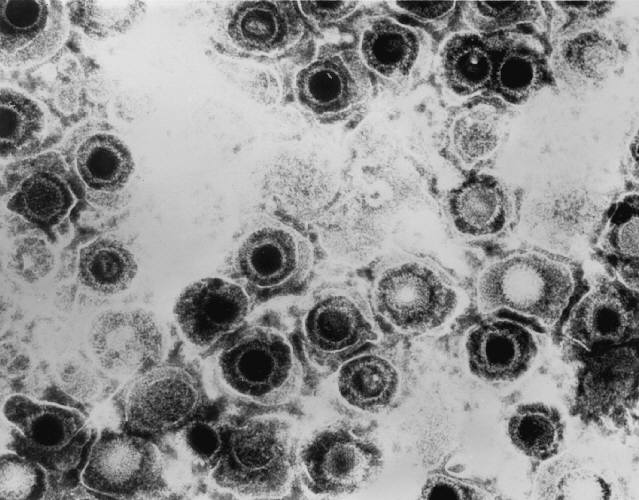
Infecção por herpes vírus congênita
📋 Origem dos dados
Esta página agrega dados de fontes públicas e oficiais. Dados sobre cobertura no SUS (PCDT, CEAF) são verificados ativamente por agente proativo (ver badge no infobox). Demais dados têm atribuição de fonte + data da última sincronização — clique para abrir o original.
- Doença rara (ontologia)
- fonte: Orphanet
- Identificador unificado
- fonte: MONDO
- Codificação WHO/SUS
- fonte: WHO ICD-10 / DATASUS
- CID-11 (futuro)
- fonte: WHO ICD-11
- NIH/GARD
- fonte: GARD (NIH)
- Dado público estruturado
- fonte: Wikidata

