
É um tipo de displasia ectodérmica — uma condição genética que afeta o desenvolvimento da pele, cabelos, dentes e glândulas — que se caracteriza pela combinação de displasia ectodérmica anidrótica (com pouca ou nenhuma transpiração) e lábio leporino e/ou fenda no céu da boca.
Introdução
O que você precisa saber de cara
É um tipo de displasia ectodérmica — uma condição genética que afeta o desenvolvimento da pele, cabelos, dentes e glândulas — que se caracteriza pela combinação de displasia ectodérmica anidrótica (com pouca ou nenhuma transpiração) e lábio leporino e/ou fenda no céu da boca.
Encontrou um erro ou informação desatualizada? Sugira uma correção →
Entender a doença
Do básico ao detalhe, leia no seu ritmo
Preparando trilha educativa...
Sinais e sintomas
O que aparece no corpo e com que frequência cada sintoma acontece
Partes do corpo afetadas
+ 14 sintomas em outras categorias
Características mais comuns
Os sintomas variam de pessoa para pessoa. Abaixo estão as 46 características clínicas mais associadas, ordenadas por frequência.
Linha do tempo da pesquisa
Encontrou um erro ou informação desatualizada? Sugira uma correção →
Genética e causas
O que está alterado no DNA e como passa nas famílias
Genes associados
1 gene identificado com associação a esta condição.
Curadoria gene-doença
fontes oficiaisActs as a sequence specific DNA binding transcriptional activator or repressor. The isoforms contain a varying set of transactivation and auto-regulating transactivation inhibiting domains thus showing an isoform specific activity. Isoform 2 activates RIPK4 transcription. May be required in conjunction with TP73/p73 for initiation of p53/TP53 dependent apoptosis in response to genotoxic insults and the presence of activated oncogenes. Involved in Notch signaling by probably inducing JAG1 and JAG
Nucleus
Acro-dermato-ungual-lacrimal-tooth syndrome
A form of ectodermal dysplasia. Ectodermal dysplasia defines a heterogeneous group of disorders due to abnormal development of two or more ectodermal structures. ADULT syndrome involves ectrodactyly, syndactyly, finger- and toenail dysplasia, hypoplastic breasts and nipples, intensive freckling, lacrimal duct atresia, frontal alopecia, primary hypodontia and loss of permanent teeth. ADULT syndrome differs significantly from EEC3 syndrome by the absence of facial clefting. Inheritance is autosomal dominant.
Variantes genéticas (ClinVar)
217 variantes patogênicas registradas no ClinVar.
Classificação de variantes (ClinVar)
Distribuição de 91 variantes classificadas pelo ClinVar.
Vias biológicas (Reactome)
12 vias biológicas associadas aos genes desta condição.
Diagnóstico
Os sinais que médicos procuram e os exames que confirmam
Tratamento e manejo
Remédios, cuidados de apoio e o que precisa acompanhar
Onde tratar no SUS
Hospitais de referência no Brasil e o protocolo oficial do SUS (PCDT)
🇧🇷 Atendimento SUS — Síndrome Rapp-Hodgkin
Selecione um estado ou use sua localização para ver resultados.
Dados de DATASUS/CNES, SBGM, ABNeuro e Ministério da Saúde. Sempre confirme a disponibilidade diretamente com o estabelecimento.
Pesquisa ativa
Ensaios clínicos abertos e novidades científicas recentes
Pesquisa e ensaios clínicos
Nenhum ensaio clínico registrado para esta condição.
Publicações mais relevantes
De Novo Missense Variant in TP63 Gene: Insights on Clinical and Molecular Investigations.
This study aims to investigate the phenotypes, mutation types, and loci associated with TP63-related syndrome by focusing on an affected proband. Employing a proband collection strategy, we identified a family presenting with TP63-related syndrome and performed thorough clinical evaluations on the proband and family members. We subsequently documented the phenotype, mutation type, and locus of the TP63 gene, followed by Sanger DNA sequencing analysis. We identified a family affected by TP63-related syndrome. The proband, a young adult male, demonstrated congenital anodontia, hypohidrosis, sparse hair, and additional features characteristic of ectodermal dysplasia. Further clinical manifestations included left ear hearing impairment, cleft lip/palate, hypospadias, and syndactyly. Sequencing analysis revealed a missense nucleotide variant (c.184G>C, p.Val62Leu) in exon 2 of the TP63 gene. This variant was absent from established SNP databases and was not detected in other family members or unrelated healthy individuals. The family exhibits significant symptoms consistent with TP63 syndrome. The identified missense mutation is preliminarily considered to be pathogenic.
A spectrum of TP63-related disorders with eight affected individuals in five unrelated families.
TP63-related disdorders broadly involve varying combinations of ectodermal dysplasia (sparse hair, hypohydrosis, tooth abnormalities, nail dysplasia), cleft lip/palate, acromelic malformation, split-hand/foot malformation/syndactyly, ankyloblepharon filiforme adnatum, lacrimal duct obstruction, hypopigmentation, and hypoplastic breasts and/or nipples. TP63-related disorders are associated with heterozygous pathogenic variants in TP63 and include seven overlapping phenotypes; Ankyloblepharon-ectodermal defects-cleft lip/palate syndrome (AEC), Ectrodactyly-ectodermal dysplasia-cleft lip/palate syndrome 3 (EEC3), Limb-mammary syndrome (LMS), Acro-dermo-ungual-lacrimal-tooth syndrome (ADULT), Rapp-Hodgkin syndrome (RHS), Split-hand/foot malformation 4 (SHFM4), and Orofacial cleft 8. We report on five unrelated families with 8 affected individuals in which the probands presented with varying combinations of ectodermal dysplasia, cleft lip/palate, split-hand/foot malformation, lacrimal duct obstruction, and ankyloblepharon filiforme adnatum. The clinical diagnosis involved AEC syndrome (2 patients), EEC3 syndrome (2 patients), and a yet hitherto unclassified TP63-related disorder. Sanger sequence analysis of the TP63 gene was performed revealing five different variants among which four were novel and three were de novo. The identificated TP63 variants co-segregated with the other affected individuals in the families. The abnormalities of ectoderm derived structures including hair, nails, sweat glands, and teeth should alert the physician to the possibility of TP63-related disorders particularly in the presence of orofacial clefting.
Peri-operative management of a patient with an ectodermal dysplasia (Rapp-Hodgkin) syndrome.
We present the case of a 41-year-old man with Rapp-Hodgkin syndrome who underwent nasal septum deviation surgery under general anaesthesia. This syndrome is rare, with approximately 70 cases reported worldwide. It is one of a group of ectodermal dysplasia syndromes and results from the aberrant development of ectoderm during fetal development. Some of the clinical features may affect anaesthetic management. The most important considerations are potentially difficult airway management, the need for meticulous temperature control, and the importance of skin protection. This case was uneventful, but as there are few case reports on the management of patients with ectodermal dysplasia syndromes undergoing anaesthesia this report contributes useful knowledge. The pathogenesis and clinical features of Rapp-Hodgkin syndrome and the anaesthetic management for this patient are described.
Use of FACIAL ARTERY MUSCULOMUCOSAL and Turbinate Flaps for Rapp Hodgkin Syndrome.
Rapp Hodgkin Syndrome (RHS), is a subtype of Ectodermal Dysplasias (EDs), which has various manifestation. Here, we report a case on repair of the palatal cleft in an 18 year old girl, having RHS, with combination of facial artery musculomucosal (FAMM) flap and inferior turbinate flaps (ITF), at Hazrat Fatima Hospital, Tehran, Iran in 2021.
A novel TP63 variant in a patient with ankyloblepharon-ectodermal defect-cleft lip/palate syndrome and Rapp-Hodgkin syndrome-like ectodermal dysplasia.
Ankyloblepharon-ectodermal defect-cleft lip/palate syndrome and Rapp-Hodgkin syndrome are well-known TP63-related autosomal-dominant genetic disorders with various similar ectodermal dysplasias. In this study, whole-exome sequencing revealed a novel, potentially pathogenic TP63 nonsense variant (NM_001114980.2:c.25 C > T: p.Gln9Ter) in a patient with an atypical clinical phenotype. This variant was detected near translation initiation sites and has an effect only on ΔNp63α, the short isoform protein product of the TP63 gene.
Publicações recentes
De Novo Missense Variant in TP63 Gene: Insights on Clinical and Molecular Investigations.
A spectrum of TP63-related disorders with eight affected individuals in five unrelated families.
Peri-operative management of a patient with an ectodermal dysplasia (Rapp-Hodgkin) syndrome.
Use of FACIAL ARTERY MUSCULOMUCOSAL and Turbinate Flaps for Rapp Hodgkin Syndrome.
A novel TP63 variant in a patient with ankyloblepharon-ectodermal defect-cleft lip/palate syndrome and Rapp-Hodgkin syndrome-like ectodermal dysplasia.
📚 EuropePMC30 artigos no totalmostrando 12
De Novo Missense Variant in TP63 Gene: Insights on Clinical and Molecular Investigations.
The journal of gene medicineA spectrum of TP63-related disorders with eight affected individuals in five unrelated families.
European journal of medical geneticsPeri-operative management of a patient with an ectodermal dysplasia (Rapp-Hodgkin) syndrome.
Anaesthesia reportsUse of FACIAL ARTERY MUSCULOMUCOSAL and Turbinate Flaps for Rapp Hodgkin Syndrome.
World journal of plastic surgeryA novel TP63 variant in a patient with ankyloblepharon-ectodermal defect-cleft lip/palate syndrome and Rapp-Hodgkin syndrome-like ectodermal dysplasia.
Human genome variationPalmoplantar keratoderma: An unusual manifestation of hypohydrotic ectodermic dysplasia.
Clinical case reportsPili Torti: A Feature of Numerous Congenital and Acquired Conditions.
Journal of clinical medicineA novel mutation (c.1010G>T; p.R337L) in TP63 as a cause of split-hand/foot malformation with hypodontia.
The journal of gene medicineDental management of Rapp-Hodgkin syndrome associated with oral cleft and hypodontia.
Journal of the Indian Society of Pedodontics and Preventive DentistryA recurrent TP63 mutation causing EEC3 and Rapp-Hodgkin syndromes.
Clinical dysmorphologyHigh-Potency Topical Steroids: An Effective Therapy for Chronic Scalp Inflammation in Rapp-Hodgkin Ectodermal Dysplasia.
Pediatric dermatologyClinical Variability in a Family with an Ectodermal Dysplasia Syndrome and a Nonsense Mutation in the TP63 Gene.
Fetal and pediatric pathologyAssociações
Organizações que acompanham esta doença — pra ter apoio e orientação
Ainda não temos associações cadastradas para Síndrome Rapp-Hodgkin.
É de uma associação que acompanha esta doença? Fale com a gente →
Comunidades
Grupos ativos de quem convive com esta doença aqui no Raras
Ainda não existe comunidade no Raras para Síndrome Rapp-Hodgkin
Pacientes, familiares e cuidadores se organizam em comunidades pra compartilhar experiências, fazer perguntas e se apoiar. Você pode ser o primeiro.
Tire suas dúvidas
Perguntas, dicas e experiências compartilhadas aqui na página
Participe da discussão
Faça login para postar dúvidas, compartilhar experiências e interagir com especialistas.
Fazer loginDoenças relacionadas
Doenças com sintomas parecidos — ajudam quem ainda está buscando diagnóstico
Referências e fontes
Bases de dados externas citadas neste artigo
Publicações científicas
Artigos indexados no PubMed ligados a esta doença no grafo RarasNet — título, periódico e PMID direto da fonte, sem intermediação de IA.
- De Novo Missense Variant in TP63 Gene: Insights on Clinical and Molecular Investigations.
- A spectrum of TP63-related disorders with eight affected individuals in five unrelated families.
- Peri-operative management of a patient with an ectodermal dysplasia (Rapp-Hodgkin) syndrome.
- Use of FACIAL ARTERY MUSCULOMUCOSAL and Turbinate Flaps for Rapp Hodgkin Syndrome.
- A novel TP63 variant in a patient with ankyloblepharon-ectodermal defect-cleft lip/palate syndrome and Rapp-Hodgkin syndrome-like ectodermal dysplasia.
Bases de dados e fontes oficiais
Identificadores e referências canônicas usadas para montar este verbete.
- ORPHA:3022(Orphanet)
- OMIM OMIM:129400(OMIM)
- MONDO:0007508(MONDO)
- GARD:5690(GARD (NIH))
- Variantes catalogadas(ClinVar)
- Busca completa no PubMed(PubMed)
- Q7294342(Wikidata)
Dados compilados pelo RarasNet a partir de fontes abertas (Orphanet, OMIM, MONDO, PubMed/EuropePMC, ClinicalTrials.gov, DATASUS, PCDT/MS). Este conteúdo é informativo e não substitui avaliação médica.
Conteúdo mantido por Agente Raras · Médicos e pesquisadores podem colaborar
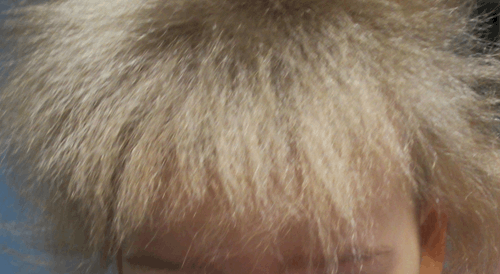
Síndrome Rapp-Hodgkin
📋 Origem dos dados
Esta página agrega dados de fontes públicas e oficiais. Dados sobre cobertura no SUS (PCDT, CEAF) são verificados ativamente por agente proativo (ver badge no infobox). Demais dados têm atribuição de fonte + data da última sincronização — clique para abrir o original.
- Doença rara (ontologia)
- fonte: Orphanet
- Identificador unificado
- fonte: MONDO
- Genética mendeliana
- fonte: OMIM
- NIH/GARD
- fonte: GARD (NIH)
- Indexação biomédica
- fonte: MeSH (NLM)
- Dado público estruturado
- fonte: Wikidata