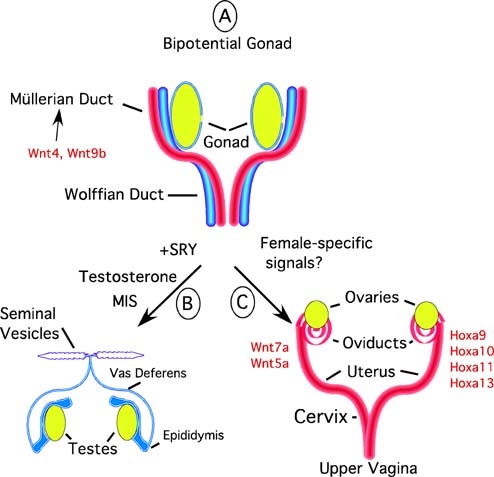
A disgenesia gonadal completa 46,XY (46,XY CGD) é um distúrbio do desenvolvimento sexual (DDS) associado a anomalias no desenvolvimento gonadal que resultam na presença de genitália externa e interna feminina, apesar do cariótipo 46,XY.
Introdução
O que você precisa saber de cara
A síndrome da morte súbita infantil com disgenesia dos testículos (SIDDT) é uma condição rara que é fatal no primeiro ano de vida; suas principais características incluem anomalias do sistema reprodutivo em machos, dificuldades de alimentação e problemas respiratórios.
Bebês com SIDDT que são geneticamente masculinos, com um cromossomo X e um cromossomo Y em cada célula, apresentam testículos subdesenvolvidos ou anormais. Eles também podem ter genitália externa que parece tipicamente feminina ou que não se parece claramente com a masculina nem com a feminina. Em bebês com a condição que são geneticamente femininos, com dois cromossomos X em cada célula, o desenvolvimento dos órgãos reprodutivos internos e externos é normal.
SIDDT está associada ao desenvolvimento anormal do cérebro, particularmente do tronco encefálico, que é a parte do cérebro que está conectada à medula espinhal. O tronco encefálico regula muitas funções corporais básicas, incluindo frequência cardíaca, respiração, alimentação e sono. Ele também transmite informações sobre movimento e os sentidos entre o cérebro e o resto do corpo. Muitas características da SIDDT parecem estar relacionadas a disfunção do tronco encefálico, incluindo frequência cardíaca lenta ou irregular, padrões respiratórios anormais, dificuldade em controlar a temperatura corporal, movimentos incomuns da língua e dos olhos, reflexo de sobressalto exagerado a luzes súbitas ou ruídos altos, e dificuldades de alimentação. Bebês com a condição também apresentam um choro incomum que foi descrito como semelhante ao balido de uma cabra, provavelmente resultante de conexões nervosas anormais entre o cérebro e a caixa de voz (laringe).
As anomalias do tronco encefálico levam à morte no primeiro ano de vida, quando bebês com a condição param repentinamente de respirar ou o coração deixa de bater (parada cardiorrespiratória).
Fonte: MedlinePlus Genetics (NLM/NIH), traduzidoA disgenesia gonadal completa 46,XY (46,XY CGD) é um distúrbio do desenvolvimento sexual (DDS) associado a anomalias no desenvolvimento gonadal que resultam na presença de genitália externa e interna feminina, apesar do cariótipo 46,XY.
Escala de raridade
<1/50kMuito rara
1/20kRara
1/10kPouco freq.
1/5kIncomum
1/2k
Encontrou um erro ou informação desatualizada? Sugira uma correção →
Entender a doença
Do básico ao detalhe, leia no seu ritmo
Preparando trilha educativa...
Sinais e sintomas
O que aparece no corpo e com que frequência cada sintoma acontece
Partes do corpo afetadas
+ 65 sintomas em outras categorias
Características mais comuns
Os sintomas variam de pessoa para pessoa. Abaixo estão as 100 características clínicas mais associadas, ordenadas por frequência.
Linha do tempo da pesquisa
Encontrou um erro ou informação desatualizada? Sugira uma correção →
Genética e causas
O que está alterado no DNA e como passa nas famílias
Genes associados
13 genes identificados com associação a esta condição. Padrão de herança: Autosomal dominant, Autosomal recessive, X-linked recessive, Y-linked.
46,XY gonadal dysgenesis with minifascicular neuropathy
An autosomal recessive disorder characterized by gonadal dysgenesis associated with polyneuropathy. Genital anomalies include the presence of a testis on one side and a streak or an absent gonad at the other, persistence of Muellerian duct structures, and a variable degree of genital ambiguity.
46,XY sex reversal 8
A disorder of sex development. Affected individuals have a 46,XY karyotype but present as phenotypically normal females.
46,XY sex reversal 8
A disorder of sex development. Affected individuals have a 46,XY karyotype but present as phenotypically normal females.
Tetralogy of Fallot
A congenital heart anomaly which consists of pulmonary stenosis, ventricular septal defect, dextroposition of the aorta (aorta is on the right side instead of the left) and hypertrophy of the right ventricle. In this condition, blood from both ventricles (oxygen-rich and oxygen-poor) is pumped into the body often causing cyanosis.
46,XY sex reversal 3
A condition characterized by male-to-female sex reversal in the presence of a normal 46,XY karyotype.
46,XY sex reversal 6
A disorder of sex development. Affected individuals have a 46,XY karyotype but present as phenotypically normal females.
Neurodevelopmental disorder with brain anomalies and with or without vertebral or cardiac anomalies
An autosomal recessive neurodevelopmental disorder characterized by severe developmental delay, impaired intellectual development, hypotonia, brain anomalies including cortical volume loss, corpus callosum dysgenesis and cerebellar hypoplasia, and variable dysmorphic features. Patients may have platyspondyly, scoliosis, and cardiac anomalies.
46,XY sex reversal 5
A disorder of sex development. Affected individuals have a 46,XY karyotype but present as phenotypically normal females.
Frasier syndrome
Characterized by a slowly progressing nephropathy leading to renal failure in adolescence or early adulthood, male pseudohermaphroditism, and no Wilms tumor. As for histological findings of the kidneys, focal glomerular sclerosis is often observed. There is phenotypic overlap with Denys-Drash syndrome. Inheritance is autosomal dominant.
Testicular germ cell tumor
A common malignancy in males representing 95% of all testicular neoplasms. TGCTs have various pathologic subtypes including: unclassified intratubular germ cell neoplasia, seminoma (including cases with syncytiotrophoblastic cells), spermatocytic seminoma, embryonal carcinoma, yolk sac tumor, choriocarcinoma, and teratoma.
Campomelic dysplasia
A rare, often lethal, osteochondrodysplasia characterized by congenital bowing and angulation of long bones. Other skeletal defects include unusually small scapula, deformed pelvis and spine, and a missing pair of ribs. Craniofacial and ear defects are common. Most patients die soon after birth due to respiratory distress which has been attributed to hypoplasia of the tracheobronchial cartilage and small thoracic cage. Up to two-thirds of affected XY individuals have genital defects or may develop as phenotypic females.
46,XY sex reversal 1
A condition characterized by male-to-female sex reversal in the presence of a normal 46,XY karyotype. Patients manifest rapid and early degeneration of their gonads, which are present in the adult as 'streak gonads', consisting mainly of fibrous tissue and variable amounts of ovarian stroma. As a result these patients do not develop secondary sexual characteristics at puberty. The external genitalia in these subjects are completely female, and Muellerian structures are normal.
Adrenal hypoplasia, congenital
A disorder of adrenal gland development characterized by absence of the permanent zone of the adrenal cortex, structural disorganization of the adrenal glands, adrenal insufficiency and profound hormonal deficiencies. AHC patients manifest primary adrenal failure usually in early infancy, and hypogonadotropic hypogonadism leading to absent or incomplete sexual maturation. AHC can be inherited in an X-linked or autosomal recessive pattern.
Variantes genéticas (ClinVar)
99 variantes patogênicas registradas no ClinVar.
Vias biológicas (Reactome)
39 vias biológicas associadas aos genes desta condição.
Diagnóstico
Os sinais que médicos procuram e os exames que confirmam
Tratamento e manejo
Remédios, cuidados de apoio e o que precisa acompanhar
Onde tratar no SUS
Hospitais de referência no Brasil e o protocolo oficial do SUS (PCDT)
🇧🇷 Atendimento SUS — Disgenesia gonadal completa 46,XY
Selecione um estado ou use sua localização para ver resultados.
Dados de DATASUS/CNES, SBGM, ABNeuro e Ministério da Saúde. Sempre confirme a disponibilidade diretamente com o estabelecimento.
Pesquisa ativa
Ensaios clínicos abertos e novidades científicas recentes
Pesquisa e ensaios clínicos
Nenhum ensaio clínico registrado para esta condição.
Publicações mais relevantes
Mostrando amostra de 4 publicações de um total de 32
46, XY Complete Gonadal Dysgenesis (Swyer Syndrome) Presenting as Primary Amenorrhea in a Normomorphic Adult Female From Kakamega, Kenya.
Differences/disorders of sex development (DSDs) are a diverse group of congenital conditions that result in disagreement between an individual's sex chromosomes, gonads, and/or anatomical sex. The 46, XY DSD group is vast and includes various conditions caused by genetic variants, hormonal imbalances, or abnormal sensitivity to testicular hormones, leading to varying degrees of under-virilization. A 19-year-old phenotypically normal female from Kakamega, Kenya, presented with primary amenorrhea. Physical examination revealed Tanner stage 3 breast development, Tanner stage 4 pubic hair, normal external genitalia, and a gynoid body shape. Hormonal profile tests indicated hypergonadotropic hypogonadism with normal 17-hydroxyprogesterone and testosterone levels. MRI revealed a hypoplastic uterus and absent ovaries. Karyotyping confirmed a 46, XY genotype, leading to the diagnosis of 46, XY complete gonadal dysgenesis (Swyer syndrome). Swyer syndrome is a rare disorder of sex development, characterized by unambiguous female genitalia, bilateral streak gonads, and elevated gonadotropin levels in individuals with a 46, XY karyotype. The condition results from abnormal gonadal development due to mutations in testis-determining factors, most commonly the SRY gene. Patients typically present with primary amenorrhea and seldom have secondary sexual characteristics as this patient had. Management includes hormone replacement therapy and gonadectomy because of the increased risk of gonadal tumors. The patient was educated about her condition, initiated on combined contraceptive pills, and counseled on exploratory laparoscopic gonadectomy. This case highlights the importance of a comprehensive diagnostic approach in patients with primary amenorrhea, keeping in mind that patients with disorders of sex development may have developed secondary sexual characteristics. The purpose of this overview is to: 1.. To describe the clinical characteristics of nonsyndromic disorders of testicular development; 2.. To review the genetic causes of nonsyndromic disorders of testicular development and conditions that may be in the differential diagnosis; 3.. To provide an evaluation strategy to identify the genetic cause of nonsyndromic disorders of testicular development (when possible); 4.. To inform management regarding sex of rearing, medical/surgical intervention (when appropriate), hormone therapy, and psychosocial aspects of care; 5.. To inform genetic risk assessment in family members of a proband.
A case of late diagnosis and management of 46 XY complete gonadal dysgenesis in adulthood.
Novel pathogenic mutations in disorders of sex development associated genes cause 46,XY complete gonadal dysgenesis.
Disorders of sex development (DSDs) are congenital conditions in which chromosomal, gonadal and sex is atypical. It is difficult to diagnose and manage patients with DSD in clinical practice, and the molecular etiology of DSD is still not completely understood. Here, we identified two novel pathogenic mutations from three unrelated Chinese patients with 46,XY complete gonadal dysgenesis (CGD) that is a clinical subgroup of DSD by whole exome sequencing. A novel mutation in the SRY gene (c.161delG) was identified in the first patient, and the second patient carried a novel missense mutation in the MAP3K1 gene (c.2117T>G). Bioinformatics analysis found that the deletion of SRY (c.161delG) led to a premature stop codon at amino acid 59 in the SRY protein, which resulted in lacking the DNA binding domain of SRY protein. Functional studies found that the missense mutation in the MAP3K1 gene (c.2117T>G) could interfere with the gene function through increasing the phosphorylation of the downstream targets of MAP3K1, ERK1/2 and p38, which resulted in reducing testis-determining factor SOX9 expression and increasing ovary-promoting factor β-catenin activity. According to the American college of medical genetics and genomics (ACMG) standards and guidelines, these mutations were categorized as "pathogenic" mutations. Thus, our findings provide two novel pathogenic mutations associated with 46,XY CGD that can improve the etiological diagnosis for 46,XY CGD. ABBREVIATIONS.
Functional Analysis of Mutations at Codon 127 of the SRY Gene Associated with 46,XY Complete Gonadal Dysgenesis.
Complete gonadal dysgenesis (CGD) is characterized by an incomplete differentiation of the genital organs in a patient with a 46,XY karyotype. It is induced by mutations in the sex-determining region Y (SRY) gene which plays a key role in testis-determining pathways. The aim of this study was to investigate the possible pathogenic nature of a novel SRY mutation (p.Y127H) identified in a 46,XY female patient. To determine the effect of this mutation on SRY function, we studied its impact on DNA interaction by electrophoretic mobility shift assays. Since tyrosine 127 is close to the C-terminal nuclear localization signal of SRY, we conducted HA-SRY protein expression to observe the impact of the mutation on the nuclear import function in transfected cells. Our results showed that the Y127H mutation nearly abolishes the DNA-binding capacity of SRY and strongly impairs the nuclear localization of the mutated protein. Together with a previously described mutation analyzed in parallel in this paper (p.Y127C), our results highlight this tyrosine residue as a crucial structural determinant of the high mobility group box domain. This is the first report to explain the molecular mechanism of the Y127H mutation causing sex reversal and gives new insights for clinical practice to benefit patients with disorders of sex development.
Publicações recentes
STARD9 and CDK5RAP2-Novel Candidate Genes for 46,XY Complete Gonadal Dysgenesis.
Perspective on postoperative hormone replacement therapy and fertility preservation in Swyer syndrome with dysgerminoma: a case series and literature review.
Isodicentric Y chromosome with SRY duplication in a female with complete gonadal dysgenesis.
46, XY Complete Gonadal Dysgenesis (Swyer Syndrome) Presenting as Primary Amenorrhea in a Normomorphic Adult Female From Kakamega, Kenya.
Case report: Rare heterozygous variant in the NR5A1 gene causing 46,XY complete gonadal dysgenesis with a non-communicating rudimentary uterus.
📚 EuropePMC25 artigos no totalmostrando 4
46, XY Complete Gonadal Dysgenesis (Swyer Syndrome) Presenting as Primary Amenorrhea in a Normomorphic Adult Female From Kakamega, Kenya.
Clinical case reportsA case of late diagnosis and management of 46 XY complete gonadal dysgenesis in adulthood.
Ginekologia polskaNovel pathogenic mutations in disorders of sex development associated genes cause 46,XY complete gonadal dysgenesis.
GeneFunctional Analysis of Mutations at Codon 127 of the SRY Gene Associated with 46,XY Complete Gonadal Dysgenesis.
Sexual development : genetics, molecular biology, evolution, endocrinology, embryology, and pathology of sex determination and differentiationAssociações
Organizações que acompanham esta doença — pra ter apoio e orientação
Ainda não temos associações cadastradas para Disgenesia gonadal completa 46,XY.
É de uma associação que acompanha esta doença? Fale com a gente →
Doença com base genética
Um médico geneticista pode ajudar no diagnóstico de Disgenesia gonadal completa 46,XY e no aconselhamento genético da família.
Doenças relacionadas
Doenças com sintomas parecidos — ajudam quem ainda está buscando diagnóstico
Perguntas frequentes
O que as famílias mais perguntam sobre esta doença — cada resposta com a fonte de onde saiu
A condição pode ter causas hereditárias com padrões autossômico dominante, autossômico recessivo, recessivo ligado ao X ou ligado ao Y. A herança está ligada a mutações em genes reguladores sexuais como SRY, MAP3K1, DMRT1 ou SOX9.
Referências
Fontes citadas no texto, publicações do grafo e bases de dados usadas neste verbete
8 publicações do grafo RarasNet (PubMed) · 7 bases de dados. Títulos, periódicos e PMIDs vêm direto da fonte, sem intermediação de IA.
Dados compilados pelo RarasNet a partir de fontes abertas (Orphanet, OMIM, MONDO, PubMed/EuropePMC, ClinicalTrials.gov, DATASUS, PCDT/MS). Este conteúdo é informativo e não substitui avaliação médica.
Citar este verbete
Raras. (s.d.). Disgenesia gonadal completa 46,XY. Em Raras — Enciclopédia de Doenças Raras do Brasil. https://raras.org/doenca/disgenesia-gonadal-completa-46xy
Formato APA. Conteúdo sob CC BY 4.0 — reuso livre com atribuição.
Conteúdo mantido por Agente Raras · Médicos e pesquisadores podem colaborar
Disgenesia gonadal completa 46,XY
📋 Origem dos dados
Esta página agrega dados de fontes públicas e oficiais. Dados sobre cobertura no SUS (PCDT, CEAF) são verificados ativamente por agente proativo (ver badge no infobox). Demais dados têm atribuição de fonte + data da última sincronização — clique para abrir o original.
- Doença rara (ontologia)
- fonte: Orphanet
- Identificador unificado
- fonte: MONDO
- Codificação WHO/SUS
- fonte: WHO ICD-10 / DATASUS
- CID-11 (futuro)
- fonte: WHO ICD-11
- NIH/GARD
- fonte: GARD (NIH)
- Indexação biomédica
- fonte: MeSH (NLM)
- Dado público estruturado
- fonte: Wikidata

