Síndrome de osteólise genética rara resultante de variantes truncadas de proteínas no éxon 34 do gene NOTCH2. Estas variantes perturbam apenas o domínio PEST, escapam ao decaimento mediado por absurdo e são postuladas para funcionar através de um mecanismo de ganho de função. Esta condição é caracterizada por acrosteólise das falanges distais e osteoporose generalizada, associada a anomalias adicionais de ossificação, dismorfismo craniofacial, anomalias dentárias e uma ampla gama de outras características. Perda auditiva, cistos renais e anomalias cardiovasculares estão presentes de forma variável.
Introdução
O que você precisa saber de cara
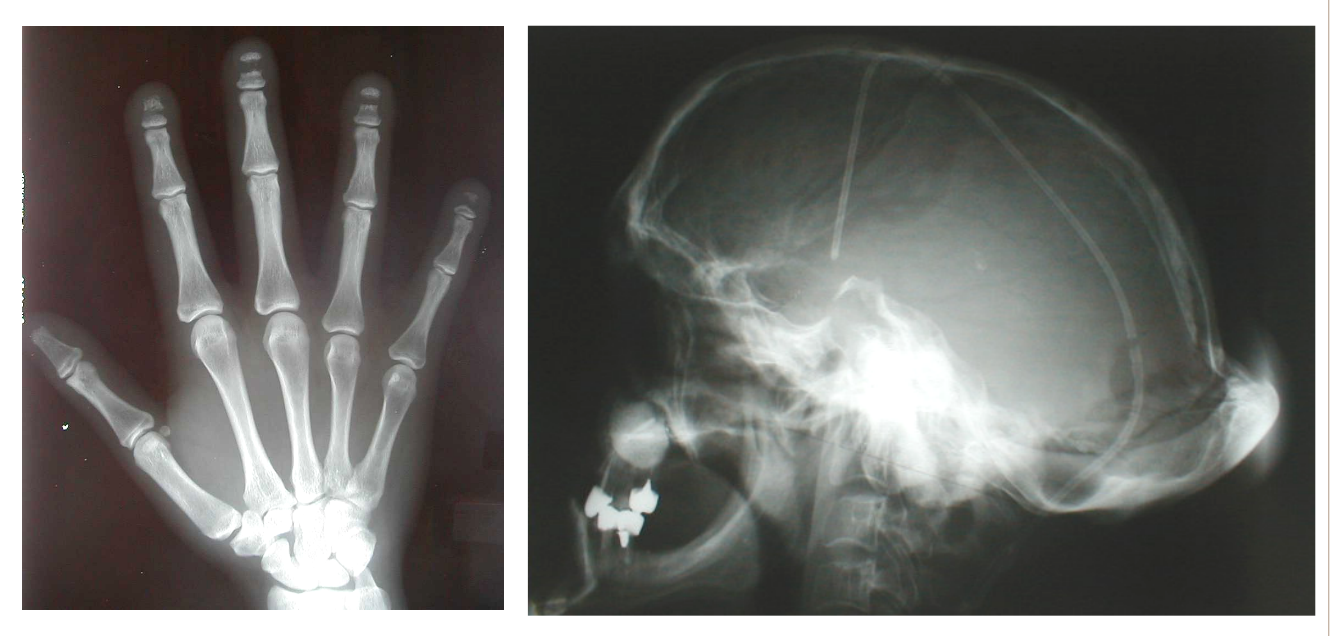
A síndrome de Hajdu-Cheney é um distúrbio raro que pode afetar muitas partes do corpo, particularmente os ossos. A perda óssea nas pontas dos dedos das mãos e dos pés (acroosteólise) é uma característica da condição. Os dedos das mãos e dos pés podem parecer curtos e arredondados, e podem ficar ainda mais curtos ao longo do tempo à medida que o osso continua a se degradar. Em pessoas com síndrome de Hajdu-Cheney, os dedos das mãos são mais frequentemente afetados do que os dos pés. A perda óssea nos dedos pode interferir nas habilidades motoras finas, como pegar objetos pequenos.
Os sinais e sintomas da síndrome de Hajdu-Cheney variam muito entre os indivíduos afetados, mesmo entre membros da mesma família. Muitas das características do distúrbio, incluindo a acroosteólise, não estão presentes ao nascimento, mas tornam‑se aparentes na infância ou mais tarde.
Anomalias ósseas adicionais são comuns em pessoas com síndrome de Hajdu-Cheney. Os indivíduos afetados tipicamente desenvolvem osteoporose, que faz com que os ossos sejam frágeis e propensos a fraturas. Muitos indivíduos afetados experimentam um tipo de fratura chamada fratura por compressão nos ossos da coluna (vértebras). Alguns desenvolvem uma curvatura anormal da coluna (escoliose ou cifose). A síndrome de Hajdu-Cheney também pode afetar a forma e a resistência dos ossos longos dos braços e das pernas. As anomalias ósseas associadas a essa condição frequentemente levam a baixa estatura.
A síndrome de Hajdu-Cheney pode também envolver os ossos do crânio. A forma do crânio costuma ser dolicocéfalo, o que significa que é alongado de trás para frente. Em muitos indivíduos afetados, o osso na parte posterior do crânio projeta‑se para fora, formando uma protuberância chamada occipital proeminente. Complicações graves da síndrome de Hajdu-Cheney incluem anomalias conhecidas como platibasia e invaginação basilar. A platibasia é um achatamento da base do crânio causado por afinamento e amolecimento dos ossos cranianos. A invaginação basilar ocorre quando os ossos amolecidos permitem que parte da coluna protrua através da abertura na base do crânio e empurre para as partes inferiores do cérebro. Essas anomalias podem levar a sérios problemas neurológicos, como acúmulo de líquido no cérebro (hidrocefalia) ou na medula espinhal (siringomielia) e dificuldades respiratórias. Em alguns casos, essas anomalias podem ser ameaçadoras à vida.
Sinais e sintomas adicionais podem incluir um queixo pequeno (micrognatia) e uma abertura no teto da boca chamada fissura palatina. Adultos com síndrome de Hajdu-Cheney podem apresentar características faciais descritas como “ásperas”. Essas características faciais podem incluir olhos amplamente espaçados e inclinados para baixo, sobrancelhas que se unem no meio (sinofris), orelhas baixas e um grande espaço entre o nariz e o lábio superior (filtrum longo).
Outras características da síndrome de Hajdu-Cheney podem incluir anomalias nas articulações, particularmente uma amplitude de movimento articular incomumente grande (hipermobilidade); problemas dentários; perda auditiva; e uma voz profunda e rouca. Os indivíduos afetados podem também ter infecções recorrentes na infância, defeitos cardíacos e anomalias renais que incluem o crescimento de múltiplos cistos cheios de líquido (rins policísticos). Algumas pessoas com essa condição apresentam atraso no desenvolvimento na infância, mas os atrasos costumam ser leves.
Fonte: MedlinePlus Genetics (NLM/NIH), traduzidoSíndrome de osteólise genética rara resultante de variantes truncadas de proteínas no éxon 34 do gene NOTCH2. Estas variantes perturbam apenas o domínio PEST, escapam ao decaimento mediado por absurdo e são postuladas para funcionar através de um mecanismo de ganho de função. Esta condição é caracterizada por acrosteólise das falanges distais e osteoporose generalizada, associada a anomalias adicionais de ossificação, dismorfismo craniofacial, anomalias dentárias e uma ampla gama de outras características. Perda auditiva, cistos renais e anomalias cardiovasculares estão presentes de forma variável.
Escala de raridade
<1/50kMuito rara
1/20kRara
1/10kPouco freq.
1/5kIncomum
1/2k
Encontrou um erro ou informação desatualizada? Sugira uma correção →
Entender a doença
Do básico ao detalhe, leia no seu ritmo
Preparando trilha educativa...
Sinais e sintomas
O que aparece no corpo e com que frequência cada sintoma acontece
Partes do corpo afetadas
+ 31 sintomas em outras categorias
Características mais comuns
Os sintomas variam de pessoa para pessoa. Abaixo estão as 115 características clínicas mais associadas, ordenadas por frequência.
Linha do tempo da pesquisa
Encontrou um erro ou informação desatualizada? Sugira uma correção →
Genética e causas
O que está alterado no DNA e como passa nas famílias
Genes associados
1 gene identificado com associação a esta condição. Padrão de herança: Autosomal dominant.
Curadoria gene-doença
fontes oficiaisAlagille syndrome 2
A form of Alagille syndrome, an autosomal dominant multisystem disorder. It is clinically defined by hepatic bile duct paucity and cholestasis in association with cardiac, skeletal, and ophthalmologic manifestations. There are characteristic facial features and less frequent clinical involvement of the renal and vascular systems.
Variantes genéticas (ClinVar)
229 variantes patogênicas registradas no ClinVar.
Classificação de variantes (ClinVar)
Distribuição de 1.646 variantes classificadas pelo ClinVar.
Vias biológicas (Reactome)
8 vias biológicas associadas aos genes desta condição.
Diagnóstico
Os sinais que médicos procuram e os exames que confirmam
Tratamento e manejo
Remédios, cuidados de apoio e o que precisa acompanhar
Onde tratar no SUS
Hospitais de referência no Brasil e o protocolo oficial do SUS (PCDT)
🇧🇷 Atendimento SUS — Síndrome Hajdu-Cheney
Selecione um estado ou use sua localização para ver resultados.
Dados de DATASUS/CNES, SBGM, ABNeuro e Ministério da Saúde. Sempre confirme a disponibilidade diretamente com o estabelecimento.
Pesquisa ativa
Ensaios clínicos abertos e novidades científicas recentes
Pesquisa e ensaios clínicos
Nenhum ensaio clínico registrado para esta condição.
Publicações mais relevantes
Unexpected genotypes associated with severe paediatric conditions identified in a healthy population cohort.
The expansion of genomics provides opportunity to screen individuals beyond clinical indication yet the classification of genomic variants and implications for health outcomes in this context is still emerging. We investigated this further by analysing clinically relevant variants and expected clinical implications in a population with no reported medical conditions. Whole genomes from 9637 healthy unrelated research-consented participants in Singapore were analysed focusing on 1619 genes associated with severe paediatric disease. Association between causative variants and expected phenotype was assessed in correlation with participant characteristics and medical history where available. After considering protein impact, mode of inheritance and participant demographics for 110 variants, further analysis was performed for 44 variants occurring in 150 participants to understand clinical implications. Most carried variants associated with a mild phenotype (cystinuria), late onset (Fabry disease) or a potentially missed phenotype (Hajdu-Cheney syndrome). However, nine participants had variants associated with severe paediatric disease predicted to be symptomatic, such as limb-girdle muscular dystrophy and spastic paraplegia. Despite a cohort selected for absence of pre-existing health conditions, individuals were identified carrying variants associated with severe paediatric conditions. Further work is required to examine for subtle clinical symptoms or alternate genetic suppression mechanisms. This study revealed the challenge of predicting clinical outcomes from genotype-derived screening and emphasises the importance of expanding phenotype characterisation which is highly relevant in population and reproductive screening settings. Trial registration: NCT02791152.
Hajdu-Cheney Syndrome With Coexisting Rheumatoid Arthritis: A Diagnostic Challenge.
We report a case of a 29-year-old female with clinical features consistent with a very rare connective tissue disorder known as Hajdu-Cheney syndrome (HCS), with coexisting inflammatory arthritis suggestive of rheumatoid arthritis. HCS primarily affects the skeletal system and demonstrates a broad spectrum of clinical presentations, including possible systemic manifestations. It is thought that a change in the NOTCH2 gene plays a role in HCS. Genetic confirmation is not always available, and diagnosis often relies on clinical and radiological findings. This case highlights the diagnostic considerations and management challenges encountered when HCS is suspected, particularly in the presence of overlapping inflammatory joint disease.
Bathrocephaly and Serpentine Fibula as Underrated Features of Osteogenesis Imperfecta Type I: A Case Report.
Osteogenesis imperfecta (OI) comprises a heterogeneous group of skeletal dysplasias characterized mainly by bone fragility and propensity to fractures. The most common forms include classic types I, II, III, and IV, according to the classification of Sillence, caused by variants in the COL1A1 or COL1A2 genes. This report describes a case series of patients with OI type I confirmed by whole genome sequencing, highlighting the clinical and radiological manifestations of one atypical family. Six individuals (1M:5F), aged 8 months to 34 years at their first consultation, were enrolled. All were clinically classified as OI type I due to the presence of osteopenia associated with blue sclerae and bone fractures; four presented with short stature, two with hearing loss, and one with fragile teeth; molecular testing confirmed that all presented with heterozygous pathogenic or likely pathogenic variants in the COL1A1 gene. In one family, an unusual presentation was observed in the patient and her daughter, both of whom presented with severe short stature (Z-score <-6), abnormal skull shape (bathrocephaly), codfish vertebrae, bowing of the long bones in the lower limbs, and serpentine fibulas. Bathrocephaly and serpentine fibula are rarely reported in classical OI types and are more frequently associated with other skeletal dysplasias, such as Hajdu-Cheney syndrome. This case report highlights the importance of recognizing underrated manifestations in OI and underscores the need for molecular confirmation.
Temporal Bone CT Findings in Hajdu-Cheney Syndrome: Case Report with Review of the Literature.
Hajdu-Cheney Syndrome (HCS) is an exceedingly rare connective tissue disorder primarily manifested by skeletal abnormalities including acro-osteolysis, severe osseous demineralization, distinctive craniofacial/dental abnormalities and short stature. The syndrome is caused by gain-of-function mutations in the NOTCH2 gene, which disrupt bone remodeling and connective tissue integrity. While hearing loss is a known clinical manifestation of HCS, specific imaging findings have not been reported. We present the case of a 36-year-old male with HCS who underwent high-resolution CT of the temporal bones for evaluation of longstanding bilateral conductive hearing loss, which showed relatively symmetric, diffuse osseous demineralization of the temporal bones, with ossicular and otic capsule involvement.ABBREVIATIONS: HCS= Hajdu-Cheney Syndrome; CT = Computed Tomography; OI = Osteogenesis Imperfecta.
Hajdu-Cheney Syndrome with Fatal Progressive Basilar Invagination: Illustrative Case.
Background: Hajdu-Cheney Syndrome is an autosomal dominantly inherited disease, with less than 50 patients reported to date. It is associated with gain-of-function variants of the NOTCH2 gene on chromosome 1p12. Methods: Here we present a case of NOTCH2 gene-associated Hajdu-Cheney syndrome with a progressive basilar impression and consecutive hydrocephalus. While the neuropsychologic development of the patient remained uneventful, allowing him to obtain his college exam, neurosurgical and orthopedic interventions became necessary to treat basal invagination and hydrocephalus at the age of 13 years. Results: Finally, the progressive compression of the medulla oblongata led to respiratory problems with the need for tracheotomy. The patient succumbed to his disease at the age of 18. Conclusions: To our knowledge, this is the first case in which a combination of hydrocephalus and basilar impression lead to a fatal outcome in spite of preemptive surgical interventions.
Publicações recentes
Alagille syndrome caused by p.L2014Vfs*10 in NOTCH2: a case report and review of the literature.
Hajdu-Cheney Syndrome With Coexisting Rheumatoid Arthritis: A Diagnostic Challenge.
Unexpected genotypes associated with severe paediatric conditions identified in a healthy population cohort.
Bathrocephaly and Serpentine Fibula as Underrated Features of Osteogenesis Imperfecta Type I: A Case Report.
Temporal Bone CT Findings in Hajdu-Cheney Syndrome: Case Report with Review of the Literature.
📚 EuropePMC162 artigos no totalmostrando 105
Hajdu-Cheney Syndrome With Coexisting Rheumatoid Arthritis: A Diagnostic Challenge.
CureusUnexpected genotypes associated with severe paediatric conditions identified in a healthy population cohort.
European journal of human genetics : EJHGBathrocephaly and Serpentine Fibula as Underrated Features of Osteogenesis Imperfecta Type I: A Case Report.
Molecular syndromologyTemporal Bone CT Findings in Hajdu-Cheney Syndrome: Case Report with Review of the Literature.
AJNR. American journal of neuroradiologyTemporal Bone Osseous Dysplasia With Conductive Hearing Loss in Hajdu-Cheney Syndrome.
Otology & neurotology : official publication of the American Otological Society, American Neurotology Society [and] European Academy of Otology and NeurotologyHajdu-Cheney Syndrome with Fatal Progressive Basilar Invagination: Illustrative Case.
Children (Basel, Switzerland)Periodontal Manifestations of Systemic Diseases.
Journal of periodontal researchBone mineral density and microarchitecture improvement in a young patient with Hajdu-Cheney syndrome and autosomal dominant polycystic kidney disease treated with alendronate.
Bone reportsNotch2 Signaling Drives Cardiac Hypertrophy by Suppressing Purine Nucleotide Metabolism.
Research (Washington, D.C.)Hajdu-Cheney Syndrome, a Rare Cause of Acro-Osteolysis and Osteoporosis With Zoledronic Acid Experience.
American journal of medical genetics. Part ANotch2 Inhibition and Kidney Cyst Growth in Autosomal Dominant Polycystic Kidney Disease.
Journal of the American Society of Nephrology : JASNA NOTCH2 pathogenic variant and HES1 regulate osteoclastogenesis in induced pluripotent stem cells.
BoneHajdu-Cheney syndrome: A case of acral osteolytic deformity of both hands.
Hand surgery & rehabilitationAnaesthesia for a patient of Hajdu Cheney syndrome scheduled for scoliosis surgery-A case study.
Indian journal of anaesthesiaFirst case of Hajdu-Cheney syndrome in Lithuania caused by novel NOTCH2 gene likely pathogenic variant.
European journal of medical geneticsJapanese siblings with multicentric osteolysis nodulosis and arthropathy.
Pediatrics international : official journal of the Japan Pediatric SocietyNOTCH2 promotes osteoclast maturation and metabolism and modulates the transcriptome profile during osteoclastogenesis.
The Journal of biological chemistryMulticentric Carpo-Tarsal Osteolysis Syndrome (MCTO) and "Function Profile": a rehabilitative approach.
Orphanet journal of rare diseasesCranial vault suspension for basilar invagination in patients with open cranial sutures: technique and long-term follow-up. Illustrative case.
Journal of neurosurgery. Case lessonsSolitary Band Acro-osteolysis in Hajdu-Cheney Syndrome.
The Journal of rheumatologyNOTCH2 sensitizes the chondrocyte to the inflammatory response of tumor necrosis factor α.
The Journal of biological chemistryAcroosteolysis and facial dysmorphia: a new case of Hajdu-Cheney syndrome.
Reumatologia clinicaClinical, radiographic and molecular characterization of two unrelated families with multicentric osteolysis, nodulosis, and arthropathy.
BMC musculoskeletal disordersHajdu-Cheney syndrome with a novel variant in NOTCH2 gene: A case report.
Bone reportsFracture healing in a mouse model of Hajdu-Cheney-Syndrome with high turnover osteopenia results in decreased biomechanical stability.
Scientific reportsA case of safe airway management by fiber-optic nasotracheal intubation in general anesthesia in a pediatric patient with Hajdu-Cheney syndrome: a case report.
JA clinical reportsOrofacial characteristics in a child with Hajdu-Cheney syndrome.
Special care in dentistry : official publication of the American Association of Hospital Dentists, the Academy of Dentistry for the Handicapped, and the American Society for Geriatric DentistryNOTCH2 related disorders: Description and review of the fetal presentation.
European journal of medical geneticsExploratory use of romosozumab for osteoporosis in a patient with Hajdu-Cheney syndrome: a case report.
Osteoporosis international : a journal established as result of cooperation between the European Foundation for Osteoporosis and the National Osteoporosis Foundation of the USA[A case of Hajdu-Cheney syndrome].
Zhonghua er ke za zhi = Chinese journal of pediatricsHajdu-Cheney syndrome with atypical cardiovascular abnormalities.
American journal of medical genetics. Part AScoliosis Correction in an Adolescent With Hajdu-Cheney Syndrome: A Case Report.
HSS journal : the musculoskeletal journal of Hospital for Special SurgeryProgress and Current Status in Hajdu-Cheney Syndrome with Focus on Novel Genetic Research.
International journal of molecular sciencesSurgical management of high-grade lumbar spondylolisthesis associated with Hajdu-Cheney syndrome: illustrative case.
Journal of neurosurgery. Case lessonsHajdu-Cheney Syndrome: A Novel NOTCH2 Mutation in a Spanish Child in Treatment with Vibrotherapy: A Case Report.
Journal of clinical medicineNursing Care Plan for Patients with Hajdu-Cheney Syndrome.
International journal of environmental research and public healthPremature Loss of Deciduous Teeth as a Symptom of Systemic Disease: A Narrative Literature Review.
International journal of environmental research and public healthHajdu-Cheney Syndrome: Report of a Case in Spain.
Diagnostics (Basel, Switzerland)Novel phenotypic feature in a patient with a recurrent NOTCH2 nonsense mutation.
American journal of medical genetics. Part ACraniospinal Surgery in Hajdu-Cheney Syndrome: A Review of Case Reports.
CureusHajdu Cheney syndrome; A novel NOTCH2 mutation in a Syrian child, and treatment with zolidronic acid: A case report and a literature review of treatments.
Annals of medicine and surgery (2012)Hairy and enhancer of split 1 is a primary effector of NOTCH2 signaling and induces osteoclast differentiation and function.
The Journal of biological chemistryOperative Management of Spinal Deformity Secondary to Hajdu-Cheney Syndrome.
CureusOral Surgery Procedures in a Patient with Hajdu-Cheney Syndrome Treated with Denosumab-A Rare Case Report.
International journal of environmental research and public healthClinical relevance of targeted exome sequencing in patients with rare syndromic short stature.
Orphanet journal of rare diseasesHajdu-Cheney Syndrome: A Report on Successful Halting of Acro-osteolysis.
JBJS case connectorA family with partially penetrant multicentric carpotarsal osteolysis due to gonadal mosaicism: First reported case.
American journal of medical genetics. Part AHajdu‑Cheney syndrome: the first case report in Poland?
Polish archives of internal medicineSkeletal characterization in a patient with Hajdu-Cheney syndrome undergoing total knee arthroplasty.
Osteoporosis international : a journal established as result of cooperation between the European Foundation for Osteoporosis and the National Osteoporosis Foundation of the USAHajdu Cheney Syndrome due to NOTCH2 defect - First case report from Pakistan and review of literature.
Annals of medicine and surgery (2012)Hajdu-Cheney Syndrome: A Systematic Review of the Literature.
International journal of environmental research and public healthObstructive hydrocephalus treated with endoscopic third ventriculostomy in a patient with Hajdu-Cheney syndrome: case report.
Journal of neurosurgery. PediatricsA mutation in NOTCH2 gene first associated with Hajdu-Cheney syndrome in a Greek family: diversity in phenotype and response to treatment.
EndocrineNotch signaling regulates Akap12 expression and primary cilia length during renal tubule morphogenesis.
FASEB journal : official publication of the Federation of American Societies for Experimental BiologyHand Deformities in Hajdu-Cheney Syndrome: A Case Series of 3 Patients Across 3 Consecutive Generations.
The Journal of hand surgeryDistinct severity of phenotype in Hajdu-Cheney syndrome: a case report and literature review.
BMC musculoskeletal disordersAntisense oligonucleotides targeting Notch2 ameliorate the osteopenic phenotype in a mouse model of Hajdu-Cheney syndrome.
The Journal of biological chemistryOff-label uses of denosumab in metabolic bone diseases.
BoneThe Hajdu Cheney mutation sensitizes mice to the osteolytic actions of tumor necrosis factor α.
The Journal of biological chemistryA novel mutation in the matrix metallopeptidase 2 coding gene associated with intrafamilial variability of multicentric osteolysis, nodulosis, and arthropathy.
Molecular genetics & genomic medicineMulticentric osteolytic syndromes represent a phenotypic spectrum defined by defective collagen remodeling.
American journal of medical genetics. Part APhenotypic presentations of Hajdu-Cheney syndrome according to age - 5 distinct clinical presentations.
European journal of medical geneticsThe Age Dependent Progression of Hajdu-Cheney Syndrome in Two Families.
Prague medical reportFatal case of Hajdu-Cheney syndrome with idiopathic pulmonary hemosiderosis.
Pediatrics international : official journal of the Japan Pediatric SocietyCongenital Glaucoma: a Novel Ocular Manifestation of Hajdu-Cheney Syndrome.
Case reports in geneticsA 23-year follow-up of a male with Hajdu-Cheney syndrome due to NOTCH2 mutation.
American journal of medical genetics. Part ANotch signaling suppresses glucose metabolism in mesenchymal progenitors to restrict osteoblast differentiation.
The Journal of clinical investigationA Notch in the joint that exacerbates osteoarthritis.
Nature reviews. RheumatologyMice harboring a Hajdu Cheney Syndrome mutation are sensitized to osteoarthritis.
BonePhenotype variability in Hajdu-Cheney syndrome.
European journal of medical geneticsBisphosphonate therapy for spinal osteoporosis in Hajdu-Cheney syndrome - new data and literature review.
Orphanet journal of rare diseasesDental implications in Hajdu-Cheney syndrome: A novel case report and review of the literature.
Oral diseasesAn unusual presentation of intracranial meningioma in Hajdu-Cheney syndrome.
Neurology IndiaInduction of the Hajdu-Cheney Syndrome Mutation in CD19 B Cells in Mice Alters B-Cell Allocation but Not Skeletal Homeostasis.
The American journal of pathologyOsseous sarcoidosis with lupus pernio.
The Indian journal of medical researchFoot Deformities in Hajdu-Cheney Syndrome: A Rare Case Report and Review of the Literature.
Journal of orthopaedic case reportsA Novel Mutation of Notch homolog protein 2 gene in a Chinese Family with Hajdu-Cheney Syndrome.
Chinese medical journalNOTCH2 Hajdu-Cheney Mutations Escape SCFFBW7-Dependent Proteolysis to Promote Osteoporosis.
Molecular cellExtreme proximal junctional kyphosis-a complication of delayed lambdoid suture closure in Hajdu-Cheney syndrome: a case report and literature review.
European spine journal : official publication of the European Spine Society, the European Spinal Deformity Society, and the European Section of the Cervical Spine Research SocietyThe Hajdu Cheney Mutation Is a Determinant of B-Cell Allocation of the Splenic Marginal Zone.
The American journal of pathologyClinical and experimental aspects of notch receptor signaling: Hajdu-Cheney syndrome and related disorders.
Metabolism: clinical and experimentalBone Structural Characteristics and Response to Bisphosphonate Treatment in Children With Hajdu-Cheney Syndrome.
The Journal of clinical endocrinology and metabolismHigh Bone Turnover in Mice Carrying a Pathogenic Notch2 Mutation Causing Hajdu-Cheney Syndrome.
Journal of bone and mineral research : the official journal of the American Society for Bone and Mineral ResearchA case of Hajdu-Cheney syndrome associated with psoriatic rheumatism, two causes of acro-osteolysis.
Joint bone spineSustained Notch2 signaling in osteoblasts, but not in osteoclasts, is linked to osteopenia in a mouse model of Hajdu-Cheney syndrome.
The Journal of biological chemistryThe developmental biology of genetic Notch disorders.
Development (Cambridge, England)An Antibody to Notch2 Reverses the Osteopenic Phenotype of Hajdu-Cheney Mutant Male Mice.
EndocrinologyMAFB Determines Human Macrophage Anti-Inflammatory Polarization: Relevance for the Pathogenic Mechanisms Operating in Multicentric Carpotarsal Osteolysis.
Journal of immunology (Baltimore, Md. : 1950)NOTCH2 genetic mutation and acro-osteolysis-the Hajdu-Cheney syndrome.
QJM : monthly journal of the Association of PhysiciansOsseointegration of Dental Implants in a Patient with Hajdu-cheney Syndrome.
The open dentistry journalPoster 315 Complications Associated with Hajdu-Cheney Syndrome: A Case Report.
PM & R : the journal of injury, function, and rehabilitationHajdu Cheney Syndrome; report of a novel NOTCH2 mutation and treatment with denosumab.
BoneHajdu-Cheney syndrome - a rare cause of micrognathia.
The Indian journal of medical researchEnd-Stage Renal Disease in an Infant With Hajdu-Cheney Syndrome.
Therapeutic apheresis and dialysis : official peer-reviewed journal of the International Society for Apheresis, the Japanese Society for Apheresis, the Japanese Society for Dialysis TherapyHajdu-Cheney Syndrome, a Disease Associated with NOTCH2 Mutations.
Current osteoporosis reportsOsteoblast-specific Notch2 inactivation causes increased trabecular bone mass at specific sites of the appendicular skeleton.
BoneImages in Medicine - Hajdu-Cheney Syndrome: A Rare Case Report.
Journal of clinical and diagnostic research : JCDRHajdu Cheney Mouse Mutants Exhibit Osteopenia, Increased Osteoclastogenesis, and Bone Resorption.
The Journal of biological chemistryCapillaroscopic findings in a case of Hajdu-Cheney syndrome.
Osteoporosis international : a journal established as result of cooperation between the European Foundation for Osteoporosis and the National Osteoporosis Foundation of the USAExpert's comment concerning Grand Rounds case entitled "Surgical challenges in the management of cervical kyphotic deformity in patients with severe osteoporosis: an illustrative case of a patient with Hajdu-Cheney syndrome" (T. A. Mattei, A. A. Rehman, A. Issawi, D. R. Fassett).
European spine journal : official publication of the European Spine Society, the European Spinal Deformity Society, and the European Section of the Cervical Spine Research SocietySurgical challenges in the management of cervical kyphotic deformity in patients with severe osteoporosis: an illustrative case of a patient with Hajdu-Cheney syndrome.
European spine journal : official publication of the European Spine Society, the European Spinal Deformity Society, and the European Section of the Cervical Spine Research SocietyA very rare cause of acro-osteolysis: Hajdu-Cheney syndrome.
Joint bone spine[Bilateral Instability of the Interphalangeal Articulation of the Thumb in Hajdu-Cheney Syndrome].
Handchirurgie, Mikrochirurgie, plastische Chirurgie : Organ der Deutschsprachigen Arbeitsgemeinschaft fur Handchirurgie : Organ der Deutschsprachigen Arbeitsgemeinschaft fur Mikrochirurgie der Peripheren Nerven und Gefasse : Organ der V...Primary osteolysis syndromes: beware of difficult airway.
Paediatric anaesthesiaA novel NOTCH2 mutation identified in a Korean family with Hajdu-Cheney syndrome showing phenotypic diversity.
Annals of clinical and laboratory scienceAssociações
Organizações que acompanham esta doença — pra ter apoio e orientação
Ainda não temos associações cadastradas para Síndrome Hajdu-Cheney.
É de uma associação que acompanha esta doença? Fale com a gente →
Doença com base genética
Um médico geneticista pode ajudar no diagnóstico de Síndrome Hajdu-Cheney e no aconselhamento genético da família.
Doenças relacionadas
Doenças com sintomas parecidos — ajudam quem ainda está buscando diagnóstico
Perguntas frequentes
O que as famílias mais perguntam sobre esta doença — cada resposta com a fonte de onde saiu
A síndrome é causada por mutações específicas no éxon 34 do gene NOTCH2, que levam a um ganho de função biológica na atividade proteica. A condição possui herança autossômica dominante, podendo ser transmitida quando apenas um dos alelos está alterado.
Referências
Fontes citadas no texto, publicações do grafo e bases de dados usadas neste verbete
6 publicações do grafo RarasNet (PubMed) · 7 bases de dados. Títulos, periódicos e PMIDs vêm direto da fonte, sem intermediação de IA.
Dados compilados pelo RarasNet a partir de fontes abertas (Orphanet, OMIM, MONDO, PubMed/EuropePMC, ClinicalTrials.gov, DATASUS, PCDT/MS). Este conteúdo é informativo e não substitui avaliação médica.
Citar este verbete
Raras. (s.d.). Síndrome Hajdu-Cheney. Em Raras — Enciclopédia de Doenças Raras do Brasil. https://raras.org/doenca/sindrome-hajdu-cheney
Formato APA. Conteúdo sob CC BY 4.0 — reuso livre com atribuição.
Conteúdo mantido por Agente Raras · Médicos e pesquisadores podem colaborar
Síndrome Hajdu-Cheney
📋 Origem dos dados
Esta página agrega dados de fontes públicas e oficiais. Dados sobre cobertura no SUS (PCDT, CEAF) são verificados ativamente por agente proativo (ver badge no infobox). Demais dados têm atribuição de fonte + data da última sincronização — clique para abrir o original.
- Doença rara (ontologia)
- fonte: Orphanet
- Identificador unificado
- fonte: MONDO
- Genética mendeliana
- fonte: OMIM
- Codificação WHO/SUS
- fonte: WHO ICD-10 / DATASUS
- CID-11 (futuro)
- fonte: WHO ICD-11
- NIH/GARD
- fonte: GARD (NIH)
- Indexação biomédica
- fonte: MeSH (NLM)
- Dado público estruturado
- fonte: Wikidata

