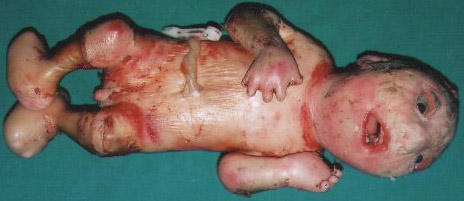
A síndrome de Neu-Laxova (NLS) é uma síndrome rara de malformação múltipla caracterizada por retardo de crescimento intrauterino grave (RCIU), microcefalia grave com testa inclinada, ictiose grave (tipo colódio bebê) e dismorfismo facial.
Introdução
O que você precisa saber de cara
A síndrome de Neu-Laxova é uma condição genética extremamente rara que se manifesta ainda durante o desenvolvimento do bebê na gestação. Ela costuma causar retardo de crescimento fetal severo, microcefalia congênita (cabeça muito pequena), alterações graves na pele com aspecto descamativo e malformações em diversos órgãos. Não existem remédios específicos ou cura descritos, e a doença não possui um protocolo clínico com medicamentos fornecidos pelo SUS. O acompanhamento médico é voltado para o suporte dos sintomas, auxílio diagnóstico genético e acolhimento da família.
A síndrome de Neu-Laxova (NLS) é uma síndrome rara de malformação múltipla caracterizada por retardo de crescimento intrauterino grave (RCIU), microcefalia grave com testa inclinada, ictiose grave (tipo colódio bebê) e dismorfismo facial.
Escala de raridade
<1/50kMuito rara
1/20kRara
1/10kPouco freq.
1/5kIncomum
1/2k
Encontrou um erro ou informação desatualizada? Sugira uma correção →
Entender a doença
Do básico ao detalhe, leia no seu ritmo
Preparando trilha educativa...
Sinais e sintomas
O que aparece no corpo e com que frequência cada sintoma acontece
Partes do corpo afetadas
+ 43 sintomas em outras categorias
Características mais comuns
Os sintomas variam de pessoa para pessoa. Abaixo estão as 103 características clínicas mais associadas, ordenadas por frequência.
Linha do tempo da pesquisa
Encontrou um erro ou informação desatualizada? Sugira uma correção →
Genética e causas
O que está alterado no DNA e como passa nas famílias
Genes associados
3 genes identificados com associação a esta condição. Padrão de herança: Autosomal recessive.
Phosphoglycerate dehydrogenase deficiency
An autosomal recessive inborn error of L-serine biosynthesis, clinically characterized by congenital microcephaly, psychomotor retardation, and seizures.
Phosphoserine phosphatase deficiency
An autosomal recessive disorder that results in pre- and postnatal growth retardation, moderate psychomotor retardation and facial features suggestive of Williams syndrome.
Phosphoserine aminotransferase deficiency
Characterized biochemically by low plasma and cerebrospinal fluid concentrations of serine and glycine and clinically by intractable seizures, acquired microcephaly, hypertonia, and psychomotor retardation.
Variantes genéticas (ClinVar)
275 variantes patogênicas registradas no ClinVar.
Classificação de variantes (ClinVar)
Distribuição de 398 variantes classificadas pelo ClinVar.
Diagnóstico
Os sinais que médicos procuram e os exames que confirmam
Tratamento e manejo
Remédios, cuidados de apoio e o que precisa acompanhar
Onde tratar no SUS
Hospitais de referência no Brasil e o protocolo oficial do SUS (PCDT)
🇧🇷 Atendimento SUS — Síndrome Neu-Laxova
Selecione um estado ou use sua localização para ver resultados.
Dados de DATASUS/CNES, SBGM, ABNeuro e Ministério da Saúde. Sempre confirme a disponibilidade diretamente com o estabelecimento.
Pesquisa ativa
Ensaios clínicos abertos e novidades científicas recentes
Pesquisa e ensaios clínicos
Nenhum ensaio clínico registrado para esta condição.
Publicações mais relevantes
Prenatal diagnosis of Neu-Laxova syndrome with compound heterozygous variants in PHGDH in a fetus presenting increased nuchal translucency and severe early-onset fetal growth restriction in a dichorionic diamniotic twin pregnancy.
We present prenatal diagnosis of Neu-Laxova syndrome with compound heterozygous variants in PHGDH in a fetus presenting increased nuchal translucency (NT) and severe early-onset fetal growth restriction (FGR) of a dichorionic diamniotic (DCDA) twin pregnancy. A 36-year-old, gravida 3, para 1, woman with an adverse pregnancy history of fetus demise, now bearing a DCDA twin pregnancy conceived by IVF-ET, underwent amniocentesis at 17+2 weeks of gestation because of one of the twin presenting increased NT at 13 + 1 weeks of gestation, and karyotype, FISH and SNP revealed no genetic abnormity. Since 22 weeks of gestation, severe FGR was presented in ultrasound in the fetus with increased NT. Fetal ultrasonic cardiogram at 26 + 1 weeks of gestation reported no abnormity. Trio-WES prescribed at 29+4 weeks of gestation revealed compound heterozygous variants in the affected fetus in PHGDH (NM_006623.4): a known missense variant c.488G > A (p.Arg163Gln) (ClinVar; [VCV000139535.8]) inherited from the father and a novel missense variant c.1129G > C (p.Gly377Arg) inherited from the mother. Brain fetal MRI performed at 36 + 6 weeks of gestation showed callosal agenesis, meanwhile, fetal ultrasound at 36 + 6 weeks of gestation re-confirmed microcephaly and micrognathia in the affected fetus. A novel likely pathological missense variant causing NLS: NM_006623.4(PHGDH):c.1129G > C (p.Gly377Arg) was reported. Trio WES shall be prescribed sequentially after a normal SNP result for fetus with early-onset severe FGR to rule out pathological genetic causes and provide guidance for future reproduction.
Fetal Phenotyping and Whole Exome Sequencing for 12 Egyptian Families With Serine Biosynthesis Defect: Novel Clinical and Allelic Findings With a Founder Effect.
The purpose of this study was to improve our understanding of severe serine biosynthesis defects through a comprehensive description of prenatal, and postnatal manifestations and the mutational spectrum in a new cohort of 12 unrelated Egyptian Families. Detailed fetal ultrasound examination, postnatal assessment, and whole exome sequencing (WES) were performed in a cohort of 12 fetuses with suspected Neu-Laxova syndrome (NLS), the most severe expression of serine biosynthesis defects. Additionally, a comprehensive review of the literature was conducted by merging the data from all the molecularly-confirmed cases with ours to gain a better understanding of the clinical variability of NLS. Novel clinical manifestations including intrauterine convulsions, hemivertebrae, natal teeth, holoprosencephaly, and rhombencephalosynapsis were observed. Molecular analysis identified 7 and 2 likely disease-causing variants in the PSAT1 and PHGDH genes, respectively. Four of them were novel, including the c.734G>A missense variant in PSAT1, which has been proposed to be a founder variant among Egyptians. The present cohort expands the spectrum of serine biosynthesis disorders. Moreover, it illuminates the role of prenatal exome sequencing in lethal conditions constituting the most severe end of already-known human diseases.
Biochemical and cellular studies of three human 3-phosphoglycerate dehydrogenase variants responsible for pathological reduced L-serine levels.
In the brain, the non-essential amino acid L-serine is produced through the phosphorylated pathway (PP) starting from the glycolytic intermediate 3-phosphoglycerate: among the different roles played by this amino acid, it can be converted into D-serine and glycine, the two main co-agonists of NMDA receptors. In humans, the enzymes of the PP, namely phosphoglycerate dehydrogenase (hPHGDH, which catalyzes the first and rate-limiting step of this pathway), 3-phosphoserine aminotransferase, and 3-phosphoserine phosphatase are likely organized in the cytosol as a metabolic assembly (a "serinosome"). The hPHGDH deficiency is a pathological condition biochemically characterized by reduced levels of L-serine in plasma and cerebrospinal fluid and clinically identified by severe neurological impairment. Here, three single-point variants responsible for hPHGDH deficiency and Neu-Laxova syndrome have been studied. Their biochemical characterization shows that V261M, V425M, and V490M substitutions alter either the kinetic (both maximal activity and Km for 3-phosphoglycerate in the physiological direction) and the structural properties (secondary, tertiary, and quaternary structure, favoring aggregation) of hPHGDH. All the three variants have been successfully ectopically expressed in U251 cells, thus the pathological effect is not due to hindered expression level. At the cellular level, mistargeting and aggregation phenomena have been observed in cells transiently expressing the pathological protein variants, as well as a reduced L-serine cellular level. Previous studies demonstrated that the pharmacological supplementation of L-serine in hPHGDH deficiencies could ameliorate some of the related symptoms: our results now suggest the use of additional and alternative therapeutic approaches.
Long-surviving Neu-Laxova syndrome confirmed by whole exome sequencing: a case report.
Constructing and interpreting a large-scale variant effect map for an ultrarare disease gene: Comprehensive prediction of the functional impact of PSAT1 genotypes.
Reduced activity of the enzymes encoded by PHGDH, PSAT1, and PSPH causes a set of ultrarare, autosomal recessive diseases known as serine biosynthesis defects. These diseases present in a broad phenotypic spectrum: at the severe end is Neu-Laxova syndrome, in the intermediate range are infantile serine biosynthesis defects with severe neurological manifestations and growth deficiency, and at the mild end is childhood disease with intellectual disability. However, L-serine supplementation, especially if started early, can ameliorate and in some cases even prevent symptoms. Therefore, knowledge of pathogenic variants can improve clinical outcomes. Here, we use a yeast-based assay to individually measure the functional impact of 1,914 SNV-accessible amino acid substitutions in PSAT. Results of our assay agree well with clinical interpretations and protein structure-function relationships, supporting the inclusion of our data as functional evidence as part of the ACMG variant interpretation guidelines. We use existing ClinVar variants, disease alleles reported in the literature and variants present as homozygotes in the primAD database to define assay ranges that could aid clinical variant interpretation for up to 98% of the tested variants. In addition to measuring the functional impact of individual variants in yeast haploid cells, we also assay pairwise combinations of PSAT1 alleles that recapitulate human genotypes, including compound heterozygotes, in yeast diploids. Results from our diploid assay successfully distinguish the genotypes of affected individuals from those of healthy carriers and agree well with disease severity. Finally, we present a linear model that uses individual allele measurements to predict the biallelic function of ~1.8 million allele combinations corresponding to potential human genotypes. Taken together, our work provides an example of how large-scale functional assays in model systems can be powerfully applied to the study of ultrarare diseases.
Publicações recentes
Magnetoencephalography as a Novel Tool for Prenatal Diagnosis of Fetal Seizures.
Prenatal diagnosis of Neu-Laxova syndrome with compound heterozygous variants in PHGDH in a fetus presenting increased nuchal translucency and severe early-onset fetal growth restriction in a dichorionic diamniotic twin pregnancy.
Fetal Phenotyping and Whole Exome Sequencing for 12 Egyptian Families With Serine Biosynthesis Defect: Novel Clinical and Allelic Findings With a Founder Effect.
Long-surviving Neu-Laxova syndrome confirmed by whole exome sequencing: a case report.
Neu Laxova syndrome and megacystis in the first trimester: Broadening the fetal phenotype.
📚 EuropePMC72 artigos no totalmostrando 29
Prenatal diagnosis of Neu-Laxova syndrome with compound heterozygous variants in PHGDH in a fetus presenting increased nuchal translucency and severe early-onset fetal growth restriction in a dichorionic diamniotic twin pregnancy.
Taiwanese journal of obstetrics & gynecologyFetal Phenotyping and Whole Exome Sequencing for 12 Egyptian Families With Serine Biosynthesis Defect: Novel Clinical and Allelic Findings With a Founder Effect.
Prenatal diagnosisLong-surviving Neu-Laxova syndrome confirmed by whole exome sequencing: a case report.
Hong Kong medical journal = Xianggang yi xue za zhiNeu Laxova syndrome and megacystis in the first trimester: Broadening the fetal phenotype.
Prenatal diagnosisConstructing and interpreting a large-scale variant effect map for an ultrarare disease gene: Comprehensive prediction of the functional impact of PSAT1 genotypes.
PLoS geneticsPHGDH-related microcephalic dwarfism in two fetuses: Expanding the phenotypical spectrum of L-serine biosynthesis defect.
European journal of medical geneticsBiochemical and cellular studies of three human 3-phosphoglycerate dehydrogenase variants responsible for pathological reduced L-serine levels.
BioFactors (Oxford, England)Phosphoserine Aminotransferase Pathogenetic Variants in Serine Deficiency Disorders: A Functional Characterization.
BiomoleculesPutting It All Together: Postmortem Diagnosis of a Rare Ichthyosis Syndrome.
CureusPredicting the functional effect of compound heterozygous genotypes from large scale variant effect maps.
bioRxiv : the preprint server for biologyJuvenile-onset PSAT1-related neuropathy: A milder phenotype of serine deficiency disorder.
Frontiers in geneticsPrenatal Diagnosis of Neu-Laxova Syndrome.
Diagnostics (Basel, Switzerland)Expanding the genotypic and phenotypic spectrum of severe serine biosynthesis disorders.
Human mutationClinical, molecular, and pathological findings in a Neu-Laxova syndrome stillborn: A Brazilian case report.
American journal of medical genetics. Part AA yeast-based complementation assay elucidates the functional impact of 200 missense variants in human PSAT1.
Journal of inherited metabolic diseaseRapid prenatal diagnosis of skeletal dysplasia using medical trio exome sequencing: Benefit for prenatal counseling and pregnancy management.
Prenatal diagnosisNovel and recurrent PHGDH and PSAT1 mutations in Chinese patients with Neu-Laxova syndrome.
European journal of dermatology : EJDNeu-Laxova syndrome presenting prenatally with increased nuchal translucency and cystic hygroma: The utility of exome sequencing in deciphering the diagnosis.
American journal of medical genetics. Part AReduction of stratum corneum ceramides in Neu-Laxova syndrome caused by phosphoglycerate dehydrogenase deficiency.
Journal of lipid researchA New Case of Neu-Laxova Syndrome: Infant with Facial Dysmorphism, Arthrogryposis, Ichthyosis, and Microcephalia.
Advanced biomedical researchPrenatal genetic diagnosis of Neu-Laxova syndrome.
Journal of obstetrics and gynaecology : the journal of the Institute of Obstetrics and GynaecologyAmino acid synthesis deficiencies.
Journal of inherited metabolic diseaseNeu-Laxova Syndrome: An Unusual Association with Kyphosis.
Turk patoloji dergisiInfantile Serine Biosynthesis Defect Due to Phosphoglycerate Dehydrogenase Deficiency: Variability in Phenotype and Treatment Response, Novel Mutations, and Diagnostic Challenges.
Journal of child neurology[Neu-Laxova syndrome: Three case reports and a review of the literature].
Annales de pathologieMicroarray data on altered transcriptional program of Phgdh-deficient mouse embryonic fibroblasts caused by ʟ-serine depletion.
Data in briefSerine biosynthesis and transport defects.
Molecular genetics and metabolismOn the phenotypic spectrum of serine biosynthesis defects.
Journal of inherited metabolic diseaseIdentification of a premature stop codon mutation in the PHGDH gene in severe Neu-Laxova syndrome-evidence for phenotypic variability.
American journal of medical genetics. Part AAssociações
Organizações que acompanham esta doença — pra ter apoio e orientação
Ainda não temos associações cadastradas para Síndrome Neu-Laxova.
É de uma associação que acompanha esta doença? Fale com a gente →
Doença com base genética
Um médico geneticista pode ajudar no diagnóstico de Síndrome Neu-Laxova e no aconselhamento genético da família.
Doenças relacionadas
Doenças com sintomas parecidos — ajudam quem ainda está buscando diagnóstico
Perguntas frequentes
O que as famílias mais perguntam sobre esta doença — cada resposta com a fonte de onde saiu
Não há cura conhecida para a síndrome de Neu-Laxova. O manejo médico atual baseia-se no suporte integral e alívio dos sinais clínicos apresentados pelo bebê.
Referências
Fontes citadas no texto, publicações do grafo e bases de dados usadas neste verbete
7 publicações do grafo RarasNet (PubMed) · 6 bases de dados. Títulos, periódicos e PMIDs vêm direto da fonte, sem intermediação de IA.
Dados compilados pelo RarasNet a partir de fontes abertas (Orphanet, OMIM, MONDO, PubMed/EuropePMC, ClinicalTrials.gov, DATASUS, PCDT/MS). Este conteúdo é informativo e não substitui avaliação médica.
Citar este verbete
Raras. (s.d.). Síndrome Neu-Laxova. Em Raras — Enciclopédia de Doenças Raras do Brasil. https://raras.org/doenca/sindrome-neu-laxova
Formato APA. Conteúdo sob CC BY 4.0 — reuso livre com atribuição.
Conteúdo mantido por Agente Raras · Médicos e pesquisadores podem colaborar
Síndrome Neu-Laxova
📋 Origem dos dados
Esta página agrega dados de fontes públicas e oficiais. Dados sobre cobertura no SUS (PCDT, CEAF) são verificados ativamente por agente proativo (ver badge no infobox). Demais dados têm atribuição de fonte + data da última sincronização — clique para abrir o original.
- Doença rara (ontologia)
- fonte: Orphanet
- Identificador unificado
- fonte: MONDO
- Codificação WHO/SUS
- fonte: WHO ICD-10 / DATASUS
- CID-11 (futuro)
- fonte: WHO ICD-11
- NIH/GARD
- fonte: GARD (NIH)
- Indexação biomédica
- fonte: MeSH (NLM)
- Dado público estruturado
- fonte: Wikidata

