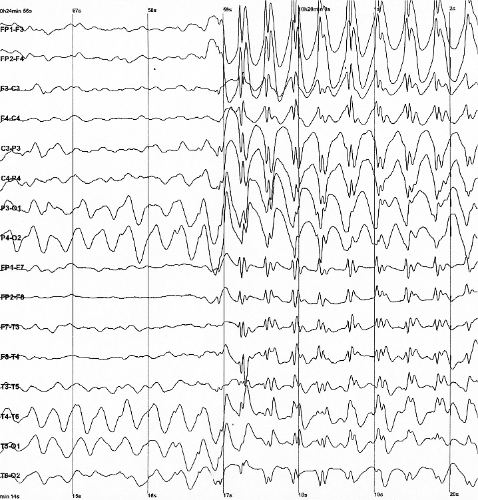
Doença genética rara, síndrome epiléptica infantil, caracterizada por crises focais mioclônicas de início neonatal até a infância, ocorrendo em vários membros de uma família, associadas em alguns com disartria leve, ataxia e deficiência intelectual limítrofe a moderada.
Introdução
O que você precisa saber de cara
Doença genética rara, síndrome epiléptica infantil, caracterizada por crises focais mioclônicas de início neonatal até a infância, ocorrendo em vários membros de uma família, associadas em alguns com disartria leve, ataxia e deficiência intelectual limítrofe a moderada.
Escala de raridade
<1/50kMuito rara
1/20kRara
1/10kPouco freq.
1/5kIncomum
1/2k
Encontrou um erro ou informação desatualizada? Sugira uma correção →
Entender a doença
Do básico ao detalhe, leia no seu ritmo
Preparando trilha educativa...
Sinais e sintomas
O que aparece no corpo e com que frequência cada sintoma acontece
Partes do corpo afetadas
+ 10 sintomas em outras categorias
Características mais comuns
Os sintomas variam de pessoa para pessoa. Abaixo estão as 33 características clínicas mais associadas, ordenadas por frequência.
Linha do tempo da pesquisa
Encontrou um erro ou informação desatualizada? Sugira uma correção →
Genética e causas
O que está alterado no DNA e como passa nas famílias
Genes associados
3 genes identificados com associação a esta condição. Padrão de herança: Autosomal recessive.
Positively regulates a late step in exocytosis of various cytoplasmic vesicles, such as synaptic vesicles and other secretory vesicles (PubMed:21785414). Organizes the SNAREs into a cross-linked zigzag topology that, when interposed between the vesicle and plasma membranes, is incompatible with fusion, thereby preventing SNAREs from releasing neurotransmitters until an action potential arrives at the synapse (PubMed:21785414). Also involved in glucose-induced secretion of insulin by pancreatic b
Cytoplasm, cytosolPerikaryonPresynapse
Developmental and epileptic encephalopathy 63
A form of epileptic encephalopathy, a heterogeneous group of severe early-onset epilepsies characterized by refractory seizures, neurodevelopmental impairment, and poor prognosis. Development is normal prior to seizure onset, after which cognitive and motor delays become apparent. DEE63 is an autosomal recessive disease with onset in infancy.
May act as a GTPase-activating protein for Rab family protein(s) (PubMed:20727515, PubMed:20797691). Involved in neuronal projections development, probably through a negative modulation of ARF6 function (PubMed:20727515). Involved in the regulation of synaptic vesicle trafficking (PubMed:31257402)
Cell membraneCytoplasmCytoplasmic vesicle membranePresynapse
Familial infantile myoclonic epilepsy
A subtype of idiopathic epilepsy starting in early infancy and manifesting as myoclonic seizures, febrile convulsions, and tonic-clonic seizures.
Pore-forming subunit of a voltage-gated sodium channel complex assuming opened or closed conformations in response to the voltage difference across membranes and through which sodium ions selectively pass along their electrochemical gradient (PubMed:24874546, PubMed:25239001, PubMed:25725044, PubMed:26900580, PubMed:29726066, PubMed:33245860, PubMed:36696443, PubMed:36823201). Contributes to neuronal excitability by regulating action potential threshold and propagation (PubMed:24874546, PubMed:2
Cell membraneCell projection, axonCytoplasmic vesicleCell projection, podosome
Cognitive impairment with or without cerebellar ataxia
A disorder characterized by markedly delayed cognitive and motor development, attention deficit disorder, and cerebellar ataxia. Features include bilateral esophoria, strabismatic amblyopia, unsustained gaze evoked nystagmus on horizontal gaze, ataxic gait, dysmetria in the upper limbs and dysarthria, with normal strength, tone, and reflexes.
Variantes genéticas (ClinVar)
1,216 variantes patogênicas registradas no ClinVar.
Classificação de variantes (ClinVar)
Distribuição de 211 variantes classificadas pelo ClinVar.
Vias biológicas (Reactome)
9 vias biológicas associadas aos genes desta condição.
Diagnóstico
Os sinais que médicos procuram e os exames que confirmam
Tratamento e manejo
Remédios, cuidados de apoio e o que precisa acompanhar
Onde tratar no SUS
Hospitais de referência no Brasil e o protocolo oficial do SUS (PCDT)
🇧🇷 Atendimento SUS — Epilepsia mioclônica familiar da infância
Selecione um estado ou use sua localização para ver resultados.
Dados de DATASUS/CNES, SBGM, ABNeuro e Ministério da Saúde. Sempre confirme a disponibilidade diretamente com o estabelecimento.
Pesquisa ativa
Ensaios clínicos abertos e novidades científicas recentes
Pesquisa e ensaios clínicos
Nenhum ensaio clínico registrado para esta condição.
Publicações mais relevantes
TBC1D24-related familial infantile multifocal myoclonus: Description of a new Chinese pedigree with a 20 year follow up.
Disorders associated with mutations in the Tre2/Bub2/Cdc16 (TBC)1 domain family member 24 gene (TBC1D24) present a wide range of phenotypes, ranging from mild to fatal seizure diseases, non-syndromic deafness, and complex syndromes such as deafness, onychodystrophy, osteodystrophy, and mental retardation(DOOR syndrome). In this study, we introduce three siblings of a previously unreported Chinese family with familial infantile myoclonic epilepsy caused by a homozygous TBC1D24 mutation. Genomic DNA was extracted from whole blood of the proband, his parents, and sisters. TBC1D24 exomes were sequenced by whole exome sequencing then analyzed by genetic analysis with Sanger sequencing validation. The patients were followed up for more than 20 years to summarize their clinical features. Genetic analysis identified a homozygous TBC1D24 mutation (c.241_252del12) in the proband and his sisters. Prediction models suggest that the mutation leads to an alteration in the properties and structure of the TBC1D24 protein, especially in the folding direction of the loop region, which is likely to decrease protein activity. The patients manifested with early-onset myoclonic epilepsy, were prone to status epilepticus, and seizures only occurred during wakefulness. Imaging characteristics included cerebellar atrophy and abnormal cerebellar signals. We report a pedigree case of infantile myoclonic epilepsy caused by a homozygous TBC1D24 mutation. Our long-term clinical follow-up not only enriches the clinical phenotype of the disease, but also provides a clinical experience for the early diagnosis and clinical treatment of the disease.
Alternating Hemiplegia and Epilepsia Partialis Continua: A new phenotype for a novel compound TBC1D24 mutation.
Mutations in the TBC1D24 gene (MIM 613577) cause familial infantile myoclonic epilepsy (FIME; 605021) and early infantile epileptic encephalopathy-16 (EIEE16; 615338), both inherited with an autosomal recessive trait. The TBC1D24 gene encodes a member of the TBC family domain proteins, involved in cell signaling and oxidative stress resistance. We studied, by a Next Generation Sequencing (NGS) target re-sequencing gene approach, the DNA of a 5 year-old girl, affected by recurrent attacks of Alternating Hemiplegia (AH) and by recurrent episodes of Epilepsia Partialis Continua (EPC). The NGS study showed the presence of two different heterozygous, probably pathogenic variants in the TBC1D24 gene, inherited in trans from her parents: the c.116C>T (p.Ala39Val) and the c.457G>A (p.Glu153Lys). This study describes for the first time the association between TBC1D24 variants and AH expanding the phenotypic spectrum of TBC1D24-related diseases and suggesting that TBC1D24 molecular analysis should be considered in the diagnostic work up of AH patients. An additional peculiar feature is the association of AH and EPC.
Homozygous TBC1D24 mutation in two siblings with familial infantile myoclonic epilepsy (FIME) and moderate intellectual disability.
Mutations in the TBC1D24 gene were first reported in an Italian family with a unique epileptic phenotype consisting of drug-responsive, early-onset idiopathic myoclonic seizures. Patients presented with isolated bilateral or focal myoclonia, which could evolve to long-lasting attacks without loss of consciousness, with a peculiar reflex component, and were associated with generalized tonic-clonic seizures. This entity was named "familial infantile myoclonic epilepsy" (FIME). More recently, TBC1D24 mutations have been shown to cause a variable range of disorders, including epilepsy of various seizure types and severity, non-syndromic deafness, and DOORS syndrome. We report on the electro-clinical features of two brothers, born to first-cousin parents, affected with infantile-onset myoclonic epilepsy. The peculiar epileptic presentation prompted us to perform direct sequencing of the TBC1D24 gene. The patients had very early onset of focal myoclonic fits with variable topography, lasting a few minutes to several hours, without loss of consciousness, which frequently evolved to generalized myoclonus or myoclonic status. Reflex myoclonia were noticed in one patient. Neurological outcome was marked by moderate intellectual disability. Despite the high frequency of seizures, repeated EEG recordings showed normal background rhythm and rare interictal spikes and waves. We found a homozygous missense mutation, c.457G>A/p.Glu153Lys, in the two affected brothers. This observation combined with recent data from the literature, suggest that mutations in TBCD24 cause a pathological continuum, with FIME at the "benign" end and severe drug-refractory epileptic encephalopathy on the severe end. Early-onset myoclonic epilepsy with focal and generalized myoclonic seizures is a common characteristic of this continuum.
Publicações recentes
TBC1D24-Related Disorders.
TBC1D24-related familial infantile multifocal myoclonus: Description of a new Chinese pedigree with a 20 year follow up.
Alternating Hemiplegia and Epilepsia Partialis Continua: A new phenotype for a novel compound TBC1D24 mutation.
Homozygous TBC1D24 mutation in two siblings with familial infantile myoclonic epilepsy (FIME) and moderate intellectual disability.
TBC1D24 mutation associated with focal epilepsy, cognitive impairment and a distinctive cerebro-cerebellar malformation.
📚 EuropePMC4 artigos no totalmostrando 3
TBC1D24-related familial infantile multifocal myoclonus: Description of a new Chinese pedigree with a 20 year follow up.
Epilepsy researchAlternating Hemiplegia and Epilepsia Partialis Continua: A new phenotype for a novel compound TBC1D24 mutation.
SeizureHomozygous TBC1D24 mutation in two siblings with familial infantile myoclonic epilepsy (FIME) and moderate intellectual disability.
Epilepsy researchAssociações
Organizações que acompanham esta doença — pra ter apoio e orientação
Ainda não temos associações cadastradas para Epilepsia mioclônica familiar da infância.
É de uma associação que acompanha esta doença? Fale com a gente →
Comunidades
Grupos ativos de quem convive com esta doença aqui no Raras
Ainda não existe comunidade no Raras para Epilepsia mioclônica familiar da infância
Pacientes, familiares e cuidadores se organizam em comunidades pra compartilhar experiências, fazer perguntas e se apoiar. Você pode ser o primeiro.
Tire suas dúvidas
Perguntas, dicas e experiências compartilhadas aqui na página
Participe da discussão
Faça login para postar dúvidas, compartilhar experiências e interagir com especialistas.
Fazer loginDoenças relacionadas
Doenças com sintomas parecidos — ajudam quem ainda está buscando diagnóstico
Referências e fontes
Bases de dados externas citadas neste artigo
Publicações científicas
Artigos indexados no PubMed ligados a esta doença no grafo RarasNet — título, periódico e PMID direto da fonte, sem intermediação de IA.
- TBC1D24-related familial infantile multifocal myoclonus: Description of a new Chinese pedigree with a 20 year follow up.
- Alternating Hemiplegia and Epilepsia Partialis Continua: A new phenotype for a novel compound TBC1D24 mutation.
- Homozygous TBC1D24 mutation in two siblings with familial infantile myoclonic epilepsy (FIME) and moderate intellectual disability.
- TBC1D24-Related Disorders.
- TBC1D24 mutation associated with focal epilepsy, cognitive impairment and a distinctive cerebro-cerebellar malformation.
Bases de dados e fontes oficiais
Identificadores e referências canônicas usadas para montar este verbete.
- ORPHA:352582(Orphanet)
- OMIM OMIM:605021(OMIM)
- MONDO:0011506(MONDO)
- Epilepsia(PCDT · Ministério da Saúde)
- GARD:17521(GARD (NIH))
- Variantes catalogadas(ClinVar)
- Busca completa no PubMed(PubMed)
- Q55783394(Wikidata)
Dados compilados pelo RarasNet a partir de fontes abertas (Orphanet, OMIM, MONDO, PubMed/EuropePMC, ClinicalTrials.gov, DATASUS, PCDT/MS). Este conteúdo é informativo e não substitui avaliação médica.
Conteúdo mantido por Agente Raras · Médicos e pesquisadores podem colaborar