
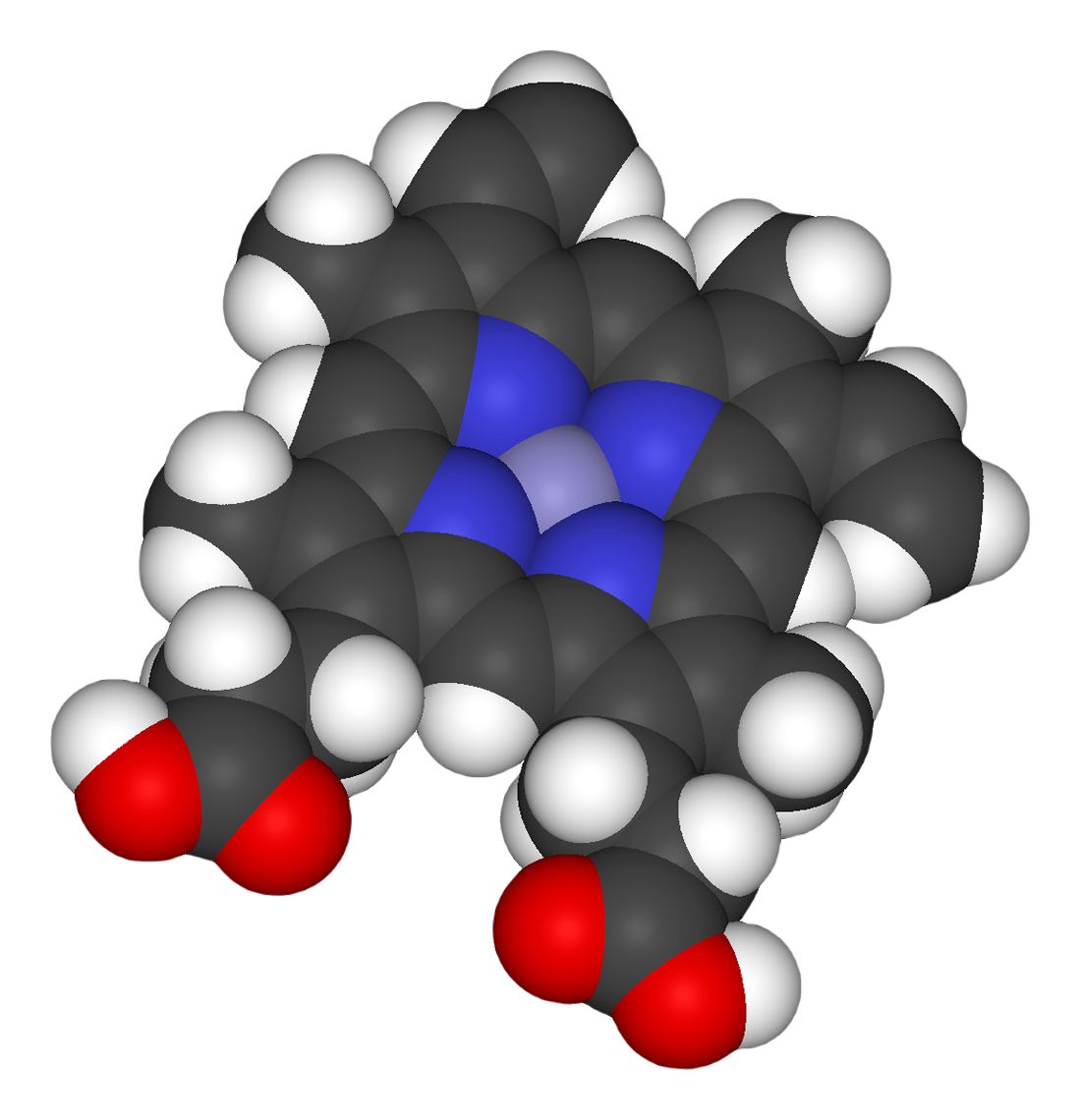
Heme, ou haem, é uma molécula em formato de anel que contém ferro e serve como ligante de várias proteínas, especialmente como um componente da hemoglobina, que transporta oxigênio na corrente sanguínea. É composto por quatro anéis pirrólicos com duas cadeias laterais de vinil e duas de ácido propiônico. O heme é biossintetizado tanto na medula óssea quanto no fígado.
Introdução
O que você precisa saber de cara
Visão geral
A deficiência de NAD(P)HX desidratase é uma doença genética rara, com prevalência estimada em menos de 1 caso por 1.000.000 de pessoas. Ela afeta o metabolismo de uma molécula chamada NAD(P)HX, essencial para a proteção das células contra danos. A condição geralmente se manifesta na infância ou na primeira infância e pode comprometer múltiplos sistemas do corpo, especialmente o sistema nervoso, o coração e a pele.[1][4]
Sinais e sintomas
Os sinais e sintomas da deficiência de NAD(P)HX desidratase são variados e podem incluir: atraso global do desenvolvimento, atraso no desenvolvimento da fala e da linguagem, perda da fala, ataxia da marcha, espasmos infantis, neurodegeneração, atrofia cerebral, morfologia anormal da substância branca cerebral, ventriculomegalia e edema cerebral. Também podem ocorrer problemas cardíacos como hipertrofia do ventrículo esquerdo, cardiomiopatia dilatada e taquicardia. Na pele, podem surgir bolhas anormais e eritema. Outros sintomas incluem deficiência auditiva neurossensorial bilateral, catarata, vômitos (inclusive episódicos), diarreia, sialorreia, irritabilidade, comportamento agressivo, pancitopenia e aumento da concentração circulante de lactato.[1][4]
Causas genéticas
A doença é causada por mutações no gene NAXD, que fornece instruções para a produção da enzima ATP-dependent (S)-NAD(P)H-hydrate dehydratase. Essa enzima é responsável por reparar formas danificadas das coenzimas NAD(P)H, protegendo as células do estresse metabólico. A herança é autossômica recessiva, o que significa que a pessoa precisa herdar uma cópia do gene alterado de cada um dos pais para desenvolver a condição.[1][2][5]
Diagnóstico
O diagnóstico é baseado na avaliação clínica dos sintomas e confirmado por testes genéticos que identificam mutações no gene NAXD. Atualmente, existem 4 testes genéticos disponíveis para essa condição, e 137 variantes patogênicas estão registradas no ClinVar. O diagnóstico diferencial inclui outras doenças metabólicas hereditárias que cursam com neurodegeneração e acidose láctica.[1][2][5]
Tratamento e manejo
Até o momento, não há medicamentos específicos aprovados para o tratamento da deficiência de NAD(P)HX desidratase. O manejo é sintomático e de suporte, envolvendo uma equipe multidisciplinar para abordar as diferentes manifestações da doença, como fisioterapia para ataxia, fonoaudiologia para atraso na fala, acompanhamento cardiológico para problemas cardíacos e suporte nutricional para vômitos e diarreia. Não há cobertura pelo Sistema Único de Saúde (SUS) para essa condição no Brasil.[1][2]
Prognóstico e qualidade de vida
O prognóstico é variável e depende da gravidade dos sintomas e da rapidez do suporte multidisciplinar. A neurodegeneração progressiva e as complicações cardíacas podem impactar significativamente a qualidade de vida e a sobrevida. O acompanhamento regular com especialistas é fundamental para otimizar o cuidado e oferecer suporte às famílias.[1][4]
Conteúdo informativo gerado e mantido automaticamente a partir de fontes oficiais (Orphanet, HPO, OMIM, SUS). Não substitui avaliação médica.
Heme, ou haem, é uma molécula em formato de anel que contém ferro e serve como ligante de várias proteínas, especialmente como um componente da hemoglobina, que transporta oxigênio na corrente sanguínea. É composto por quatro anéis pirrólicos com duas cadeias laterais de vinil e duas de ácido propiônico. O heme é biossintetizado tanto na medula óssea quanto no fígado.
Escala de raridade
<1/50kMuito rara
1/20kRara
1/10kPouco freq.
1/5kIncomum
1/2k
Encontrou um erro ou informação desatualizada? Sugira uma correção →
Entender a doença
Do básico ao detalhe, leia no seu ritmo
Preparando trilha educativa...
Sinais e sintomas
O que aparece no corpo e com que frequência cada sintoma acontece
Visão geral
A deficiência de NAD(P)HX desidratase é uma doença genética rara, com prevalência estimada em menos de 1 caso por 1.000.000 de pessoas. Ela afeta o metabolismo de uma molécula chamada NAD(P)HX, essencial para a proteção das células contra danos. A condição geralmente se manifesta na infância ou na primeira infância e pode comprometer múltiplos sistemas do corpo, especialmente o sistema nervoso, o coração e a pele.[1][4]
Sinais e sintomas
Os sinais e sintomas da deficiência de NAD(P)HX desidratase são variados e podem incluir: atraso global do desenvolvimento, atraso no desenvolvimento da fala e da linguagem, perda da fala, ataxia da marcha, espasmos infantis, neurodegeneração, atrofia cerebral, morfologia anormal da substância branca cerebral, ventriculomegalia e edema cerebral. Também podem ocorrer problemas cardíacos como hipertrofia do ventrículo esquerdo, cardiomiopatia dilatada e taquicardia. Na pele, podem surgir bolhas anormais e eritema. Outros sintomas incluem deficiência auditiva neurossensorial bilateral, catarata, vômitos (inclusive episódicos), diarreia, sialorreia, irritabilidade, comportamento agressivo, pancitopenia e aumento da concentração circulante de lactato.[1][4]
Causas genéticas
A doença é causada por mutações no gene NAXD, que fornece instruções para a produção da enzima ATP-dependent (S)-NAD(P)H-hydrate dehydratase. Essa enzima é responsável por reparar formas danificadas das coenzimas NAD(P)H, protegendo as células do estresse metabólico. A herança é autossômica recessiva, o que significa que a pessoa precisa herdar uma cópia do gene alterado de cada um dos pais para desenvolver a condição.[1][2][5]
Diagnóstico
O diagnóstico é baseado na avaliação clínica dos sintomas e confirmado por testes genéticos que identificam mutações no gene NAXD. Atualmente, existem 4 testes genéticos disponíveis para essa condição, e 137 variantes patogênicas estão registradas no ClinVar. O diagnóstico diferencial inclui outras doenças metabólicas hereditárias que cursam com neurodegeneração e acidose láctica.[1][2][5]
Tratamento e manejo
Até o momento, não há medicamentos específicos aprovados para o tratamento da deficiência de NAD(P)HX desidratase. O manejo é sintomático e de suporte, envolvendo uma equipe multidisciplinar para abordar as diferentes manifestações da doença, como fisioterapia para ataxia, fonoaudiologia para atraso na fala, acompanhamento cardiológico para problemas cardíacos e suporte nutricional para vômitos e diarreia. Não há cobertura pelo Sistema Único de Saúde (SUS) para essa condição no Brasil.[1][2]
Prognóstico e qualidade de vida
O prognóstico é variável e depende da gravidade dos sintomas e da rapidez do suporte multidisciplinar. A neurodegeneração progressiva e as complicações cardíacas podem impactar significativamente a qualidade de vida e a sobrevida. O acompanhamento regular com especialistas é fundamental para otimizar o cuidado e oferecer suporte às famílias.[1][4]
Conteúdo informativo gerado e mantido automaticamente a partir de fontes oficiais (Orphanet, HPO, OMIM, SUS). Não substitui avaliação médica.
Partes do corpo afetadas
+ 16 sintomas em outras categorias
Características mais comuns
Os sintomas variam de pessoa para pessoa. Abaixo estão as 46 características clínicas mais associadas, ordenadas por frequência.
Linha do tempo da pesquisa
Encontrou um erro ou informação desatualizada? Sugira uma correção →
Genética e causas
O que está alterado no DNA e como passa nas famílias
Genes associados
1 gene identificado com associação a esta condição. Padrão de herança: Autosomal recessive.
Curadoria gene-doença
fontes oficiaisCatalyzes the dehydration of the S-form of NAD(P)HX at the expense of ATP, which is converted to ADP. Together with NAD(P)HX epimerase, which catalyzes the epimerization of the S- and R-forms, the enzyme allows the repair of both epimers of NAD(P)HX, a damaged form of NAD(P)H that is a result of enzymatic or heat-dependent hydration
Mitochondrion
Encephalopathy, progressive, early-onset, with brain edema and/or leukoencephalopathy, 2
An autosomal recessive severe neurometabolic disorder characterized by severe leukoencephalopathy usually associated with a trivial febrile illness. Affected infants tend to show normal early development followed by acute psychomotor regression with ataxia, hypotonia, respiratory insufficiency, and seizures. Disease course is rapidly progressive, leading to coma, global brain atrophy, and death in the first years of life. Brain imaging shows multiple abnormalities, including brain edema and signal abnormalities in the cortical and subcortical regions.
Variantes genéticas (ClinVar)
137 variantes patogênicas registradas no ClinVar.
Classificação de variantes (ClinVar)
Distribuição de 28 variantes classificadas pelo ClinVar.
Diagnóstico
Os sinais que médicos procuram e os exames que confirmam
Tratamento e manejo
Remédios, cuidados de apoio e o que precisa acompanhar
Onde tratar no SUS
Hospitais de referência no Brasil e o protocolo oficial do SUS (PCDT)
🇧🇷 Atendimento SUS — Deficiência de NAD(P)HX desidratase
Selecione um estado ou use sua localização para ver resultados.
Dados de DATASUS/CNES, SBGM, ABNeuro e Ministério da Saúde. Sempre confirme a disponibilidade diretamente com o estabelecimento.
Pesquisa ativa
Ensaios clínicos abertos e novidades científicas recentes
Pesquisa e ensaios clínicos
Nenhum ensaio clínico registrado para esta condição.
Publicações mais relevantes
Unveiling Immune System Perturbations in Early Development Through Zebrafish Models of NADHX Repair Deficiency.
The vital cofactors NADH and NADPH are prone to hydration, forming hydroxylated redox-inactive derivatives (NADHX and NADPHX) in cells. These damaged metabolites are repaired by two highly conserved enzymes, an NAD(P)HX dehydratase (NAXD) and an NAD(P)HX epimerase (NAXE). Mutations in NAXE or NAXD cause early onset progressive encephalopathy (PEBEL1 or PEBEL2), typically induced by fever or other triggers, and leading to premature death. To advance our comprehension of the disease mechanism and investigate potential therapeutic strategies, we generated zebrafish lines deficient in naxe or naxd using CRISPR/Cas9 technology. While both models accumulated NADHX, only naxd-/- larvae developed a severe phenotype, showing reduced locomotion and early death, which was partially rescued by nicotinic acid supplementation. Both mutant lines displayed signs of dysregulated immune function based on gene expression analyses and increased neutral red staining in the head region, indicating an increased number or activation of microglial cells. Our findings suggest that immune system perturbations play a role in PEBEL disease development, aligning with its inflammatory trigger-induced nature in humans. The naxd-/- model's responsiveness to nicotinic acid underscores its utility for preclinical drug screening. Overall, these models will be instrumental in furthering our understanding of PEBEL disease mechanisms and enhancing translational research efforts.
Deficiency of the NAD(P)HX metabolic repair system: a treatable mitochondrial disease.
This study aims to explore the clinical characteristics of patients with NAD(P)HX metabolic deficiency and their prognosis after nicotinamide treatment. This study retrospectively analyzed the clinical characteristics, efficacy of nicotinamide treatment, and prognosis of patients with genetically confirmed NAD(P)HX metabolic defects admitted to Beijing Children’s Hospital from January 2016 to January 2025, as well as cases previously reported in the literature. The log-rank test was used for survival analysis, and the prognosis was evaluated using the Modified Rankin Scale (mRS). Nine patients were analyzed, including eight with NAXE deficiency and one with NAXD deficiency, seven of whom received nicotinamide treatment (180–500 mg/day). With a median follow-up of 3.92 years [range: 0.50–6 years, interquartile range (IQR) = 2.42 years], the overall prognosis was favourable. All seven treated patients survived, three of whom were able to attend school normally, and no significant adverse reactions were observed during treatment. Combined with previous studies, a total of 59 patients were included for analysis (14 cases of NAXD deficiency and 45 cases of NAXE deficiency), with an overall mortality rate of 66.7%. Among the 21 patients who received niacin/nicotinamide treatment, 17 survived (80.95%), whereas only two untreated patients survived, and 85.45% of the untreated patients died within 2 years of onset. Respiratory failure was the most common cause of death. NAD(P)HX metabolic defects are rare mitochondrial diseases with high mortality and morbidity rates. Early identification and timely initiation of nicotinamide treatment are crucial for improving patient prognosis and quality of life. The online version contains supplementary material available at 10.1186/s13023-026-04218-4.
Suppression of ATP-dependent (S)-NAD(P)H-hydrate dehydratase expression inhibits adipocyte differentiation of 3T3-L1 preadipocytes by increasing excessive accumulation of NADHX.
ATP-dependent (S)-NAD(P)H-hydrate dehydratase (NAXD) is a crucial enzyme in the nicotinamide adenine dinucleotide repair system that regenerates NAD(P)H, an essential electron donor in metabolic redox reactions. NAD+-related metabolic pathways connect cellular metabolism and the expression of genes responsible for adipogenesis; however, the biological significance of the NAXD-mediated repair pathway remains unclear. Herein, we showed that NAXD is essential for normal adipocyte differentiation of 3T3-L1 murine preadipocytes. Silencing of the Naxd gene attenuated differentiation-induced lipid accumulation with excessive accumulation of hydrated NADH (NADHX) without altering NAD+ levels. FK866, a specific inhibitor of NAMPT, further reduced lipid accumulation even in Naxd-silenced cells with substantial decrease in NAD+. Supplementation with nicotinamide mononucleotide, a precursor of NAD+, restored NAD+ levels comparably in Naxd- and LacZ-silenced cells treated with FK866, but failed to recover adipocyte differentiation of Naxd-silenced cells to the level of LacZ-silenced cells. In contrast, exposure of wild-type 3T3-L1 cells to NADHX recapitulated the Naxd deficiency-elicited inhibitory effects on adipocyte differentiation with reduced expression of master transcriptional regulators of adipogenesis, peroxisome proliferator-activated receptor γ and CCAAT/enhancer binding protein α. These results suggest that NAXD supports normal adipogenesis, in part, by inhibiting excessive accumulation of NADHX.
Establishment of an iPSC line (BCHNDi001-A) from a patient with nicotinamide nucleotide repair system deficiency caused by biallelic NAXD mutations.
NAD(P)HX dehydratase (NAXD) gene is one of the key enzymes encoding the nicotinamide nucleotide repair system, reportedly associated with Encephalopathy, progressive, early-onset, with brain edema and/or leukoencephalopathy, 2 (PEBEL2). Here, we generated an induced pluripotent stem cell (iPSC) line from the dermal fibroblasts (HDFs) of a PEBEL2 patient who carried biallelic mutations, c.101_102delTA(p.Thr35Phefs*63) and c.318C > G (p.Ile160Met) in NAXD. These iPSCs showed stable amplification in vitro, expressed pluripotent markers, and differentiated spontaneously into three germ layers, as well as NAXD mutations with normal karyotype.
Progressive encephalopathy after routine 4-month immunizations in a patient with NAXD genetic variant.
Metabolic pathways are known to generate byproducts-some of which have no clear metabolic function and some of which are toxic. Nicotinamide adenine dinucleotide phosphate hydrate (NAD(P)HX) is a toxic metabolite that is produced by stressors such as a fever, infection, or physical stress. Nicotinamide adenine dinucleotide phosphate hydrate dehydratase (NAXD) and nicotinamide adenine dinucleotide phosphate hydrate epimerase (NAXE) are part of the nicotinamide repair system that function to break down this toxic metabolite. Deficiency of NAXD and NAXE interrupts the critical intracellular repair of NAD(P)HX and allows for its accumulation. Clinically, deficiency of NAXE manifests as progressive, early onset encephalopathy with brain edema and/or leukoencephalopathy (PEBEL) 1, while deficiency of NAXD manifests as PEBEL2. In this report, we describe a case of probable PEBEL2 in a patient with a variant of unknown significance (c.362C>T, p.121L) in the NAXD gene who presented after routine immunizations with significant skin findings and in the absence of fevers.
Publicações recentes
Vitamin B2 and B3 nutrigenomics reveals a therapy for NAXD disease.
Unveiling Immune System Perturbations in Early Development Through Zebrafish Models of NADHX Repair Deficiency.
Deficiency of the NAD(P)HX metabolic repair system: a treatable mitochondrial disease.
Suppression of ATP-dependent (S)-NAD(P)H-hydrate dehydratase expression inhibits adipocyte differentiation of 3T3-L1 preadipocytes by increasing excessive accumulation of NADHX.
Metabolic cardiomyopathy associated with a compound heterozygous variant in NAD(P)HX dehydratase: a case report and literature review.
📚 EuropePMCmostrando 14
Unveiling Immune System Perturbations in Early Development Through Zebrafish Models of NADHX Repair Deficiency.
Journal of inherited metabolic diseaseDeficiency of the NAD(P)HX metabolic repair system: a treatable mitochondrial disease.
Orphanet journal of rare diseasesSuppression of ATP-dependent (S)-NAD(P)H-hydrate dehydratase expression inhibits adipocyte differentiation of 3T3-L1 preadipocytes by increasing excessive accumulation of NADHX.
Journal of biochemistryEstablishment of an iPSC line (BCHNDi001-A) from a patient with nicotinamide nucleotide repair system deficiency caused by biallelic NAXD mutations.
Stem cell researchProgressive encephalopathy after routine 4-month immunizations in a patient with NAXD genetic variant.
American journal of medical genetics. Part ASevere NAD(P)HX Dehydratase (NAXD) Neurometabolic Syndrome May Present in Adulthood after Mild Head Trauma.
International journal of molecular sciencesA Case with NAD(P)HX Dehydratase (NAXD) Deficiency: A Newly Defined Mutation in a Novel Neurodegenerative Disorder.
Molecular syndromologyClinical and biochemical distinctions for a metabolite repair disorder caused by NAXD or NAXE deficiency.
Journal of inherited metabolic diseaseNAXE deficiency: A neurometabolic disorder of NAD(P)HX repair amenable for metabolic correction.
Molecular genetics and metabolismNAD(P)HX dehydratase (NAXD) deficiency due to a novel biallelic missense variant and review of literature.
European journal of medical geneticsCutaneous manifestations of NAXD deficiency - A case report.
Annals of medicine and surgery (2012)NAD(P)HX dehydratase (NAXD) deficiency: a novel neurodegenerative disorder exacerbated by febrile illnesses.
Brain : a journal of neurologyNAD(P)HX repair deficiency causes central metabolic perturbations in yeast and human cells.
The FEBS journalEvidence that the metabolite repair enzyme NAD(P)HX epimerase has a moonlighting function.
Bioscience reportsAssociações
Organizações que acompanham esta doença — pra ter apoio e orientação
Ainda não temos associações cadastradas para Deficiência de NAD(P)HX desidratase.
É de uma associação que acompanha esta doença? Fale com a gente →
Comunidades
Grupos ativos de quem convive com esta doença aqui no Raras
Ainda não existe comunidade no Raras para Deficiência de NAD(P)HX desidratase
Pacientes, familiares e cuidadores se organizam em comunidades pra compartilhar experiências, fazer perguntas e se apoiar. Você pode ser o primeiro.
Tire suas dúvidas
Perguntas, dicas e experiências compartilhadas aqui na página
Participe da discussão
Faça login para postar dúvidas, compartilhar experiências e interagir com especialistas.
Fazer loginDoenças relacionadas
Doenças com sintomas parecidos — ajudam quem ainda está buscando diagnóstico
Referências e fontes
Bases de dados externas citadas neste artigo
Publicações científicas
Artigos indexados no PubMed ligados a esta doença no grafo RarasNet — título, periódico e PMID direto da fonte, sem intermediação de IA.
- Unveiling Immune System Perturbations in Early Development Through Zebrafish Models of NADHX Repair Deficiency.
- Deficiency of the NAD(P)HX metabolic repair system: a treatable mitochondrial disease.
- Suppression of ATP-dependent (S)-NAD(P)H-hydrate dehydratase expression inhibits adipocyte differentiation of 3T3-L1 preadipocytes by increasing excessive accumulation of NADHX.
- Establishment of an iPSC line (BCHNDi001-A) from a patient with nicotinamide nucleotide repair system deficiency caused by biallelic NAXD mutations.
- Progressive encephalopathy after routine 4-month immunizations in a patient with NAXD genetic variant.
- Vitamin B2 and B3 nutrigenomics reveals a therapy for NAXD disease.
- Metabolic cardiomyopathy associated with a compound heterozygous variant in NAD(P)HX dehydratase: a case report and literature review.
Bases de dados e fontes oficiais
Identificadores e referências canônicas usadas para montar este verbete.
- ORPHA:555402(Orphanet)
- OMIM OMIM:618321(OMIM)
- MONDO:0034121(MONDO)
- GARD:17990(GARD (NIH))
- Variantes catalogadas(ClinVar)
- Busca completa no PubMed(PubMed)
Dados compilados pelo RarasNet a partir de fontes abertas (Orphanet, OMIM, MONDO, PubMed/EuropePMC, ClinicalTrials.gov, DATASUS, PCDT/MS). Este conteúdo é informativo e não substitui avaliação médica.
Conteúdo mantido por Agente Raras · Médicos e pesquisadores podem colaborar
Deficiência de NAD(P)HX desidratase
📋 Origem dos dados
Esta página agrega dados de fontes públicas e oficiais. Dados sobre cobertura no SUS (PCDT, CEAF) são verificados ativamente por agente proativo (ver badge no infobox). Demais dados têm atribuição de fonte + data da última sincronização — clique para abrir o original.
- Doença rara (ontologia)
- fonte: Orphanet
- Identificador unificado
- fonte: MONDO
- Genética mendeliana
- fonte: OMIM
- Codificação WHO/SUS
- fonte: WHO ICD-10 / DATASUS
- NIH/GARD
- fonte: GARD (NIH)