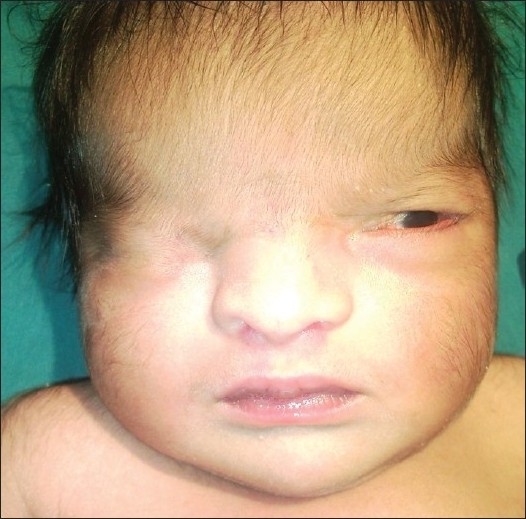
É uma condição presente desde o nascimento em que uma camada contínua de pele cobre os olhos. Não há pálpebras e nem a abertura que normalmente existe entre elas.
Introdução
O que você precisa saber de cara
A criptoftalmia é uma malformação congênita rara em que a criança nasce com a pele cobrindo os olhos de maneira contínua, sem pálpebras visíveis. Além do quadro ocular, o bebê pode apresentar anomalias em outros órgãos, como alterações renais, respiratórias ou dedos unidos por pele. A condição está ligada a alterações em genes do desenvolvimento, como FRAS1, FREM2 e GRIP1. Não existe medicamento específico aprovado, e a doença não consta na lista oficial de PCDT de doenças raras do Ministério da Saúde. O suporte e o manejo clínico são organizados pelos serviços de alta complexidade do SUS.
É uma condição presente desde o nascimento em que uma camada contínua de pele cobre os olhos. Não há pálpebras e nem a abertura que normalmente existe entre elas.
Encontrou um erro ou informação desatualizada? Sugira uma correção →
Entender a doença
Do básico ao detalhe, leia no seu ritmo
Preparando trilha educativa...
Sinais e sintomas
O que aparece no corpo e com que frequência cada sintoma acontece
Partes do corpo afetadas
+ 46 sintomas em outras categorias
Características mais comuns
Os sintomas variam de pessoa para pessoa. Abaixo estão as 129 características clínicas mais associadas, ordenadas por frequência.
Linha do tempo da pesquisa
Encontrou um erro ou informação desatualizada? Sugira uma correção →
Genética e causas
O que está alterado no DNA e como passa nas famílias
Genes associados
3 genes identificados com associação a esta condição.
Fraser syndrome 3
A form of Fraser syndrome, an autosomal recessive disorder characterized by cryptophthalmos, cutaneous syndactyly, and urogenital abnormalities including renal agenesis or hypoplasia. Additional features include abnormalities of the larynx, ear malformations, and facial abnormalities.
Fraser syndrome 2
A form of Fraser syndrome, an autosomal recessive disorder characterized by cryptophthalmos, cutaneous syndactyly, and urogenital abnormalities including renal agenesis or hypoplasia. Additional features include abnormalities of the larynx, ear malformations, and facial abnormalities.
Fraser syndrome 1
A form of Fraser syndrome, an autosomal recessive disorder characterized by cryptophthalmos, cutaneous syndactyly, and urogenital abnormalities including renal agenesis or hypoplasia. Additional features include abnormalities of the larynx, ear malformations, and facial abnormalities.
Variantes genéticas (ClinVar)
798 variantes patogênicas registradas no ClinVar.
Classificação de variantes (ClinVar)
Distribuição de 539 variantes classificadas pelo ClinVar.
Vias biológicas (Reactome)
1 via biológica associada aos genes desta condição.
Diagnóstico
Os sinais que médicos procuram e os exames que confirmam
Tratamento e manejo
Remédios, cuidados de apoio e o que precisa acompanhar
Onde tratar no SUS
Hospitais de referência no Brasil e o protocolo oficial do SUS (PCDT)
🇧🇷 Atendimento SUS — Criptoftalmia
Selecione um estado ou use sua localização para ver resultados.
Dados de DATASUS/CNES, SBGM, ABNeuro e Ministério da Saúde. Sempre confirme a disponibilidade diretamente com o estabelecimento.
Pesquisa ativa
Ensaios clínicos abertos e novidades científicas recentes
Pesquisa e ensaios clínicos
Nenhum ensaio clínico registrado para esta condição.
Publicações mais relevantes
Cryptophthalmia, microphthalmia, oronasal malformation, and hydrocephalus in an aborted equine fetus with umbilical torsion in the state of Mato Grosso, Brazil.
Facial abnormalities and brain defects in aborted equine fetuses are rarely reported, and the causes that predispose the occurrence of this condition are difficult to identify. This work reports the morphological and tomographic findings of a case of cryptophthalmia, microphthalmia, oronasal malformation, and hydrocephalus in an aborted equine fetus with umbilical cord torsion in the state of Mato Grosso, Brazil, from a primiparous Quarter Horse female, with 7 months of gestational age. The occurrence of miscarriage was associated with compromised maternal-fetal blood flow due to umbilical cord torsion concomitant with fetal malformation. The congenital defects described in this report occurred sporadically, and it was not possible to determine the cause. The concurrent presentation of congenital malformations and umbilical torsion in equine fetuses is exceptionally rare, and this report includes the first description of the use of computer tomography for the characterization of fetal congenital malformation.
The first adolescent case of Fraser syndrome 3, with a novel nonsense variant in GRIP1.
Fraser syndrome is characterized by cryptophthalmos, syndactyly and other autopod defects, and abnormalities of the respiratory and urogenital tracts. Biallelic variants in GRIP1 can cause Fraser syndrome 3 (FRASRS3), and five unrelated FRASRS3 cases have been reported to date. Four cases are fetuses with homozygous truncating variants. The remaining case is an almost 9-year-old Turkish girl compound heterozygous for a truncation variant and a possibly frame-shift intragenic deletion. We present a 15.5-year old Pakistani boy with homozygous truncating variant c.1774C>T (p.Gln592Ter). Of the hallmarks of the disease, the boy has cryptophthalmia, midface retrusion, very low anterior hairline, hair growth on temples extending to the supraorbital line and also on alae nasi, agenesis of right kidney, and cutaneous syndactyly of fingers and toes but no symptoms in any other organs, including lungs, anorectal system, genitalia, and umbilical system. This case is the oldest known individual with FRASRS3, and our findings show that a homozygous GRIP1 truncating variant can manifest with a non-lethal phenotype than in the reported cases with such variants, expanding the phenotypic and mutational spectrum of GRIP1.
Molecular phylogenetics reveals convergent evolution in lower Congo River spiny eels.
The lower Congo River (LCR) is a region of exceptional species diversity and endemism in the Congo basin, including numerous species of spiny eels (genus Mastacembelus). Four of these exhibit distinctive phenotypes characterized by greatly reduced optic globes deeply embedded into the head (cryptophthalmia) and reduced (or absent) melanin pigmentation, among other characteristics. A strikingly similar cryptophthalmic phenotype is also found in members of a number of unrelated fish families, strongly suggesting the possibility of convergent evolution. However, little is known about the evolutionary processes that shaped diversification in LCR Mastacembelus, their biogeographic origins, or when colonization of the LCR occurred. We sequenced mitochondrial and nuclear genes from Mastacembelus species collected in the lower Congo River, and compared them with other African species and Asian representatives as outgroups. We analyzed the sequence data using Maximum Likelihood and Bayesian phylogenetic inference. Bayesian and Maximum Likelihood phylogenetic analyses, and Bayesian coalescent methods for species tree reconstruction, reveal that endemic LCR spiny eels derive from two independent origins, clearly demonstrating convergent evolution of the cryptophthalmic phenotype. Mastacembelus crassus, M. aviceps, and M. simbi form a clade, allied to species found in southern, eastern and central Africa. Unexpectedly, M. brichardi and brachyrhinus fall within a clade otherwise endemic to Lake Tanganikya (LT) ca. 1500 km east of the LCR. Divergence dating suggests the ages of these two clades of LCR endemics differ markedly. The age of the crassus group is estimated at ~4 Myr while colonization of the LCR by the brichardi-brachyrhinus progenitor was considerably more recent, dated at ~0.5 Myr. The phylogenetic framework of spiny eels presented here, the first to include LCR species, demonstrates that cryptophthalmia and associated traits evolved at least twice in Mastacembelus: once in M. brichardi and at least once in the M. crassus clade. Timing of diversification is broadly consistent with the onset of modern high-energy flow conditions in the LCR and with previous studies of endemic cichlids. The close genetic relationship between M. brichardi and M. brachyrhinus is particularly notable given the extreme difference in phenotype between these species, and additional work is needed to better understand the evolutionary history of diversification in this clade. The findings presented here demonstrate strong, multi-trait convergence in LCR spiny eels, suggesting that extreme selective pressures have shaped numerous phenotypic attributes of the endemic species of this region.
Publicações recentes
Cryptophthalmia, microphthalmia, oronasal malformation, and hydrocephalus in an aborted equine fetus with umbilical torsion in the state of Mato Grosso, Brazil.
The first adolescent case of Fraser syndrome 3, with a novel nonsense variant in GRIP1.
Molecular phylogenetics reveals convergent evolution in lower Congo River spiny eels.
[Fraser syndrome: case report].
A case of bilateral cryptophthalmia and euryblepharon with two-stage reconstruction.
📚 EuropePMC13 artigos no totalmostrando 3
Cryptophthalmia, microphthalmia, oronasal malformation, and hydrocephalus in an aborted equine fetus with umbilical torsion in the state of Mato Grosso, Brazil.
Veterinary research communicationsThe first adolescent case of Fraser syndrome 3, with a novel nonsense variant in GRIP1.
American journal of medical genetics. Part AMolecular phylogenetics reveals convergent evolution in lower Congo River spiny eels.
BMC evolutionary biologyAssociações
Organizações que acompanham esta doença — pra ter apoio e orientação
Ainda não temos associações cadastradas para Criptoftalmia.
É de uma associação que acompanha esta doença? Fale com a gente →
Doença com base genética
Um médico geneticista pode ajudar no diagnóstico de Criptoftalmia e no aconselhamento genético da família.
Doenças relacionadas
Doenças com sintomas parecidos — ajudam quem ainda está buscando diagnóstico
Perguntas frequentes
O que as famílias mais perguntam sobre esta doença — cada resposta com a fonte de onde saiu
É uma alteração presente ao nascer caracterizada por uma camada contínua de pele cobrindo os olhos. Não se observam pálpebras normais nem a fenda habitual entre elas.
Referências
Fontes citadas no texto, publicações do grafo e bases de dados usadas neste verbete
5 publicações do grafo RarasNet (PubMed) · 6 bases de dados. Títulos, periódicos e PMIDs vêm direto da fonte, sem intermediação de IA.
Dados compilados pelo RarasNet a partir de fontes abertas (Orphanet, OMIM, MONDO, PubMed/EuropePMC, ClinicalTrials.gov, DATASUS, PCDT/MS). Este conteúdo é informativo e não substitui avaliação médica.
Citar este verbete
Raras. (s.d.). Criptoftalmia. Em Raras — Enciclopédia de Doenças Raras do Brasil. https://raras.org/doenca/criptoftalmia
Formato APA. Conteúdo sob CC BY 4.0 — reuso livre com atribuição.
Conteúdo mantido por Agente Raras · Médicos e pesquisadores podem colaborar
Criptoftalmia
📋 Origem dos dados
Esta página agrega dados de fontes públicas e oficiais. Dados sobre cobertura no SUS (PCDT, CEAF) são verificados ativamente por agente proativo (ver badge no infobox). Demais dados têm atribuição de fonte + data da última sincronização — clique para abrir o original.
- Doença rara (ontologia)
- fonte: Orphanet
- Identificador unificado
- fonte: MONDO
- Codificação WHO/SUS
- fonte: WHO ICD-10 / DATASUS
- CID-11 (futuro)
- fonte: WHO ICD-11
- NIH/GARD
- fonte: GARD (NIH)
- Dado público estruturado
- fonte: Wikidata

