Doença genética rara associada a mutações no gene MYH11, predispondo à dissecção da aorta e outras anomalias vasculares. Caracteriza-se por alto risco de dissecção em múltiplos segmentos da aorta, necrose cística da média e outras manifestações cardiovasculares.
Introdução
O que você precisa saber de cara
Visão geral
A dissecção da aorta familiar (conhecida em inglês como familial aortic dissection) é uma condição vascular com código CID-10 I71.0, catalogada sob os registros MONDO:0024559 e OMIM:607086. A prevalência exata na população geral é desconhecida e as manifestações clínicas podem ter início em todas as idades.[1][2]
Sinais e sintomas
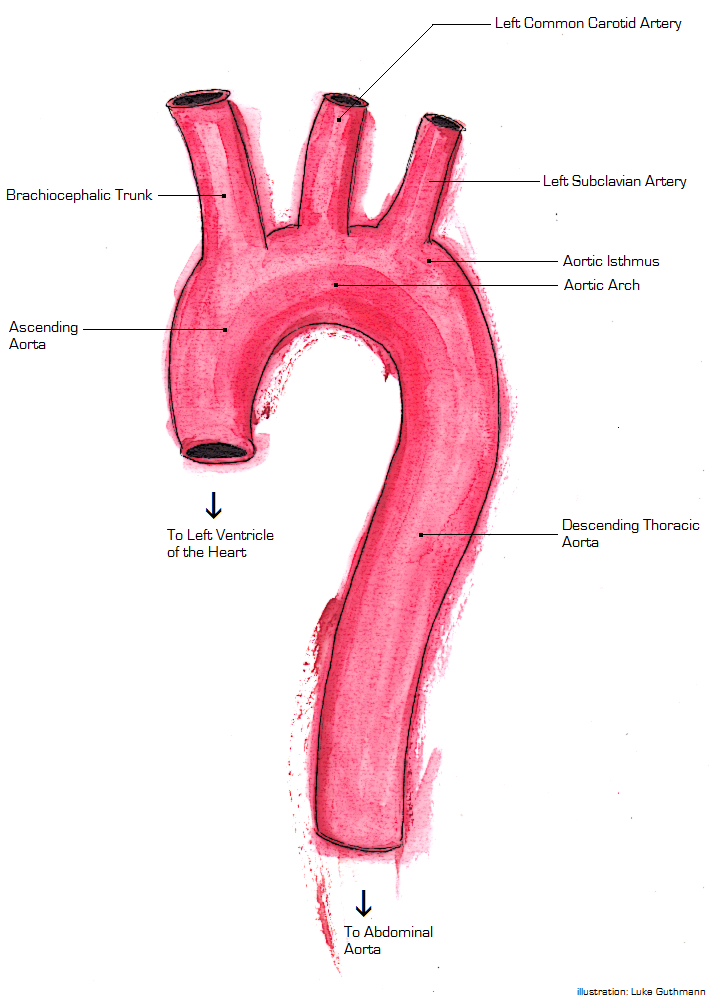
O quadro clínico envolve primordialmente alterações cardiovasculares e aórticas graves. Entre as manifestações observadas estão dissecção da aorta, dissecção da aorta ascendente, dissecção da aorta descendente, aneurisma da raiz da aorta e aneurisma da aorta torácica descendente. Podem ocorrer sintomas como dor torácica, dispneia de esforço e dispneia paroxística.[1][2]
Outras manifestações descritas compreendem regurgitação aórtica, necrose cística da média da aorta, persistência do canal arterial, cardiomegalia, função ventricular esquerda anormal e aterosclerose da artéria coronária. Também são relatadas alterações vasculares sistêmicas e cerebrais, como estenose arterial periférica, dilatação da artéria carótida, dilatação da artéria cerebral, acidente vascular cerebral e cutis marmorata.[1][2]
Causas genéticas
Diagnóstico
Tratamento e manejo
Atualmente, a condição está classificada com o nível 'Sem cobertura SUS'. Não constam procedimentos SUS específicos cadastrados, medicamentos aprovados formalmente, terapias de reposicionamento ou medicamentos dispensados pelo SUS para esta patologia, tampouco relatórios ou decisões avaliadas pela CONITEC até o momento. Há 1 ensaio clínico ativo registrado.[1][3][5]
Tratamentos citados na literatura
Fármacos identificados em estudos científicos via mineração de dados biomédicos compreendem: Steroids (3 publicações), Midazolam (2 publicações), Sevoflurane (2 publicações), Warfarin (2 publicações), Fluorodeoxyglucose F18 (1 publicação), Iodine 125 (1 publicação), Atorvastatin (1 publicação), Fentanyl (1 publicação), Glutaral (1 publicação) e Heparin (1 publicação). Ressalta-se que estas menções representam exclusivamente associações em artigos científicos e não constituem recomendação, prescrição ou indicação de tratamento clínico.[5]
Conteúdo informativo gerado e mantido automaticamente a partir de fontes oficiais (Orphanet, HPO, OMIM, SUS). Não substitui avaliação médica.
A dissecção da aorta familiar é uma alteração genética rara que fragiliza a principal artéria do corpo humano. Essa fragilidade pode gerar dilatações, conhecidas como aneurismas, ou rupturas nas paredes da aorta que causam dor no peito e falta de ar. Mutações no gene MYH11 estão entre as causas identificadas da doença em diferentes famílias. No Brasil, a enfermidade não consta na lista oficial de Protocolos Clínicos e Diretrizes Terapêuticas (PCDT) de doenças raras do Ministério da Saúde. O cuidado e o rastreamento dos membros da família devem ser conduzidos por serviços de referência em cardiologia do SUS.
Doença genética rara associada a mutações no gene MYH11, predispondo à dissecção da aorta e outras anomalias vasculares. Caracteriza-se por alto risco de dissecção em múltiplos segmentos da aorta, necrose cística da média e outras manifestações cardiovasculares.
Escala de raridade
<1/50kMuito rara
1/20kRara
1/10kPouco freq.
1/5kIncomum
1/2k
Encontrou um erro ou informação desatualizada? Sugira uma correção →
Entender a doença
Do básico ao detalhe, leia no seu ritmo
Preparando trilha educativa...
Sinais e sintomas
O que aparece no corpo e com que frequência cada sintoma acontece
Partes do corpo afetadas
+ 7 sintomas em outras categorias
Características mais comuns
Os sintomas variam de pessoa para pessoa. Abaixo estão as 19 características clínicas mais associadas, ordenadas por frequência.
Linha do tempo da pesquisa
Encontrou um erro ou informação desatualizada? Sugira uma correção →
Genética e causas
O que está alterado no DNA e como passa nas famílias
Genes associados
1 gene identificado com associação a esta condição.
Variantes genéticas (ClinVar)
849 variantes patogênicas registradas no ClinVar.
Vias biológicas (Reactome)
8 vias biológicas associadas aos genes desta condição.
Diagnóstico
Os sinais que médicos procuram e os exames que confirmam
Tratamento e manejo
Remédios, cuidados de apoio e o que precisa acompanhar
Onde tratar no SUS
Hospitais de referência no Brasil e o protocolo oficial do SUS (PCDT)
🇧🇷 Atendimento SUS — Dissecção da aorta familiar
Selecione um estado ou use sua localização para ver resultados.
Dados de DATASUS/CNES, SBGM, ABNeuro e Ministério da Saúde. Sempre confirme a disponibilidade diretamente com o estabelecimento.
Pesquisa ativa
Ensaios clínicos abertos e novidades científicas recentes
Ensaios em destaque
Com ensaio aberto em 1 país. O ponto verde marca onde há vaga agora.
Pesquisa e ensaios clínicos
3 ensaios clínicos encontrados, 1 ativos.
Publicações mais relevantes
Fibrillin-1 G234D mutation in the hybrid1 domain causes tight skin associated with dysregulated elastogenesis and increased collagen cross-linking in mice.
Fibrillin-1, an extracellular matrix (ECM) protein encoded by the FBN1 gene, serves as a microfibril scaffold crucial for elastic fiber formation and homeostasis in pliable tissue such as the skin. Aside from causing Marfan syndrome, some mutations in FBN1 result in scleroderma, marked by hardened and thicker skin which limits joint mobility. Here, we describe a tight skin phenotype in the Fbn1G234D/G234D mice carrying a corresponding variant of FBN1 in the hybrid1 domain that was identified in a patient with familial aortic dissection. Unlike scleroderma, skin thickness and collagen fiber abundance do not change in the Fbn1G234D/G234D mutant skin. Instead, increased collagen cross-links were observed. In addition, short elastic fibers were sparsely located underneath the panniculus muscle layer, and an abundance of thin, aberrant elastic fibers was increased within the subcutaneous fascia, which may have tightened skin attachment to the underlying skeletal muscle. Structurally, Fbn1G234D/G234D microfibrils have a disrupted shoulder region that shares similarities with hybrid1 deletion mutant microfibrils. We then demonstrate the consequence of fibrillin-1 G234D mutation on dermal fibroblast functions. Mutant primary fibroblasts produce fewer elastic fibers, exhibit slower migration and increased cell stiffness. Moreover, secretome from mutant fibroblasts are marked by enhanced secretion of ECM, ECM-modifying enzymes, proteoglycans and cytokines, which are pro-tissue repair/fibrogenic. The transcriptome of mutant fibroblasts displays an increased expression of myogenic developmental and immune-related genes. Our study proposes that imbalanced ECM homeostasis due to a fibrillin-1 G234D mutation impacts fibroblast properties with potential ramifications on skin function.
Symptomatic familial primary iris cysts at the pupillary margin in three consecutive generations: A case series.
Iris cysts are uncommon lesions, most of them are iris pigment epithelial (IPE) cysts which typically manifest in adults as unilateral single cysts, are typically asymptomatic and rarely require treatment. The most frequent location of IPE cysts is the iris periphery and the iridociliary sulcus, whereas pupillary cysts are rare. This observational case series aims to describe a unique occurrence of bilateral pupillary IPE cysts in three consecutive generations of a single family. The series describes eight patients of a single family with no consanguineous marriage. All patients have IPE cysts with remarkable abnormally-shaped pupils. The patients were examined at the slit-lamp and imaged with anterior segment optical coherence tomography. Three brothers (14, 19 and 28 years old) were symptomatic and suffered from hemeralopia and reduced visual acuity. ND-YAG laser was successful in relieving the symptoms in the two younger brothers. No recurrence or refill of the cysts occurred after laser application and no intra- or ppostoperative complications were observed during a 9-month follow-up. The older family members showed spontaneously shrunken IPE cysts. IPE cysts are considered idiopathic with an unclear origin. The rare familial incidence of the cysts suggests an autosomal dominant heredity pattern. Many theories were proposed to explain the origin of cysts and none is conclusive. Their principal clinical significance is their similarity to pigmented iris tumors, but they might also cause visual symptoms. Treatment modalities vary from less invasive chemical compounds and ND: YAG laser application to more invasive surgical procedures with disparate efficacy and safety. In the case of multiple cysts, examination of other family members is worthy even when asymptomatic and cardiac consultation of affected patients is warranted as IPE cysts may proclaim a coexisting cardiovascular abnormality, such as familial aortic dissection.
Familial Thoracic Aortic Dissection.
This case report details familial aortic dissection in 2 second-degree blood relatives who experienced sudden aortic dissections. One patient underwent emergency computed tomography angiography (CTA) and the other underwent magnetic resonance angiography (MRA). These imaging examinations were instrumental in revealing each patient's condition. One patient died of dissection rupture while being prepped for surgery. The other patient underwent surgery, recovered, and undergoes continual monitoring for the condition. A positive family history of aortic dissection should be considered in patients presenting with aortic emergencies. Many genes can contribute to this condition, with most genes relating to smooth muscle and connective tissue disorders. Imaging studies for evaluating and monitoring aortic dissection include transesophageal echocardiography, CTA, and MRA. Surgical treatment is possible for aortic dissection, with the goals being to stabilize the dissection and reduce the possibility of rupture. The mortality rate for aortic dissection is high, with the main cause of death being dissection rupture. Lifelong monitoring of survivors and first-degree relatives is recommended.
Descending threshold for ascending aortic aneurysmectomy: Is it time for a "left-shift" in guidelines?
Current guidelines on the management of thoracic aortic disease recommend that the ascending aorta be replaced when it reaches the size of 5.5 cm. Recently emerging data suggest that this criterion may need to be shifted to the left, signifying a recommendation to operate on patients with smaller aortic sizes. The data that support the need for a leftward shift in the guidelines include (1) novel and more granular data on the natural history of ascending aortic aneurysm between 5 and 6 cm showing that 2 hinge risk points exist-one at 5.25 cm, and the other at 5.75 cm; (2) aortic diameter before the moment of aortic dissection is at least 7 mm smaller than postdissection aortic size; (3) the advent of a semiautomated centerline method of imaging assessment seems to underestimate true ascending aortic size; (4) aortic surgery in the present era is very safe and its benefits outweigh the associated risks; (5) genetic testing via high-throughput next-generation sequencing identifies genetic defects responsible for aortic catastrophes at smaller aortic sizes; and (6) familial aortic dissection occurrence suggests that family members of an aortic dissection victim who harbor a sizable aneurysm should be operated on regardless of aortic size.
Familial Aortic Dissection in a Young Adult Caused by MYH11 Gene Mutation.
Publicações recentes
Fibrillin-1 G234D mutation in the hybrid1 domain causes tight skin associated with dysregulated elastogenesis and increased collagen cross-linking in mice.
Symptomatic familial primary iris cysts at the pupillary margin in three consecutive generations: A case series.
Familial Thoracic Aortic Dissection.
Familial Aortic Dissection in a Young Adult Caused by MYH11 Gene Mutation.
Descending threshold for ascending aortic aneurysmectomy: Is it time for a "left-shift" in guidelines?
📚 EuropePMC10 artigos no totalmostrando 6
Fibrillin-1 G234D mutation in the hybrid1 domain causes tight skin associated with dysregulated elastogenesis and increased collagen cross-linking in mice.
Matrix biology : journal of the International Society for Matrix BiologySymptomatic familial primary iris cysts at the pupillary margin in three consecutive generations: A case series.
American journal of ophthalmology case reportsFamilial Thoracic Aortic Dissection.
Radiologic technologyFamilial Aortic Dissection in a Young Adult Caused by MYH11 Gene Mutation.
The Annals of thoracic surgeryDescending threshold for ascending aortic aneurysmectomy: Is it time for a "left-shift" in guidelines?
The Journal of thoracic and cardiovascular surgeryAortic Disease Presentation and Outcome Associated With ACTA2 Mutations.
Circulation. Cardiovascular geneticsAssociações
Organizações que acompanham esta doença — pra ter apoio e orientação
Ainda não temos associações cadastradas para Dissecção da aorta familiar.
É de uma associação que acompanha esta doença? Fale com a gente →
Doença com base genética
Um médico geneticista pode ajudar no diagnóstico de Dissecção da aorta familiar e no aconselhamento genético da família.
Doenças relacionadas
Doenças com sintomas parecidos — ajudam quem ainda está buscando diagnóstico
Perguntas frequentes
O que as famílias mais perguntam sobre esta doença — cada resposta com a fonte de onde saiu
A condição decorre de alterações genéticas, com destaque para mutações no gene MYH11. Esse gene produz a proteína Myosin-11, fundamental para manter a força e a elasticidade das paredes aórticas.
Referências
Fontes citadas no texto, publicações do grafo e bases de dados usadas neste verbete
6 fontes citadas no texto · 5 publicações do grafo RarasNet (PubMed) · 5 bases de dados. Títulos, periódicos e PMIDs vêm direto da fonte, sem intermediação de IA.
Dados compilados pelo RarasNet a partir de fontes abertas (Orphanet, OMIM, MONDO, PubMed/EuropePMC, ClinicalTrials.gov, DATASUS, PCDT/MS). Este conteúdo é informativo e não substitui avaliação médica.
Citar este verbete
Raras. (2026). Dissecção da aorta familiar. Em Raras — Enciclopédia de Doenças Raras do Brasil. https://raras.org/doenca/disseccao-da-aorta-familiar
Formato APA. Conteúdo sob CC BY 4.0 — reuso livre com atribuição.
Conteúdo mantido por Agente Raras · Médicos e pesquisadores podem colaborar
Dissecção da aorta familiar
📋 Origem dos dados
Esta página agrega dados de fontes públicas e oficiais. Dados sobre cobertura no SUS (PCDT, CEAF) são verificados ativamente por agente proativo (ver badge no infobox). Demais dados têm atribuição de fonte + data da última sincronização — clique para abrir o original.
- Doença rara (ontologia)
- fonte: Orphanet
- Identificador unificado
- fonte: MONDO
- Genética mendeliana
- fonte: OMIM
- Codificação WHO/SUS
- fonte: WHO ICD-10 / DATASUS
- CID-11 (futuro)
- fonte: WHO ICD-11
- NIH/GARD
- fonte: GARD (NIH)
- Indexação biomédica
- fonte: MeSH (NLM)
- Dado público estruturado
- fonte: Wikidata
- Ensaios clínicos
- fonte: ClinicalTrials.gov

