
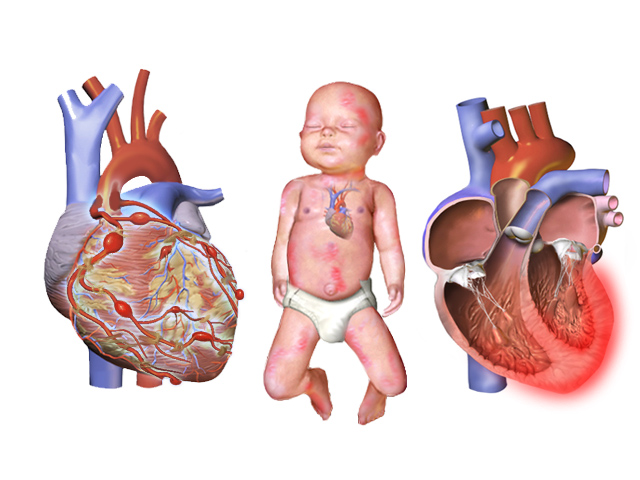
A síndrome coração-mão tipo 3 é uma síndrome coração-mão muito rara, descrita até o momento em três membros de uma família espanhola, que se caracteriza por um defeito de condução cardíaca (seio doente, bloqueio de ramo) e braquidactilia, semelhante à braquidactilia tipo C das mãos, afetando principalmente as falanges médias em conjunto com um ossículo extra na falange proximal de ambos os dedos indicadores. As anormalidades nos pés são mais sutis.
Introdução
O que você precisa saber de cara
A síndrome coração-mão tipo 3 é uma síndrome coração-mão muito rara, descrita até o momento em três membros de uma família espanhola, que se caracteriza por um defeito de condução cardíaca (seio doente, bloqueio de ramo) e braquidactilia, semelhante à braquidactilia tipo C das mãos, afetando principalmente as falanges médias em conjunto com um ossículo extra na falange proximal de ambos os dedos indicadores. As anormalidades nos pés são mais sutis.
Escala de raridade
<1/50kMuito rara
1/20kRara
1/10kPouco freq.
1/5kIncomum
1/2k
Encontrou um erro ou informação desatualizada? Sugira uma correção →
Entender a doença
Do básico ao detalhe, leia no seu ritmo
Preparando trilha educativa...
Sinais e sintomas
O que aparece no corpo e com que frequência cada sintoma acontece
Partes do corpo afetadas
+ 2 sintomas em outras categorias
Características mais comuns
Os sintomas variam de pessoa para pessoa. Abaixo estão as 6 características clínicas mais associadas, ordenadas por frequência.
Linha do tempo da pesquisa
Encontrou um erro ou informação desatualizada? Sugira uma correção →
Genética e causas
O que está alterado no DNA e como passa nas famílias
Nenhum gene associado encontrado
Os dados genéticos desta condição ainda estão sendo catalogados.
Diagnóstico
Os sinais que médicos procuram e os exames que confirmam
Tratamento e manejo
Remédios, cuidados de apoio e o que precisa acompanhar
Onde tratar no SUS
Hospitais de referência no Brasil e o protocolo oficial do SUS (PCDT)
🇧🇷 Atendimento SUS — Síndrome coração-mão tipo 3
Selecione um estado ou use sua localização para ver resultados.
Dados de DATASUS/CNES, SBGM, ABNeuro e Ministério da Saúde. Sempre confirme a disponibilidade diretamente com o estabelecimento.
Pesquisa ativa
Ensaios clínicos abertos e novidades científicas recentes
Pesquisa e ensaios clínicos
Nenhum ensaio clínico registrado para esta condição.
Publicações mais relevantes
Elucidating the roles of SOD3 correlated genes and reactive oxygen species in rare human diseases using a bioinformatic-ontology approach.
Superoxide Dismutase 3 (SOD3) scavenges extracellular superoxide giving a hydrogen peroxide metabolite. Both Reactive Oxygen Species diffuse through aquaporins causing oxidative stress and biomolecular damage. SOD3 is differentially expressed in cancer and this research utilises Gene Expression Omnibus data series GSE2109 with 2,158 cancer samples. Genome-wide expression correlation analysis was conducted with SOD3 as the seed gene. Categorical SOD3 Pearson Correlation gene lists incrementing in correlation strength by 0.01 from ρ≥|0.34| to ρ≥|0.41| were extracted from the data. Positively and negatively SOD3 correlated genes were separated for each list and checked for significance against disease overlapping genes in the ClinVar and Orphanet databases via Enrichr. Disease causal genes were added to the relevant gene list and checked against Gene Ontology, Phenotype Ontology, and Elsevier Pathways via Enrichr before the significant ontologies containing causal and non-overlapping genes were reviewed with a literature search for possible disease and oxidative stress associations. 12 significant individually discriminated disorders were identified: Autosomal Dominant Cutis Laxa (p = 6.05x10⁻⁷), Renal Tubular Dysgenesis of Genetic Origin (p = 6.05x10⁻⁷), Lethal Arteriopathy Syndrome due to Fibulin-4 Deficiency (p = 6.54x10⁻⁹), EMILIN-1-related Connective Tissue Disease (p = 6.54x10⁻⁹), Holt-Oram Syndrome (p = 7.72x10⁻¹⁰), Multisystemic Smooth Muscle Dysfunction Syndrome (p = 9.95x10⁻¹⁵), Distal Hereditary Motor Neuropathy type 2 (p = 4.48x10⁻⁷), Congenital Glaucoma (p = 5.24x210-9), Megacystis-Microcolon-Intestinal Hypoperistalsis Syndrome (p = 3.77x10⁻¹⁶), Classical-like Ehlers-Danlos Syndrome type 1 (p = 3.77x10⁻¹⁶), Retinoblastoma (p = 1.9x10⁻⁸), and Lynch Syndrome (p = 5.04x10⁻⁹). 35 novel (21 unique) genes across 12 disorders were identified: ADNP, AOC3, CDC42EP2, CHTOP, CNN1, DES, FOXF1, FXR1, HLTF, KCNMB1, MTF2, MYH11, PLN, PNPLA2, REST, SGCA, SORBS1, SYNPO2, TAGLN, WAPL, and ZMYM4. These genes are proffered as potential biomarkers or therapeutic targets for the corresponding rare diseases discussed.
Familial atrial myopathy in a large multigenerational heart-hand syndrome pedigree carrying an LMNA missense variant in rod 2B domain (p.R335W).
The literature on laminopathy with ventricular phenotype is extensive. However, the pathogenicity of LMNA variations in atrial lesions still lacks research. The purpose of this study was to characterize the atrial phenotypes and possible mechanisms in a large Chinese family with heart-hand syndrome carrying a LMNA missense variant in rod 2B domain (c.1003C>T p.R335W). Clinical characteristics were collected on the basis of the pedigree investigation. Comprehensive functional analyses, including molecular dynamic (MD) simulation, cellular, and animal functional assays, determined the pathogenicity in atrial myopathy. In the pedigree investigation, 6 of 13 of the mutation carriers showed heterogeneous cardiac phenotypes and 8 carriers also had brachydactyly. In silico molecular dynamics simulations predicted increased binding energy of the R335W mutant lamin A. Atrial cardiomyocytes (HL-1, human induced pluripotent stem cell-derived atrial cardiomyocytes) expressing R335W showed abnormal nuclear morphology, compromised DNA repair, and dysfunctional contraction. Adult zebrafish expressing mutant lamin A showed increased P wave duration in the electrocardiogram, decreased peak A wave velocity in echocardiography, and atrial lesions under the transmission electron microscope. LMNA p.R335W mutation leads to familial heart-hand syndrome characterized by an overlapping phenotype of prominent atrial lesions and brachydactyly. The unstable lamin dimerization and impaired DNA repair are possible mechanisms underlying cardiac phenotypes. Our findings consolidated the genetic role in the course of atrial arrhythmias and cardiac aging, which is helpful in the diagnosis and treatment of cardiac laminopathy.
Atrial myopathy: A primary substrate for atrial fibrillation.
Transcriptional regulation of human T-box 5 gene (TBX5) by bone- and cardiac-related transcription factors.
T-box 5 (TBX5) protein belongs to the T-box family whose members play a crucial role in cell-type specification, morphogenesis and organogenesis. TBX5 is a transcription factor important for cardiac development and upper limbs formation and its haploinsufficiency causes Holt-Oram syndrome (HOS). An increase in TBX5 dosage also leads to HOS, suggesting that TBX5 is a dose-sensitive transcription factor that needs to be tightly regulated but the molecular mechanisms involved remain unclear. In this work we report the cloning and functional analysis of human TBX5 promoter region 1 (upstream of exon 1) and promoter region 2 (upstream of exon 2), that probably regulate the transcription of the different transcript variants. In silico analysis showed several binding sites for cardiac and skeletal related transcription factors (TFs) and their functionality was assessed using promoter-luciferase constructions and TF-expressing vectors. MEF2A (Myocyte enhancer factor 2 A) was shown to positively regulate both TBX5 promoters, while EGR1 (early growth response 1) repressed both promoters. SOX9 (SRY (sex determining region Y)-box 9) repressed only the activity of promoter region 2. Interestingly, YY1 (Yin and yang 1) repressed promoter region 1 (that regulates the expression of variant 1 and 3), but activated promoter region 2 (that regulates the expression of variant 4). In conclusion, this work provides novel insights toward the better understanding of TBX5 transcriptional regulation by cardiac- and skeletal-related TFs.
Modeling human point mutation diseases in Xenopus tropicalis with a modified CRISPR/Cas9 system.
Precise single-base editing in Xenopus tropicalis would greatly expand the utility of this true diploid frog for modeling human genetic diseases caused by point mutations. Here, we report the efficient conversion of C-to-T or G-to-A in X. tropicalis using the rat apolipoprotein B mRNA editing enzyme catalytic subunit 1-XTEN-clustered regularly interspaced short palindromic repeat-associated protein 9 (Cas9) nickase-uracil DNA glycosylase inhibitor-nuclear localization sequence base editor [base editor 3 (BE3)]. Coinjection of guide RNA and the Cas9 mutant complex mRNA into 1-cell stage X. tropicalis embryos caused precise C-to-T or G-to-A substitution in 14 out of 19 tested sites with efficiencies of 5-75%, which allowed for easy establishment of stable lines. Targeting the conserved T-box 5 R237 and Tyr C28 residues in X. tropicalis with the BE3 system mimicked human Holt-Oram syndrome and oculocutaneous albinism type 1A, respectively. Our data indicate that BE3 is an easy and efficient tool for precise base editing in X. tropicalis.-Shi, Z., Xin, H., Tian, D., Lian, J., Wang, J., Liu, G., Ran, R., Shi, S., Zhang, Z., Shi, Y., Deng, Y., Hou, C., Chen, Y. Modeling human point mutation diseases in Xenopus tropicalis with a modified CRISPR/Cas9 system.
Publicações recentes
Unusual metastatic patterns of urologic malignancies: a case series and literature review.
🥇 Ensaio randomizadoHolt-Oram Syndrome With Atrial Septal Defect.
Lateral thinking in syndromic congenital cardiovascular disease.
📚 EuropePMC29 artigos no totalmostrando 10
Elucidating the roles of SOD3 correlated genes and reactive oxygen species in rare human diseases using a bioinformatic-ontology approach.
PloS oneAtrial myopathy: A primary substrate for atrial fibrillation.
Heart rhythmFamilial atrial myopathy in a large multigenerational heart-hand syndrome pedigree carrying an LMNA missense variant in rod 2B domain (p.R335W).
Heart rhythmTranscriptional regulation of human T-box 5 gene (TBX5) by bone- and cardiac-related transcription factors.
GeneAtrial septal defect type II and upper limb malformation in 40-year-old male as a manifestation of Holt-Oram syndrome.
Cardiology journalModeling human point mutation diseases in Xenopus tropicalis with a modified CRISPR/Cas9 system.
FASEB journal : official publication of the Federation of American Societies for Experimental BiologyFetal akinesia deformation sequence, arthrogryposis multiplex congenita, and bilateral clubfeet: Is motor assessment of additional value for in utero diagnosis? A 10-year cohort study.
Prenatal diagnosisHeart-hand syndrome IV: a second family with LMNA-related cardiomyopathy and brachydactyly.
Clinical geneticsExome sequencing identifies a c.148-1G>C mutation of TBX5 in a Holt-Oram family with unusual genotype-phenotype correlations.
Cellular physiology and biochemistry : international journal of experimental cellular physiology, biochemistry, and pharmacologyDefining Features of the Upper Extremity in Holt-Oram Syndrome.
The Journal of hand surgeryAssociações
Organizações que acompanham esta doença — pra ter apoio e orientação
Ainda não temos associações cadastradas para Síndrome coração-mão tipo 3.
É de uma associação que acompanha esta doença? Fale com a gente →
Comunidades
Grupos ativos de quem convive com esta doença aqui no Raras
Ainda não existe comunidade no Raras para Síndrome coração-mão tipo 3
Pacientes, familiares e cuidadores se organizam em comunidades pra compartilhar experiências, fazer perguntas e se apoiar. Você pode ser o primeiro.
Tire suas dúvidas
Perguntas, dicas e experiências compartilhadas aqui na página
Participe da discussão
Faça login para postar dúvidas, compartilhar experiências e interagir com especialistas.
Fazer loginDoenças relacionadas
Doenças com sintomas parecidos — ajudam quem ainda está buscando diagnóstico
Referências e fontes
Bases de dados externas citadas neste artigo
Publicações científicas
Artigos indexados no PubMed ligados a esta doença no grafo RarasNet — título, periódico e PMID direto da fonte, sem intermediação de IA.
- Elucidating the roles of SOD3 correlated genes and reactive oxygen species in rare human diseases using a bioinformatic-ontology approach.
- Familial atrial myopathy in a large multigenerational heart-hand syndrome pedigree carrying an LMNA missense variant in rod 2B domain (p.R335W).
- Atrial myopathy: A primary substrate for atrial fibrillation.
- Transcriptional regulation of human T-box 5 gene (TBX5) by bone- and cardiac-related transcription factors.
- Modeling human point mutation diseases in Xenopus tropicalis with a modified CRISPR/Cas9 system.FASEB journal : official publication of the Federation of American Societies for Experimental Biology· 2019· PMID 30844313mais citado
- Unusual metastatic patterns of urologic malignancies: a case series and literature review.
- Holt-Oram Syndrome.
- Holt-Oram Syndrome With Atrial Septal Defect.
- Holt-Oram Syndrome.
- Lateral thinking in syndromic congenital cardiovascular disease.
Bases de dados e fontes oficiais
Identificadores e referências canônicas usadas para montar este verbete.
- ORPHA:1342(Orphanet)
- OMIM OMIM:140450(OMIM)
- MONDO:0007702(MONDO)
- GARD:2614(GARD (NIH))
- Busca completa no PubMed(PubMed)
- Q55780854(Wikidata)
Dados compilados pelo RarasNet a partir de fontes abertas (Orphanet, OMIM, MONDO, PubMed/EuropePMC, ClinicalTrials.gov, DATASUS, PCDT/MS). Este conteúdo é informativo e não substitui avaliação médica.
Conteúdo mantido por Agente Raras · Médicos e pesquisadores podem colaborar
Síndrome coração-mão tipo 3
📋 Origem dos dados
Esta página agrega dados de fontes públicas e oficiais. Dados sobre cobertura no SUS (PCDT, CEAF) são verificados ativamente por agente proativo (ver badge no infobox). Demais dados têm atribuição de fonte + data da última sincronização — clique para abrir o original.
- Doença rara (ontologia)
- fonte: Orphanet
- Identificador unificado
- fonte: MONDO
- Genética mendeliana
- fonte: OMIM
- Codificação WHO/SUS
- fonte: WHO ICD-10 / DATASUS
- CID-11 (futuro)
- fonte: WHO ICD-11
- NIH/GARD
- fonte: GARD (NIH)
- Indexação biomédica
- fonte: MeSH (NLM)
- Dado público estruturado
- fonte: Wikidata