
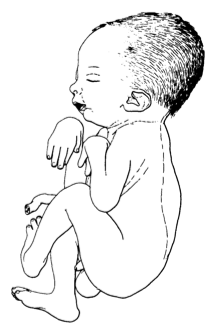
A síndrome da contratura congênita letal tipo 1 é uma síndrome de artrogripose genética rara, caracterizada por acinesia fetal total (detectável desde a 13ª semana de gestação) acompanhada de hidropisia, micrognatia, hipoplasia pulmonar, pterígio e múltiplas contraturas articulares (geralmente contraturas em flexão nos cotovelos e extensão nos joelhos), levando invariavelmente ao óbito antes da 32ª semana de gestação. A falta de motoneurônios do corno anterior, atrofia grave da medula espinhal ventral e hipoplasia muscular esquelética grave são achados neuropatológicos característicos, sem evidência de anomalias estruturais de outros órgãos.
Introdução
O que você precisa saber de cara
A síndrome da contratura congênita letal tipo 1 é uma síndrome de artrogripose genética rara, caracterizada por acinesia fetal total (detectável desde a 13ª semana de gestação) acompanhada de hidropisia, micrognatia, hipoplasia pulmonar, pterígio e múltiplas contraturas articulares (geralmente contraturas em flexão nos cotovelos e extensão nos joelhos), levando invariavelmente ao óbito antes da 32ª semana de gestação. A falta de motoneurônios do corno anterior, atrofia grave da medula espinhal ventral e hipoplasia muscular esquelética grave são achados neuropatológicos característicos, sem evidência de anomalias estruturais de outros órgãos.
Escala de raridade
<1/50kMuito rara
1/20kRara
1/10kPouco freq.
1/5kIncomum
1/2k
Encontrou um erro ou informação desatualizada? Sugira uma correção →
Entender a doença
Do básico ao detalhe, leia no seu ritmo
Preparando trilha educativa...
Sinais e sintomas
O que aparece no corpo e com que frequência cada sintoma acontece
Partes do corpo afetadas
+ 10 sintomas em outras categorias
Características mais comuns
Os sintomas variam de pessoa para pessoa. Abaixo estão as 27 características clínicas mais associadas, ordenadas por frequência.
Linha do tempo da pesquisa
Encontrou um erro ou informação desatualizada? Sugira uma correção →
Genética e causas
O que está alterado no DNA e como passa nas famílias
Genes associados
1 gene identificado com associação a esta condição. Padrão de herança: Autosomal recessive.
Curadoria gene-doença
fontes oficiaisRequired for the export of mRNAs containing poly(A) tails from the nucleus into the cytoplasm. May be involved in the terminal step of the mRNA transport through the nuclear pore complex (NPC)
NucleusCytoplasmNucleus, nuclear pore complex
Lethal congenital contracture syndrome 1
A form of lethal congenital contracture syndrome, an autosomal recessive disorder characterized by degeneration of anterior horn neurons, extreme skeletal muscle atrophy, and congenital non-progressive joint contractures (arthrogryposis). The contractures can involve the upper or lower limbs and/or the vertebral column, leading to various degrees of flexion or extension limitations evident at birth. LCCS1 patients manifest early fetal hydrops and akinesia, micrognathia, pulmonary hypoplasia, pterygia, and multiple joint contractures. It leads to prenatal death.
Variantes genéticas (ClinVar)
204 variantes patogênicas registradas no ClinVar.
Classificação de variantes (ClinVar)
Distribuição de 219 variantes classificadas pelo ClinVar.
Vias biológicas (Reactome)
1 via biológica associada aos genes desta condição.
Diagnóstico
Os sinais que médicos procuram e os exames que confirmam
Tratamento e manejo
Remédios, cuidados de apoio e o que precisa acompanhar
Onde tratar no SUS
Hospitais de referência no Brasil e o protocolo oficial do SUS (PCDT)
🇧🇷 Atendimento SUS — Síndrome de contraturas congênitas letais tipo 1
Centros de Referência SUS
24 centros habilitados pelo SUS para Síndrome de contraturas congênitas letais tipo 1
Centros para Síndrome de contraturas congênitas letais tipo 1
Detalhes dos centros
Hospital Universitário Prof. Edgard Santos (HUPES)
R. Dr. Augusto Viana, s/n - Canela, Salvador - BA, 40110-060 · CNES 0003808
Serviço de Referência
Hospital Infantil Albert Sabin
R. Tertuliano Sales, 544 - Vila União, Fortaleza - CE, 60410-794 · CNES 2407876
Serviço de Referência
Hospital de Apoio de Brasília (HAB)
AENW 3 Lote A Setor Noroeste - Plano Piloto, Brasília - DF, 70684-831 · CNES 0010456
Serviço de Referência
Hospital Estadual Infantil e Maternidade Alzir Bernardino Alves (HIABA)
Av. Min. Salgado Filho, 918 - Soteco, Vila Velha - ES, 29106-010 · CNES 6631207
Serviço de Referência
Hospital das Clínicas da UFG
Rua 235 QD. 68 Lote Área, Nº 285, s/nº - Setor Leste Universitário, Goiânia - GO, 74605-050 · CNES 2338424
Serviço de Referência
Hospital Universitário da UFJF
R. Catulo Breviglieri, Bairro - s/n - Santa Catarina, Juiz de Fora - MG, 36036-110 · CNES 2297442
Atenção Especializada
Hospital das Clínicas da UFMG
Av. Prof. Alfredo Balena, 110 - Santa Efigênia, Belo Horizonte - MG, 30130-100 · CNES 2280167
Serviço de Referência
Hospital Universitário Julio Müller (HUJM)
R. Luis Philippe Pereira Leite, s/n - Alvorada, Cuiabá - MT, 78048-902 · CNES 2726092
Atenção Especializada
Hospital Universitário João de Barros Barreto
R. dos Mundurucus, 4487 - Guamá, Belém - PA, 66073-000 · CNES 2337878
Serviço de Referência
Hospital Universitário Lauro Wanderley (HULW)
R. Tabeliao Estanislau Eloy, 585 - Castelo Branco, João Pessoa - PB, 58050-585 · CNES 0002470
Atenção Especializada
Instituto de Medicina Integral Prof. Fernando Figueira (IMIP)
R. dos Coelhos, 300 - Boa Vista, Recife - PE, 50070-902 · CNES 0000647
Serviço de Referência
Hospital Pequeno Príncipe
R. Des. Motta, 1070 - Água Verde, Curitiba - PR, 80250-060 · CNES 3143805
Serviço de Referência
Hospital Universitário Regional de Maringá (HUM)
Av. Mandacaru, 1590 - Parque das Laranjeiras, Maringá - PR, 87083-240 · CNES 2216108
Atenção Especializada
Hospital de Clínicas da UFPR
R. Gen. Carneiro, 181 - Alto da Glória, Curitiba - PR, 80060-900 · CNES 2364980
Serviço de Referência
Hospital Universitário Pedro Ernesto (HUPE-UERJ)
Blvd. 28 de Setembro, 77 - Vila Isabel, Rio de Janeiro - RJ, 20551-030 · CNES 2280221
Serviço de Referência
Instituto Nacional de Saúde da Mulher, da Criança e do Adolescente Fernandes Figueira (IFF/Fiocruz)
Av. Rui Barbosa, 716 - Flamengo, Rio de Janeiro - RJ, 22250-020 · CNES 2269988
Serviço de Referência
Hospital São Lucas da PUCRS
Av. Ipiranga, 6690 - Jardim Botânico, Porto Alegre - RS, 90610-000 · CNES 2232928
Serviço de Referência
Hospital de Clínicas de Porto Alegre (HCPA)
Rua Ramiro Barcelos, 2350 Bloco A - Av. Protásio Alves, 211 - Bloco B e C - Santa Cecília, Porto Alegre - RS, 90035-903 · CNES 2237601
Serviço de Referência
Hospital Universitário da UFSC (HU-UFSC)
R. Profa. Maria Flora Pausewang - Trindade, Florianópolis - SC, 88036-800 · CNES 2560356
Serviço de Referência
Hospital das Clínicas da FMUSP
R. Dr. Ovídio Pires de Campos, 225 - Cerqueira César, São Paulo - SP, 05403-010 · CNES 2077485
Serviço de Referência
Hospital de Base de São José do Rio Preto
Av. Brg. Faria Lima, 5544 - Vila Sao Jose, São José do Rio Preto - SP, 15090-000 · CNES 2079798
Atenção Especializada
Hospital de Clínicas da UNICAMP
R. Vital Brasil, 251 - Cidade Universitária, Campinas - SP, 13083-888 · CNES 2748223
Serviço de Referência
Hospital de Clínicas de Ribeirão Preto (HCRP-USP)
R. Ten. Catão Roxo, 3900 - Vila Monte Alegre, Ribeirão Preto - SP, 14015-010 · CNES 2082187
Serviço de Referência
UNIFESP / Hospital São Paulo
R. Napoleão de Barros, 715 - Vila Clementino, São Paulo - SP, 04024-002 · CNES 2688689
Serviço de Referência
Dados de DATASUS/CNES, SBGM, ABNeuro e Ministério da Saúde. Sempre confirme a disponibilidade diretamente com o estabelecimento.
Pesquisa ativa
Ensaios clínicos abertos e novidades científicas recentes
Ensaios em destaque
🟢 Recrutando agora
1 pesquisa recrutando participantes. Converse com seu médico sobre a possibilidade de participar.
Outros ensaios clínicos
0 ensaios clínicos encontrados.
Publicações mais relevantes
Mostrando amostra de 9 publicações de um total de 30
In vivo modeling of lethal congenital contracture syndrome 1 suggests pathomechanisms in cellular stress responses.
The mRNA export factor GLE1 protein plays critical yet enigmatic functions in RNA processing and has been linked with multiple developmental disorders, including lethal congenital contracture syndrome 1 (LCCS1). Using in vivo genetic engineering to study disturbed GLE1 functions under physiological conditions, we demonstrate that total inactivation of GLE1 results in disorganization of the blastocyst inner cell mass and early embryonic lethality due to defects in lineage specification. In contrast, the knock-in mice genocopying the LCCS1-associated GLE1FinMajor variant (Gle1PFQ/PFQ) survive the prenatal period but die suddenly at midadulthood. Gle1PFQ/PFQ mice present an irregular count and distribution of spinal motor neurons as well as impaired development of neural crest-derived tissues, as demonstrated by defects in the sympathetic innervation of heart ventricles, irregularities in the paravertebral sympathetic ganglia volume, and decreased adrenal chromaffin cell counts. Unlike previously reported for yeast and HeLa cells, analysis of the molecular consequences of the GLE1FinMajor variant identified normal poly(A) + RNA distribution in Gle1PFQ/PFQ cells; however, cells were impaired in RNA and protein synthesis and simultaneously showed severely disturbed formation of G3BP stress granule assembly factor 1 (G3BP1)-positive stress granules. Intriguingly, stressed Gle1PFQ/PFQ cells show microRNA profiles indicative of impaired transcription, protein metabolism, nervous system development, and axon guidance, further corroborating our functional findings. Our results show the necessity of functional GLE1 for life and indicate that LCCS1 etiology is a result of the pathogenic GLE1FinMajor variant impinging differentiation of neural crest derivatives and leading to complex multiorgan defects.
Falling through the cracks: Failing to identify compromised Miranda abilities for defendants with limited cognitive capacities.
Custodial suspects must be informed of their Miranda rights (Miranda v. Arizona, 1966) prior to police questioning. Since this landmark decision, scholars have rigorously studied Miranda comprehension and reasoning among vulnerable groups including those with intellectual disabilities (ID). However, the focus on ID has left arrestees with limited cognitive capacities (i.e., LCCs with IQs between 70 and 85) entirely overlooked. The current dataset addressed this oversight using a large (N = 820) sample of pretrial defendants who had completed the Standardized Assessment of Miranda Abilities (SAMA). Traditional (i.e., ID and no-ID) criterion groups were first analyzed with the standard error of measurement (SEM) removed. Second, a nuanced three-group framework included defendants with LCCs. Results indicate that LCC defendants are vulnerable to impaired Miranda comprehension (i.e., limited recall of the Miranda warning and deficits in Miranda-related vocabulary knowledge). Not surprisingly, their waiver decisions were often impaired by crucial misconceptions (e.g., seeing the investigating officers as beneficently on their side). The practical implications of these findings were underscored with respect to Constitutional safeguards for this critically important group, who have appeared to fall through the cracks in the criminal justice system.
Expanding the clinical and molecular spectrum of lethal congenital contracture syndrome 8 associated with biallelic variants of ADCY6.
Arthrogryposis multiplex congenita (AMC) is defined as congenital, non-progressive contractures in more than two joints and in multiple body areas, resulting from reduced fetal mobility. So far, more than 400 causative genes for AMC have been identified. Some isolated AMC phenotypes arise as a result of mutations in genes encoding components required for motor neuron structure, function, and myelination, as in the case of ADCY6 encoding the enzyme adenylyl cyclase type 6. ADCY6 inactivation, due to biallelic variants, have been previously associated with the lethal congenital contracture syndrome 8 (LCCS8). So far, only four LCCS8 patients, from two families, have been reported. Here, we describe a new patient affected by a severe form of AMC, harboring two novel compound heterozygous variants in ADCY6. Our findings expand the clinical and mutational spectrum of LCCS8, showing a possible correlation between the impact of the ADCY6 missense variants reported to date, predicted by molecular modeling, and the severity of the phenotype.
Biallelic variants in GLE1 with survival beyond neonatal period.
Extension of the phenotypic spectrum of GLE1-related disorders to a mild congenital form resembling congenital myopathy.
GLE1 (GLE1, RNA Export Mediator, OMIM#603371) variants are associated with severe autosomal recessive motor neuron diseases, that are lethal congenital contracture syndrome 1 (LCCS1, OMIM#253310) and congenital arthrogryposis with anterior horn cell disease (CAAHD, OMIM#611890). The clinical spectrum of GLE1-related disorders has been expanding these past years, including with adult-onset amyotrophic lateral sclerosis (ALS) GLE1-related forms, especially through the new molecular diagnosis strategies associated with the emergence of next-generation sequencing (NGS) technologies. However, despite this phenotypic variability, reported congenital or ALS adult-onset forms remain severe, leading to premature death. Through multidisciplinary interactions between our Neuropediatric and Medical Genetics departments, we were able to diagnose two siblings presenting with congenital disorder, using an NGS approach accordingly to the novel French national recommendations. Two siblings with very similar clinical features, meaning neuromuscular disorder of neonatal onset with progressive improvement, were examined in our Neuropediatrics department. The clinical presentation evoked initially congenital myopathy with autosomal recessive inheritance. However, additional symptoms such as mild dysmorphic features including high anterior hairline, downslanted palpebral fissures, anteverted nares, smooth philtrum with thin upper-lip, narrow mouth and microretrognathia or delayed expressive language and postnatal growth retardation were suggestive of a more complex clinical presentation and molecular diagnosis. Our NGS approach revealed an unexpected molecular diagnosis for these two siblings, meaning the presence of the homozygous c.1808G>T GLE1 variant. We here report the mildest phenotype ever described, in two siblings carrying the homozygous c.1808G>T GLE1 variant, further widening the clinical spectrum of GLE1-related diseases. Moreover, by reflecting current medical practice, this case report confirms the importance of establishing regular multidisciplinary meetings, essential for discussing such difficult clinical presentations to finally enable molecular diagnosis, especially when NGS technologies are used.
Publicações recentes
A case of CNTNAP1 gene-related abnormality and literature review.
Expanding the Prenatal Phenotype of Lethal Congenital Contracture Syndrome 11: Novel Homozygous GLDN Variant in a Family With Recurrent Affected Fetuses.
Human CNTNAP1 Variants Associated With Severe Neurological Deficits: Additional Cases and Literature Review.
ADGRG6-related disorder: a novel mutation resulting in distal arthrogryposis and a patchy neuropathy.
In vivo modeling of lethal congenital contracture syndrome 1 suggests pathomechanisms in cellular stress responses.
📚 EuropePMC16 artigos no totalmostrando 9
In vivo modeling of lethal congenital contracture syndrome 1 suggests pathomechanisms in cellular stress responses.
The FEBS journalFalling through the cracks: Failing to identify compromised Miranda abilities for defendants with limited cognitive capacities.
Behavioral sciences & the lawBiallelic variants in GLE1 with survival beyond neonatal period.
Clinical geneticsExtension of the phenotypic spectrum of GLE1-related disorders to a mild congenital form resembling congenital myopathy.
Molecular genetics & genomic medicineExpanding the clinical and molecular spectrum of lethal congenital contracture syndrome 8 associated with biallelic variants of ADCY6.
Clinical geneticsSurvival beyond the perinatal period expands the phenotypes caused by mutations in GLE1.
American journal of medical genetics. Part AA homozygous I684T in GLE1 as a novel cause of arthrogryposis and motor neuron loss.
Clinical geneticsExpansion of the GLE1-associated arthrogryposis multiplex congenita clinical spectrum.
Clinical geneticsDeficiency in the mRNA export mediator Gle1 impairs Schwann cell development in the zebrafish embryo.
NeuroscienceAssociações
Organizações que acompanham esta doença — pra ter apoio e orientação
Ainda não temos associações cadastradas para Síndrome de contraturas congênitas letais tipo 1.
É de uma associação que acompanha esta doença? Fale com a gente →
Comunidades
Grupos ativos de quem convive com esta doença aqui no Raras
Ainda não existe comunidade no Raras para Síndrome de contraturas congênitas letais tipo 1
Pacientes, familiares e cuidadores se organizam em comunidades pra compartilhar experiências, fazer perguntas e se apoiar. Você pode ser o primeiro.
Tire suas dúvidas
Perguntas, dicas e experiências compartilhadas aqui na página
Participe da discussão
Faça login para postar dúvidas, compartilhar experiências e interagir com especialistas.
Fazer loginDoenças relacionadas
Doenças com sintomas parecidos — ajudam quem ainda está buscando diagnóstico
Referências e fontes
Bases de dados externas citadas neste artigo
Publicações científicas
Artigos indexados no PubMed ligados a esta doença no grafo RarasNet — título, periódico e PMID direto da fonte, sem intermediação de IA.
- In vivo modeling of lethal congenital contracture syndrome 1 suggests pathomechanisms in cellular stress responses.
- Falling through the cracks: Failing to identify compromised Miranda abilities for defendants with limited cognitive capacities.
- Expanding the clinical and molecular spectrum of lethal congenital contracture syndrome 8 associated with biallelic variants of ADCY6.
- Biallelic variants in GLE1 with survival beyond neonatal period.
- Extension of the phenotypic spectrum of GLE1-related disorders to a mild congenital form resembling congenital myopathy.
- A case of CNTNAP1 gene-related abnormality and literature review.
- Expanding the Prenatal Phenotype of Lethal Congenital Contracture Syndrome 11: Novel Homozygous GLDN Variant in a Family With Recurrent Affected Fetuses.
- Human CNTNAP1 Variants Associated With Severe Neurological Deficits: Additional Cases and Literature Review.
- ADGRG6-related disorder: a novel mutation resulting in distal arthrogryposis and a patchy neuropathy.
Bases de dados e fontes oficiais
Identificadores e referências canônicas usadas para montar este verbete.
- ORPHA:1486(Orphanet)
- OMIM OMIM:253310(OMIM)
- MONDO:0009670(MONDO)
- GARD:3227(GARD (NIH))
- Variantes catalogadas(ClinVar)
- Busca completa no PubMed(PubMed)
- Q6533262(Wikidata)
Dados compilados pelo RarasNet a partir de fontes abertas (Orphanet, OMIM, MONDO, PubMed/EuropePMC, ClinicalTrials.gov, DATASUS, PCDT/MS). Este conteúdo é informativo e não substitui avaliação médica.
Conteúdo mantido por Agente Raras · Médicos e pesquisadores podem colaborar
Síndrome de contraturas congênitas letais tipo 1
📋 Origem dos dados
Esta página agrega dados de fontes públicas e oficiais. Dados sobre cobertura no SUS (PCDT, CEAF) são verificados ativamente por agente proativo (ver badge no infobox). Demais dados têm atribuição de fonte + data da última sincronização — clique para abrir o original.
- Doença rara (ontologia)
- fonte: Orphanet
- Identificador unificado
- fonte: MONDO
- Genética mendeliana
- fonte: OMIM
- Codificação WHO/SUS
- fonte: WHO ICD-10 / DATASUS
- CID-11 (futuro)
- fonte: WHO ICD-11
- NIH/GARD
- fonte: GARD (NIH)
- Indexação biomédica
- fonte: MeSH (NLM)
- Dado público estruturado
- fonte: Wikidata