
Heterotaxia visceral caracterizada por comunicação interatrioventricular completa com átrio comum e conexão AV univentricular, drenagem pulmonar anômala total e transposição ou mau posicionamento das grandes artérias e pode estar associada a pulmões trilobados bilaterais, fígado na linha média, asplenia e situs inversus afetando outros órgãos que tem base material em mutação homozigótica no gene GDF1 no cromossomo 19p12.
Introdução
O que você precisa saber de cara
Heterotaxia visceral caracterizada por comunicação interatrioventricular completa com átrio comum e conexão AV univentricular, drenagem pulmonar anômala total e transposição ou mau posicionamento das grandes artérias e pode estar associada a pulmões trilobados bilaterais, fígado na linha média, asplenia e situs inversus afetando outros órgãos que tem base material em mutação homozigótica no gene GDF1 no cromossomo 19p12.
Escala de raridade
<1/50kMuito rara
1/20kRara
1/10kPouco freq.
1/5kIncomum
1/2k
Encontrou um erro ou informação desatualizada? Sugira uma correção →
Entender a doença
Do básico ao detalhe, leia no seu ritmo
Preparando trilha educativa...
Sinais e sintomas
O que aparece no corpo e com que frequência cada sintoma acontece
Partes do corpo afetadas
+ 8 sintomas em outras categorias
Características mais comuns
Os sintomas variam de pessoa para pessoa. Abaixo estão as 21 características clínicas mais associadas, ordenadas por frequência.
Linha do tempo da pesquisa
Encontrou um erro ou informação desatualizada? Sugira uma correção →
Genética e causas
O que está alterado no DNA e como passa nas famílias
Genes associados
1 gene identificado com associação a esta condição. Padrão de herança: Autosomal recessive.
Curadoria gene-doença
fontes oficiaisMay mediate cell differentiation events during embryonic development
Secreted
Conotruncal heart malformations
A group of congenital heart defects involving the outflow tracts. Examples include truncus arteriosus communis, double-outlet right ventricle and transposition of great arteries. Truncus arteriosus communis is characterized by a single outflow tract instead of a separate aorta and pulmonary artery. In transposition of the great arteries, the aorta arises from the right ventricle and the pulmonary artery from the left ventricle. In double outlet of the right ventricle, both the pulmonary artery and aorta arise from the right ventricle.
Variantes genéticas (ClinVar)
76 variantes patogênicas registradas no ClinVar.
Diagnóstico
Os sinais que médicos procuram e os exames que confirmam
Tratamento e manejo
Remédios, cuidados de apoio e o que precisa acompanhar
Onde tratar no SUS
Hospitais de referência no Brasil e o protocolo oficial do SUS (PCDT)
🇧🇷 Atendimento SUS — Isomerismo auricular lado direito
Selecione um estado ou use sua localização para ver resultados.
Dados de DATASUS/CNES, SBGM, ABNeuro e Ministério da Saúde. Sempre confirme a disponibilidade diretamente com o estabelecimento.
Pesquisa ativa
Ensaios clínicos abertos e novidades científicas recentes
Ensaios em destaque
🟢 Recrutando agora
1 pesquisa recrutando participantes. Converse com seu médico sobre a possibilidade de participar.
Outros ensaios clínicos
Publicações mais relevantes
COVID-19 in an adult with right isomerism and Fontan circulation: Successful management using risk stratification.
Reports regarding coronavirus disease 2019 (COVID-19) with Fontan circulation are limited. Most studies indicate a relatively good clinical outcome in which SARS-CoV-2 infection is abated; however, COVID-19 can still cause severe pneumonia, and some studies report circulatory breakdown associated with acute respiratory distress syndrome in patients with Fontan circulation. We present the case of a 32-year-old Japanese woman with right isomerism and a single right ventricle who had undergone a fenestrated extracardiac total cavopulmonary connection (Fontan operation), atrioventricular valve replacement, and pacemaker implantation. Despite receiving three doses of the severe acute respiratory syndrome coronavirus 2 mRNA vaccine, the patient contracted COVID-19 and presented with pneumonia. Although her symptoms were mild, the patient was classified as high-risk based on the European Society of Cardiology risk stratification guidelines for COVID-19 in patients with adult congenital heart disease and was admitted to the hospital. Initially, the patient received only symptomatic treatment. However, 2 days later, the patient's COVID-19 condition worsened to moderate grade level II (SpO2 ≤93%, oxygen demand), with SpO2 dropping from 95% to 88% on room air. Treatment with remdesivir and dexamethasone following Japanese treatment protocols resulted in clinical improvement and discharge without hemodynamic complications. COVID-19 pneumonia risks disrupting Fontan circulation in affected patients. This case illustrates the importance of prompt risk stratification using anatomical and physical evaluation and adherence to treatment guidelines in the management of patients with Fontan circulation and COVID-19.
From multiple spleens to absence: Insights from two cases of heterotaxy syndromes.
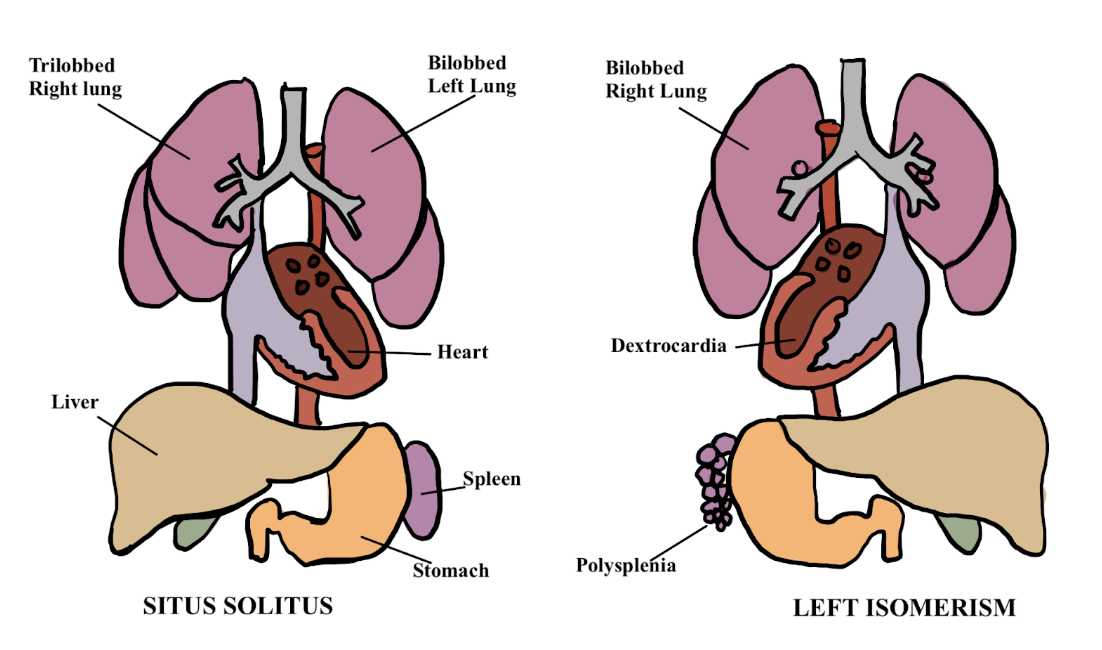
Heterotaxy syndrome is a rare congenital disorder characterized by abnormal arrangement of the thoracic and abdominal organs and is classified into polysplenia (left isomerism) and asplenia (right isomerism) syndromes. Polysplenia is associated with multiple splenic nodules, bilobed lungs, vascular anomalies, and organ malpositioning. In contrast, asplenia features bilateral trilobed lungs and eparterial bronchi, and is commonly associated with severe cardiac defects and high neonatal mortality. Here, we report 2 cases that illustrate the clinical spectrum of heterotaxy syndrome. The first case involved a 59-year-old female presenting with vague abdominal pain that was incidentally found to have features of polysplenia syndrome, including multiple splenules, malpositioned liver, partial pancreatic agenesis, and bilobed lungs. The second case was a 26-hour-old neonate who presented with cyanosis and respiratory distress and was diagnosed with right isomerism and complex congenital heart disease, including right ventricular outflow tract (RVOT) stenosis, atrioventricular canal defect, situs inversus, and asplenia. These cases highlight the varied presentations and anatomical complexity of heterotaxy syndrome, emphasizing the role of imaging in its diagnosis and clinical management.
Clarifying the Cardiovascular Morphology and Associated Abnormalities in Patients with Double Inlet Right Ventricle Using Multidetector CT Angiography.
We sought to evaluate the intracardiac morphology and associated cardiovascular anomalies in patients with double inlet right ventricle (DIRV) on multidetector CT angiography. A retrospective search of our departmental database was conducted from January 2014 to January 2023 to identify patients with a diagnosis of DIRV on CT angiography. The intracardiac anatomy and associated cardiovascular abnormalities were systematically evaluated. Patients with a common atrioventricular valve were excluded. DIRV was diagnosed in 41 patients (36 males, 5 females; mean age at imaging: 7.4 years [range: 4 months-30 years]). Mirror-imaged viscero-atrial arrangement was observed in 12/41 (29.3%) while right isomerism and left isomerism were seen in 6/41 (14.6%) and 2/41 (4.9%) patients respectively. Hypoplastic left ventricular cavity was seen in 39/41 (95.1%) patients. AV valve straddling was observed in 40/41 (97.6%) patients. Atrial septal defect was seen in 28/41 (68.3%) patients. All (100%) patients had presence of ventricular septal defect. Twisted atrioventricular connections were seen in 4/41 (9.8%) patients. The most common ventriculo-arterial morphology was presence of double outlet right ventricle (DORV) seen in 25/41 (61%) patients. Some degree of pulmonary outflow obstruction was seen in 24/41 (58.5%) patients. Systemic venous anomalies, pulmonary venous anomalies and coronary artery anomalies were observed in 13/41 (31.7%), 6/41 (14.6%) and 8/41 (19.5%) patients. DIRV is a type of single ventricle congenital heart disease associated with an array of cardiovascular abnormalities, most commonly DORV and pulmonary outflow tract obstruction. The knowledge of associated anomalies is imperative for preoperative planning. CT angiography allows for detailed anatomical evaluation of DIRV and associated cardiovascular anomalies which may positively impact surgical management in these patients.
Specific cardiovascular morphology on computed tomography angiography in patients with right isomerism.
Children with right isomerism usually accompany complex congenital heart disease, which is associated with pulmonary atresia, common atrioventricular valve, and total anomalous pulmonary venous connection. This study aimed to explore specific cardiovascular morphology associated with right isomerism on computed tomography angiography (CTA). We retrospectively reviewed CTA images to assess the atrio-ventricular connections and the spatial relationship between the systemic and pulmonary channels in children with right isomerism. We studied 33 patients (17 females). Atrial situs was classified into solitus and inversus in 21 and 12 patients, respectively. Atrioventricular valve morphology included unilateral insertion in 15/33 (46%), balanced insertion into both ventricles in 11/33 (33%), unbalanced insertion into both ventricles in 7/33 (21%), and common atrioventricular valve in 27/33 (82%). The pulmonary connection included atresia and stenosis in 14/33 (42%) and 17/33 (52%), respectively. The anteroposterior relationship between the aorta and the pulmonary trunk was observed in 15/33 (46%). Total anomalous pulmonary venous connection concurred in 21/33 (63%), including supracardiac type in 16/21 (76%) and infracardiac type in 2/21 (10%). Preoperative pulmonary venous obstruction was found in 10/21 (47%). There were 14 patients with bilateral superior caval veins (42%). The anteroposterior relationship between the aorta and the pulmonary trunk was significantly correlated to the pulmonary arterial and venous channel anomalies (p = 0.001 and p = 0.027). The spatial relationship between the systemic and pulmonary channels was associated with distinct cardiovascular morphology associated with right isomerism.
Plasticity of ventricle position after heart looping in heterotaxy with right isomerism.
The heart functions in two parallel but asymmetric circulations, driven by the right and left ventricles. In the heterotaxy syndrome, abnormal left-right patterning leads to a spectrum of severe congenital heart defects, including ventricle malposition. A postulate anchored in the clinical nomenclature assumes that the looping direction of the embryonic heart tube determines ventricle position at birth. However, this has not been demonstrated experimentally. Here, we performed a unique longitudinal analysis of heterotaxy with right isomerism, using multimodality imaging of Nodal mouse mutants. Using direct correlations and advanced statistics, we dissected the contribution of heart looping variations to specific structural heart malformations, and uncovered unexpected plasticity of ventricle position after looping in 30% of revertant samples. Genetic tracing and topological associations show that plasticity involves a further step of heart remodeling at E13.5, rather than molecular reprogramming. Human patient scans are consistent with ventricle plasticity and suggest association with poorer prognosis. Our work reveals distinct asymmetric events shaping organs.
Publicações recentes
COVID-19 in an adult with right isomerism and Fontan circulation: Successful management using risk stratification.
From multiple spleens to absence: Insights from two cases of heterotaxy syndromes.
Outcomes of Current Surgical Strategy for Achieving Optimal Fontan Haemodynamics in Patients With Right Isomerism.
Specific cardiovascular morphology on computed tomography angiography in patients with right isomerism.
Aberrant fibromuscular common atrial band in right isomerism.
📚 EuropePMC46 artigos no totalmostrando 75
COVID-19 in an adult with right isomerism and Fontan circulation: Successful management using risk stratification.
Fujita medical journalFrom multiple spleens to absence: Insights from two cases of heterotaxy syndromes.
Radiology case reportsOutcomes of Current Surgical Strategy for Achieving Optimal Fontan Haemodynamics in Patients With Right Isomerism.
European journal of cardio-thoracic surgery : official journal of the European Association for Cardio-thoracic SurgerySpecific cardiovascular morphology on computed tomography angiography in patients with right isomerism.
Pediatrics international : official journal of the Japan Pediatric SocietyAberrant fibromuscular common atrial band in right isomerism.
BMJ case reportsPlasticity of ventricle position after heart looping in heterotaxy with right isomerism.
Science advancesThe Ultrasound and Genetic Characteristics of Fetuses With Laterality Defects-A Prenatal Cohort in Asian Population.
Prenatal diagnosisA Retrospective Study on the Imaging Spectrum of Functional Single Ventricle and Its Associations.
The Indian journal of radiology & imagingCardiopulmonary exercise testing surprise: deciphering a shifting QRS axis in right isomerism-electrocardiogram challenge.
European heart journal. Case reportsClarifying the cardiovascular morphology and associated abnormalities in patients with tricuspid Atresia using multidetector computed tomography angiography.
The international journal of cardiovascular imagingLeft Isomerism With Normal Bronchopulmonary Anatomy: Broadening the Heterotaxy Spectrum.
Case reports in radiologyClarifying the Cardiovascular Morphology and Associated Abnormalities in Patients with Double Inlet Right Ventricle Using Multidetector CT Angiography.
Pediatric cardiologyA Rare Presentation of Hepatolithiasis and Acute Cholangitis: A Case Report Highlighting Heterotaxy Syndrome With Left Isomerism.
CureusCatheter Ablation of Tachycardia Involving Twin/Single Atrioventricular Node in Patients With Right Isomerism.
Pacing and clinical electrophysiology : PACEFetal bradyarrhythmias: classification, monitoring and outcomes of 40 cases at a single center.
Journal of perinatal medicineThoracic duct drainage patterns in heterotaxy.
Journal of cardiovascular magnetic resonance : official journal of the Society for Cardiovascular Magnetic ResonanceNormal pulmonary venous drainage in the setting of total anomalous pulmonary venous connection.
Annals of pediatric cardiologyHeterotaxy Syndrome With Right Isomerism and Interrupted Inferior Vena Cava: A Case Report and Literature Review.
CureusPrenatal diagnosis of total anomalous pulmonary venous connection with vertical vein branching into two.
Journal of medical ultrasonics (2001)Persistant Left Superior Vena Cava with and Without Right Superior Vena Cava: Significance of Prenatal Diagnosis.
Pediatric cardiologyCharacterization of ultrasound and postnatal pathology in fetuses with heterotaxy syndrome.
Frontiers in cardiovascular medicineLong-Term Surgical Outcomes of Patients With Isomeric Right and Left Atrial Appendages.
World journal for pediatric & congenital heart surgeryDuctus arteriosus banding to regulate excessive pulmonary blood flow in a neonate with necrotizing enterocolitis and complex congenital heart disease, including pulmonary atresia and total anomalous pulmonary venous return: a case report.
Journal of cardiothoracic surgeryStrategy of delayed repair of total anomalous pulmonary venous connection in right atrial isomerism and functional single ventricle.
JTCVS openGenetic and Clinical Features of Heterotaxy in a Prenatal Cohort.
Frontiers in geneticsImaging characteristics and associations of left atrioventricular valve atresia and patent aortic root with isometric atrial appendages on multidetector CT.
Journal of cardiac surgeryHomozygous variants in the GDF1 gene related to recurrent right isomerism and complex CHD in two Indian families.
Cardiology in the youngThe surgical anatomy of hearts with isomeric atrial appendages-implications for surgical management.
European journal of cardio-thoracic surgery : official journal of the European Association for Cardio-thoracic SurgeryRisk factors for mortality after cardiovascular surgery in patients with functional single ventricle and right isomerism.
European journal of cardio-thoracic surgery : official journal of the European Association for Cardio-thoracic SurgerySurgical management of hearts with isomeric atrial appendages.
Journal of cardiac surgeryPulmonary Versus Systemic Outflow Obstruction in Functionally Univentricular Hearts with Isomerism: An Observation.
Pediatric cardiologyBilateral tracheal bronchi in a patient with right isomerism.
Journal of cardiovascular computed tomographyPrimary central pulmonary artery plasty for right atrial isomerism with pulmonary coarctation.
Asian cardiovascular & thoracic annalsFetal Ultrasonic Evaluation of Bronchial Morphology in Fetuses with Isomerism.
Fetal diagnosis and therapyPitx controls amphioxus asymmetric morphogenesis by promoting left-side development and repressing right-side formation.
BMC biologySurgical management of lesions encountered in the setting of the retroaortic left brachiocephalic vein.
Journal of cardiac surgeryIntrapulmonary Right Vertical Vein in Supracardiac Total Anomalous Pulmonary Venous Connection with Right Isomerism.
Radiology. Cardiothoracic imagingA rare pediatric case of bilateral bronchopulmonary vascular malformations and right isomerism.
Journal of cardiac surgeryAsymptomatic left isomerism with preduodenal portal vein: computed tomography appearance.
Surgical and radiologic anatomy : SRACongenitally Malformed Hearts: Aspects of Teaching and Research Involving Medical Students.
Journal of cardiovascular development and diseaseEchocardiogram Unmasked Hemodynamic Advantage of Atrial Pacing in Securing Ventricular Preload in a Fontan Patient with Junctional Rhythm.
International heart journalRetrograde sharp potential resembling the his-bundle electrogram: is this a case of atrioventricular re-entrant tachycardia involving twin atrioventricular nodes with the anterior node exhibiting only retrograde conduction?
Cardiology in the youngPrenatal diagnosis of asplenia syndrome with sliding hiatus hernia in a fetus.
Annals of pediatric cardiologyThe Spectrum of Cardiac Anomalies Associated with Heterotaxy: A Single-Center Study of a Large Series Based on Computed Tomography.
Pediatric cardiologyPolysplenia syndrome with complex heart disease and jejunal atresia with malrotation in neonate: A case report.
Clinical case reportsHeterotaxy Polysplenia Syndrome in Adulthood: Focused Review and a Case Report.
CureusA founder truncating variant in GDF1 causes autosomal-recessive right isomerism and associated congenital heart defects in multiplex Arab kindreds.
American journal of medical genetics. Part AHeterotaxy Is Not a Risk Factor for Adverse Long-Term Outcomes After Fontan Completion.
The Annals of thoracic surgerySpontaneous Left Cardiac Isomerism in Chick Embryos: Case Report, Review of the Literature, and Possible Significance for the Understanding of Ventricular Non-Compaction Cardiomyopathy in the Setting of Human Heterotaxy Syndromes.
Journal of cardiovascular development and diseasePersistent right umbilical vein in isomerism.
Prenatal diagnosisCharacteristics and outcomes of fetuses with laterality defects are the current outcomes better? A single center study.
The journal of maternal-fetal & neonatal medicine : the official journal of the European Association of Perinatal Medicine, the Federation of Asia and Oceania Perinatal Societies, the International Society of Perinatal ObstetriciansPre natal evaluation of heterotaxy syndrome by fetal echocardiography and correlating with autopsy.
Ultrasound (Leeds, England)Development of acquired intrapulmonary venous anastomosis contributing to establishment of Fontan circulation.
Pulmonary circulationComplex Congenital Heart Disease Associated With Disordered Myocardial Architecture in a Midtrimester Human Fetus.
Circulation. Cardiovascular imagingComplex congenital cardiac anomalies in the setting of right isomerism in a 31-month-old infant: a case report.
Journal of medical case reportsAccuracy of echocardiography in diagnosing total anomalous pulmonary venous return.
Pakistan journal of medical sciencesTransposition of the great arteries: A laterality defect in the group of heterotaxy syndromes or an outflow tract malformation?
Annals of pediatric cardiologyHeterotaxy Syndrome and Intestinal Rotation Abnormalities.
PediatricsA Requirement for Zic2 in the Regulation of Nodal Expression Underlies the Establishment of Left-Sided Identity.
Scientific reportsDisharmonious Patterns of Heterotaxy and Isomerism: How Often Are the Classic Patterns Breached?
Circulation. Cardiovascular imagingIs an Appreciation of Isomerism the Key to Unlocking the Mysteries of the Cardiac Findings in Heterotaxy?
Journal of cardiovascular development and diseaseThe Bmp signaling pathway regulates development of left-right asymmetry in amphioxus.
Developmental biologyThe evolution of asymmetric photosensitive structures in metazoans and the Nodal connection.
Mechanisms of developmentPrenatal diagnosis of total and partial anomalous pulmonary venous connection: multicenter cohort study and meta-analysis.
Ultrasound in obstetrics & gynecology : the official journal of the International Society of Ultrasound in Obstetrics and GynecologyPartial anomalous hepatic venous drainage into left-sided atrium with right isomerism: A case report with review of literature.
The Indian journal of radiology & imagingIvemark syndrome: bronchial compression from anomalous pulmonary venous anatomy.
Journal of surgical case reportsSegregating bodily isomerism or heterotaxy: potential echocardiographic correlations of morphological findings.
Cardiology in the youngDiverse multi-organ histopathologic changes in a failed Fontan patient.
Pediatrics international : official journal of the Japan Pediatric SocietyIntestinal malrotation in patients with situs anomaly: Implication of the relative positions of the superior mesenteric artery and vein.
European journal of radiologyAsplenia Syndrome in a Neonate: A Case Report.
Journal of clinical and diagnostic research : JCDRMechanism responsible for D-transposition of the great arteries: Is this part of the spectrum of right isomerism?
Congenital anomaliesImpact of Era, Type of Isomerism, and Ventricular Morphology on Survival in Heterotaxy: Implications for Therapeutic Management.
World journal for pediatric & congenital heart surgeryChronic Arrhythmias in the Setting of Heterotaxy: Differences between Right and Left Isomerism.
Congenital heart disease[Total Anomalous Pulmonary Venous Connection].
Kyobu geka. The Japanese journal of thoracic surgeryThe importance of being isomeric.
Clinical anatomy (New York, N.Y.)Associações
Organizações que acompanham esta doença — pra ter apoio e orientação
Ainda não temos associações cadastradas para Isomerismo auricular lado direito.
É de uma associação que acompanha esta doença? Fale com a gente →
Comunidades
Grupos ativos de quem convive com esta doença aqui no Raras
Ainda não existe comunidade no Raras para Isomerismo auricular lado direito
Pacientes, familiares e cuidadores se organizam em comunidades pra compartilhar experiências, fazer perguntas e se apoiar. Você pode ser o primeiro.
Tire suas dúvidas
Perguntas, dicas e experiências compartilhadas aqui na página
Participe da discussão
Faça login para postar dúvidas, compartilhar experiências e interagir com especialistas.
Fazer loginDoenças relacionadas
Doenças com sintomas parecidos — ajudam quem ainda está buscando diagnóstico
Referências e fontes
Bases de dados externas citadas neste artigo
Publicações científicas
Artigos indexados no PubMed ligados a esta doença no grafo RarasNet — título, periódico e PMID direto da fonte, sem intermediação de IA.
- COVID-19 in an adult with right isomerism and Fontan circulation: Successful management using risk stratification.
- From multiple spleens to absence: Insights from two cases of heterotaxy syndromes.
- Clarifying the Cardiovascular Morphology and Associated Abnormalities in Patients with Double Inlet Right Ventricle Using Multidetector CT Angiography.
- Specific cardiovascular morphology on computed tomography angiography in patients with right isomerism.Pediatrics international : official journal of the Japan Pediatric Society· 2025· PMID 41133277mais citado
- Plasticity of ventricle position after heart looping in heterotaxy with right isomerism.
- Outcomes of Current Surgical Strategy for Achieving Optimal Fontan Haemodynamics in Patients With Right Isomerism.
- Aberrant fibromuscular common atrial band in right isomerism.
Bases de dados e fontes oficiais
Identificadores e referências canônicas usadas para montar este verbete.
- ORPHA:97548(Orphanet)
- OMIM OMIM:208530(OMIM)
- MONDO:0008832(MONDO)
- GARD:6795(GARD (NIH))
- Variantes catalogadas(ClinVar)
- Busca completa no PubMed(PubMed)
- Q772022(Wikidata)
Dados compilados pelo RarasNet a partir de fontes abertas (Orphanet, OMIM, MONDO, PubMed/EuropePMC, ClinicalTrials.gov, DATASUS, PCDT/MS). Este conteúdo é informativo e não substitui avaliação médica.
Conteúdo mantido por Agente Raras · Médicos e pesquisadores podem colaborar
Isomerismo auricular lado direito
📋 Origem dos dados
Esta página agrega dados de fontes públicas e oficiais. Dados sobre cobertura no SUS (PCDT, CEAF) são verificados ativamente por agente proativo (ver badge no infobox). Demais dados têm atribuição de fonte + data da última sincronização — clique para abrir o original.
- Doença rara (ontologia)
- fonte: Orphanet
- Identificador unificado
- fonte: MONDO
- Genética mendeliana
- fonte: OMIM
- Codificação WHO/SUS
- fonte: WHO ICD-10 / DATASUS
- CID-11 (futuro)
- fonte: WHO ICD-11
- NIH/GARD
- fonte: GARD (NIH)
- Dado público estruturado
- fonte: Wikidata