A hemimelia fibular é uma deficiência longitudinal congênita dos membros caracterizada pela ausência completa ou parcial do osso da fíbula.
Introdução
O que você precisa saber de cara
A hemimelia peroneal isolada é uma malformação congênita em que a criança nasce com a fíbula, osso fino da perna, ausente ou menor do que o normal. Essa alteração provoca encurtamento da perna, encurvamento da tíbia, deformidades no pé e dificuldades para caminhar. O acompanhamento costuma envolver adaptação de próteses, fisioterapia e cirurgias ortopédicas corretivas para melhorar o alinhamento corporal. Esta condição não possui um PCDT próprio no Ministério da Saúde, mas o SUS prevê atendimentos de reabilitação em doenças raras.
A hemimelia fibular é uma deficiência longitudinal congênita dos membros caracterizada pela ausência completa ou parcial do osso da fíbula.
Escala de raridade
<1/50kMuito rara
1/20kRara
1/10kPouco freq.
1/5kIncomum
1/2k
Encontrou um erro ou informação desatualizada? Sugira uma correção →
Entender a doença
Do básico ao detalhe, leia no seu ritmo
Preparando trilha educativa...
Sinais e sintomas
O que aparece no corpo e com que frequência cada sintoma acontece
Partes do corpo afetadas
+ 22 sintomas em outras categorias
Características mais comuns
Os sintomas variam de pessoa para pessoa. Abaixo estão as 47 características clínicas mais associadas, ordenadas por frequência.
Linha do tempo da pesquisa
Encontrou um erro ou informação desatualizada? Sugira uma correção →
Genética e causas
O que está alterado no DNA e como passa nas famílias
Nenhum gene associado encontrado
Os dados genéticos desta condição ainda estão sendo catalogados.
Diagnóstico
Os sinais que médicos procuram e os exames que confirmam
Tratamento e manejo
Remédios, cuidados de apoio e o que precisa acompanhar
Onde tratar no SUS
Hospitais de referência no Brasil e o protocolo oficial do SUS (PCDT)
🇧🇷 Atendimento SUS — Hemimelia peroneal isolada
Selecione um estado ou use sua localização para ver resultados.
Dados de DATASUS/CNES, SBGM, ABNeuro e Ministério da Saúde. Sempre confirme a disponibilidade diretamente com o estabelecimento.
Pesquisa ativa
Ensaios clínicos abertos e novidades científicas recentes
Pesquisa e ensaios clínicos
Nenhum ensaio clínico registrado para esta condição.
Publicações mais relevantes
Mostrando amostra de 11 publicações de um total de 86
Bilateral Chronic Anterior Cruciate Ligament Tear or Congenital Absence of Anterior Cruciate Ligament? - A Case Report.
Congenital absence of the anterior cruciate ligament (ACL), first reported by Giorgi in 1956 is an extremely rare condition. The prevalence of this condition is reported to be around 0.017/1,000 live births. This congenital anomaly can present in isolation or be associated with other skeletal malformations, including fibular hemimelia, congenital femoral deficiencies, and hip dysplasia. Congenital ACL deficiency may often go undiagnosed in early life. Others will eventually experience symptoms due to the long-term effects of knee instability that can lead to chronic knee pain, particularly in the medial knee and patellofemoral compartments, and may predispose individuals to early-onset osteoarthritis. As the condition is extremely rare and can occur with or without associated deformities, there is no single treatment of choice for the condition. We herein report a case of bilateral isolated congenital absence of ACL in a 24-year-old young woman who presented to us with the chief complaints of pain in the right knee for the past 2 years and the left knee for the past 10 months. Although good outcomes with conservative management in individuals without symptomatic instability have been reported, surgeons advocate ACL reconstruction in cases presenting with symptomatic instability.
Treatment of relapse valgus knee deformity in fibular hemimelia with hemiepiphysiodesis.
The objective of this study was to analyze the treatment of recurrent valgus knee in fibular hemimelia patients with hemiepiphysiodesis and define associated variables for deformity relapse. Sixteen consecutive patients with fibular hemimelia treated with hemiepiphysiodesis (57 physis) were compared to 21 physis of idiopathic cases, in terms of magnitude, speed, and time of correction. Correction of valgus deformity was successfully achieved in all cases. In the fibular hemimelia group, children 4 years and younger had a bigger magnitude of correction than older ones (11° versus 6.9°) and greater speed (1° versus 0.6°), with statistical significance ( P = 0.018 and P = 0.009, respectively), while time for correction was similar among these groups (11.6 months versus 12.3 months). Femoral distal physis corrected faster than proximal tibial physis (10.8 months versus 16.8 months), with statistical significance ( P = 0.032). Thirty-three physis (57.9%) were isolated and 24 (42.1%) were tibia and femur. We found no statistical difference between the two groups regarding time for correction, magnitude, or speed ( P = 0.526, P = 0.910, P = 0.803, respectively). Relapse was observed in 49 physis (86%) of the fibular hemimelia patients. These had a mean age of 5.5 years versus 3.9 years for those without a relapse, with statistical significance ( P = 0.204). Relapse occurred after 2 years of the first procedure. Recurrent valgus deformity in fibular hemimelia can be successfully treated with single or multiple hemiepiphysiodesis with tension band plates in skeletally immature patients in an effective and gradual manner. Level of Evidence: Level III, therapeutic study.
Foot Oligodactyly as the Main Dysplasia in Children.
Introduction Foot oligodactyly is usually associated with fibular insufficiency or cleft foot syndrome. A foot with a reduced number of rays may occasionally have an isolated dysplasia. Methods We reviewed the clinical notes and X-rays of six children with oligodactyly, having a normal development of the tibia and fibula. Clinical evaluation recorded the plantigrade or deviated foot, appropriate shoe wear, and aesthetic presentation of barefoot children. Radiological examination revealed missing or hypoplastic bones in the foot, the presence of other deformities, and leg length discrepancy (LLD) of the affected limb. Results On clinical evaluation, all children except one had a plantigrade foot with normal shoe wear; the lesion was not spotted in three of them unless informed of the presence of the dysplasia. Radiological examination in four of them revealed the absence or hypoplasia of the navicular, with a normal shape of the first metatarsal. Calcaneocuboid joints were normal in five of them; LLD was the main problem in three children. The girl with bilateral oligodactyly presented as a normal child. Conclusion Oligodactyly may present as an isolated dysplasia. LLD in these patients, which is less severe than in children with fibular or tibial insufficiency, is the main issue that requires surgical management in later life. Prenatal diagnosis of oligodactyly as an isolated dysplasia is an important feature for appropriate counseling of parents.
Fibular hemimelia.
Fibular hemimelia is defined as a partial or complete absence of the fibula. Alongside fibular deformities, there is a wide spectrum of anomalies, foot deformities, and absent rays. A literature review showed only a handful of cases of prenatal diagnosis of fibular hemimelia. It is a rare disorder that might be isolated or associated with visceral anomalies.
Isolated unilateral proximal focal femoral deficiency presenting in a young woman.
Proximal focal femoral deficiency (PFFD) is a rare congenital skeletal abnormality characterised by the partial absence of the proximal femoral segment with shortening of the entire lower extremity. It typically presents as a shortened thigh, which is flexed, externally rotated and abducted. Some other skeletal anomalies, especially fibular hemimelia, usually accompany the disorder. The diagnosis of PFFD is made in early childhood and based mainly on conventional radiography. However, the radiographic appearance of the disease evolves as the child grows. In addition, treatment procedures applied to the child affect the radiographic presentation of the disease in adulthood. Almost all cases of PFFD reported to date are in young children and in the current literature, there is a paucity of radiographic images of PFFD in mature skeleton. The aim of this case report is to present the radiographic appearance of PFFD in an adult patient and to increase awareness among radiologists about this disease.
Publicações recentes
Association between isolated fibular fracture displacement and deep deltoid injury: A comparative analysis of arthroscopic and radiographic assessments.
3D-Printed Brace Utilization for an Isolated Fibular Head Fracture: A Case Report.
Management of Hypertrophic non-Union After Isolated Fibular Shaft Fracture With Percutaneous Screw Fixation: A Case Report.
Arthroscopic repair is an effective treatment for dynamic medial ankle instability secondary to posttraumatic and partial injury of the deltoid ligament deep fascicle.
Delayed Presentation of Acute Compartment Syndrome After Isolated Closed Fibular Shaft Fracture: A Case Report.
📚 EuropePMCmostrando 10
Bilateral Chronic Anterior Cruciate Ligament Tear or Congenital Absence of Anterior Cruciate Ligament? - A Case Report.
Journal of orthopaedic case reportsTreatment of relapse valgus knee deformity in fibular hemimelia with hemiepiphysiodesis.
Journal of pediatric orthopedics. Part BFoot Oligodactyly as the Main Dysplasia in Children.
CureusAssociation of upper limb meromelia, proximal focal femoral deficiency, fibular hemimelia, and intermetatarsal coalition in a young adult male.
Radiology case reportsIsolated unilateral proximal focal femoral deficiency presenting in a young woman.
BMJ case reportsFetal fibular hemimelia with focal femoral deficiency: A case report.
Turkish journal of obstetrics and gynecologyUpper Limb Meromelia with Oligodactyly and Brachymesophalangy of the Foot: An Unusual Association.
Case reports in radiologyClinical Results and Complications of Lower Limb Lengthening for Fibular Hemimelia: A Report of Eight Cases.
MedicineFIBULAR HEMIMELIA: A RARE CASE REPORT.
Ethiopian medical journalImaging features of lower limb malformations above the foot.
Diagnostic and interventional imagingAssociações
Organizações que acompanham esta doença — pra ter apoio e orientação
Ainda não temos associações cadastradas para Hemimelia peroneal isolada.
É de uma associação que acompanha esta doença? Fale com a gente →
Doença com base genética
Um médico geneticista pode ajudar no diagnóstico de Hemimelia peroneal isolada e no aconselhamento genético da família.
Doenças relacionadas
Doenças com sintomas parecidos — ajudam quem ainda está buscando diagnóstico
Perguntas frequentes
O que as famílias mais perguntam sobre esta doença — cada resposta com a fonte de onde saiu
Trata-se de uma alteração no desenvolvimento embrionário dos membros inferiores com início antenatal. Seu modo de herança é registrado como não aplicável nas bases clínicas e ainda não existem genes específicos catalogados.
Referências
Fontes citadas no texto, publicações do grafo e bases de dados usadas neste verbete
10 publicações do grafo RarasNet (PubMed) · 5 bases de dados. Títulos, periódicos e PMIDs vêm direto da fonte, sem intermediação de IA.
Dados compilados pelo RarasNet a partir de fontes abertas (Orphanet, OMIM, MONDO, PubMed/EuropePMC, ClinicalTrials.gov, DATASUS, PCDT/MS). Este conteúdo é informativo e não substitui avaliação médica.
Citar este verbete
Raras. (s.d.). Hemimelia peroneal isolada. Em Raras — Enciclopédia de Doenças Raras do Brasil. https://raras.org/doenca/hemimelia-peroneal-isolada
Formato APA. Conteúdo sob CC BY 4.0 — reuso livre com atribuição.
Conteúdo mantido por Agente Raras · Médicos e pesquisadores podem colaborar
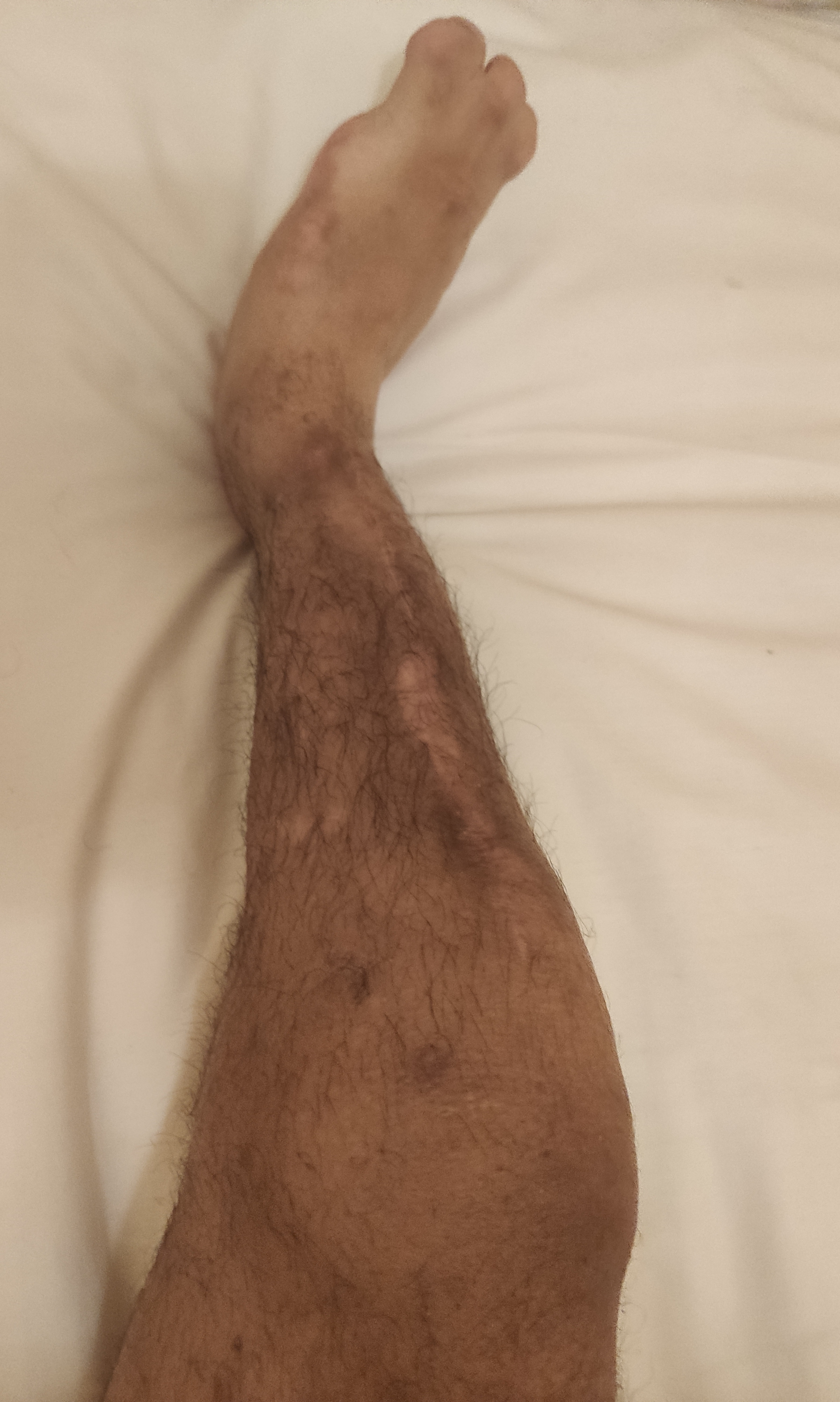
Hemimelia peroneal isolada
📋 Origem dos dados
Esta página agrega dados de fontes públicas e oficiais. Dados sobre cobertura no SUS (PCDT, CEAF) são verificados ativamente por agente proativo (ver badge no infobox). Demais dados têm atribuição de fonte + data da última sincronização — clique para abrir o original.
- Doença rara (ontologia)
- fonte: Orphanet
- Identificador unificado
- fonte: MONDO
- Codificação WHO/SUS
- fonte: WHO ICD-10 / DATASUS
- CID-11 (futuro)
- fonte: WHO ICD-11
- NIH/GARD
- fonte: GARD (NIH)
- Dado público estruturado
- fonte: Wikidata

