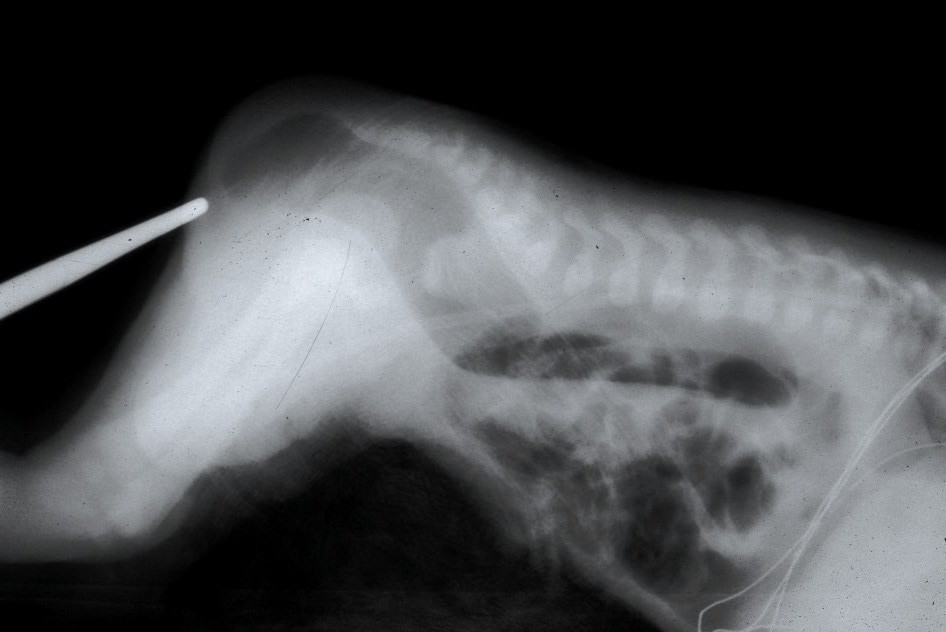
A síndrome de Currarino (SC) é uma doença congênita rara caracterizada pela tríade de malformações anorretais (ARMs) (geralmente estenose anal), massa pré-sacral (geralmente meningocele sacral anterior (ASM) ou teratoma) e anomalias sacrais (isto é, agenesia total ou parcial do sacro e cóccix ou deformidade das vértebras sacrais).
Introdução
O que você precisa saber de cara
A Síndrome Currarino é uma condição genética congênita rara caracterizada por três alterações principais: defeitos na formação do ânus, alterações no osso do sacro e massas na região pélvica. Geralmente, os familiares percebem sinais como prisão de ventre crônica grave, inchaço na barriga ou alterações visíveis na abertura anal desde os primeiros meses de vida. Não há remédio específico curativo, e o tratamento exige procedimentos cirúrgicos reparadores e acompanhamento especializado para proteger o intestino, a bexiga e a coluna. No Brasil, a síndrome não possui um PCDT oficial publicado pelo Ministério da Saúde, mas exames genéticos e reabilitação constam na tabela de procedimentos do SUS.
A síndrome de Currarino (SC) é uma doença congênita rara caracterizada pela tríade de malformações anorretais (ARMs) (geralmente estenose anal), massa pré-sacral (geralmente meningocele sacral anterior (ASM) ou teratoma) e anomalias sacrais (isto é, agenesia total ou parcial do sacro e cóccix ou deformidade das vértebras sacrais).
Escala de raridade
<1/50kMuito rara
1/20kRara
1/10kPouco freq.
1/5kIncomum
1/2k
Encontrou um erro ou informação desatualizada? Sugira uma correção →
Entender a doença
Do básico ao detalhe, leia no seu ritmo
Preparando trilha educativa...
Sinais e sintomas
O que aparece no corpo e com que frequência cada sintoma acontece
Partes do corpo afetadas
+ 21 sintomas em outras categorias
Características mais comuns
Os sintomas variam de pessoa para pessoa. Abaixo estão as 42 características clínicas mais associadas, ordenadas por frequência.
Linha do tempo da pesquisa
Encontrou um erro ou informação desatualizada? Sugira uma correção →
Genética e causas
O que está alterado no DNA e como passa nas famílias
Genes associados
1 gene identificado com associação a esta condição. Padrão de herança: Autosomal dominant, Not applicable.
Curadoria gene-doença
fontes oficiaisCurrarino syndrome
The triad of a presacral tumor, sacral agenesis and anorectal malformation constitutes the Currarino syndrome which is caused by dorsal-ventral patterning defects during embryonic development. The syndrome occurs in the majority of patients as an autosomal dominant trait.
Variantes genéticas (ClinVar)
153 variantes patogênicas registradas no ClinVar.
Diagnóstico
Os sinais que médicos procuram e os exames que confirmam
Tratamento e manejo
Remédios, cuidados de apoio e o que precisa acompanhar
Onde tratar no SUS
Hospitais de referência no Brasil e o protocolo oficial do SUS (PCDT)
🇧🇷 Atendimento SUS — Síndrome Currarino
Selecione um estado ou use sua localização para ver resultados.
Dados de DATASUS/CNES, SBGM, ABNeuro e Ministério da Saúde. Sempre confirme a disponibilidade diretamente com o estabelecimento.
Pesquisa ativa
Ensaios clínicos abertos e novidades científicas recentes
Ensaios em destaque
Nenhum país com ensaio aberto no momento.
Pesquisa e ensaios clínicos
1 ensaios clínicos encontrados.
Publicações mais relevantes
Currarino syndrome associated with an isolated 7q terminal deletion in Korea: a case report.
The 7q terminal deletion syndrome is a rare genetic disorder caused by the deletion of the long arm of chromosome 7 between 7q32 and 7q36.3. It is characterized by various clinical symptoms, such as abnormal facial features and impaired mental and physical development. Currarino syndrome is defined by a triad of sacral bone defects, anorectal malformations, and presacral masses and is often associated with mutations in the MNX1 gene located at 7q36.3. Only a few cases of 7q terminal deletion syndrome have been reported in Korea. In one of these familial cases, Currarino syndrome was associated with a complex chromosomal rearrangement involving a 7q deletion and an 8q duplication. However, to our knowledge, cases of isolated 7q terminal deletions without other structural chromosomal abnormalities have not been described in the literature. We report the case of a 9-month-old girl who presented with the complete Currarino syndrome triad and a 7q35 to 7q36.3 (12 Mb) deletion identified by chromosomal microarray analysis. To the best of our knowledge, this is the first Korean case report of the Currarino triad caused by an isolated terminal 7q deletion.
Clinical Diversity in Currarino Syndrome: Insights From Monozygotic Twins and a Single-Center Retrospective Study.
Currarino syndrome (CS) is a congenital disorder caused by MNX1 gene mutation, resulting in abnormal caudal cell mass development. Clinical presentation varies from severe to mild forms. Classic triad of CS includes sacral agenesis, presacral mass, and anorectal malformation (ARM). We report a pair of monozygotic twins, both with the MNX1: c.780C>G mutation, presenting with different clinical phenotypes of Currarino syndrome (CS). Both were suspected of anorectal atresia in utero, and postnatal diagnosis confirmed CS with tethered cord syndrome (TCS). They underwent staged surgeries, with normal growth at 10 months follow-up. Additionally, a retrospective analysis of 95 CS cases diagnosed between April 2010 and April 2024 at Shanghai Xinhua Hospital was performed. Clinical, imaging, and pathological data were collected, and binary logistic regression was used to analyze the correlation between clinical factors and TCS. A literature review of twin CS cases was also conducted. Of the 95 patients, 23.2% had complete CS, and 76.8% had incomplete CS. TCS was present in 55.8% of cases. Logistic regression showed no significant correlation between age, sex, sacral deformity severity, ARM type, presacral mass, and TCS. Two previous twin CS cases were identified, both with differing phenotypes. CS exhibits phenotypic variability, and monozygotic twins with the same MNX1 mutation may present with different severities. The MNX1: c.780C>G mutation broadens the genetic spectrum of CS. TCS is common, emphasizing the need for multidisciplinary management. Surgical approaches should be personalized based on presentation.
Surgical repair of prolapsed stoma via the buttonpexy approach: a case series.
Stoma prolapse is a frequent complication following stoma formation in pediatric patients and often necessitates surgical intervention. The buttonpexy technique offers a minimally invasive, low-cost, and anesthesia-sparing alternative to formal stoma revision. This case series highlights its safety and effectiveness in managing pediatric stoma prolapse. Five pediatric patients with stoma prolapse secondary to various underlying conditions, including anorectal malformation, Hirschsprung's disease, and Currarino syndrome, were managed using the buttonpexy technique. In each case, the prolapsed bowel was gently reduced, and pledgets derived from intravenous tubing were secured above and below the skin margins to anchor the stoma locally. The procedures were performed under local anesthesia, and all patients tolerated them well. Four patients demonstrated complete resolution without recurrence during follow-up, while one experienced partial prolapse that was successfully corrected with a repeat buttonpexy. None of the patients required conversion to formal stoma revision, and no complications such as infection, necrosis, or bleeding were observed. Follow-up ranged from one to eight months, confirming sustained stoma stability until definitive closure. The buttonpexy technique is a simple, safe, reproducible method for managing pediatric stoma prolapse. It can be performed under local anesthesia, minimizing anesthetic exposure and hospital stay. This approach provides a practical first-line option before considering formal revision, especially in resource-limited or pediatric settings where minimizing surgical and anesthetic risks is paramount.
Invited commentary re: "Malignant transformation of sacrococcygeal teratoma (SCT) versus presacral teratoma in currarino syndrome (CS): Results of 'The SCT-study,'" -van Heurn et al.
Familial constipation and death: one family with Currarino syndrome.
Publicações recentes
Surgical management of anterior sacral meningoceles: a case series and systematic review.
Initially suspected case of prenatal VACTERL association ultimately diagnosed as Currarino syndrome via magnetic resonance imaging: a case description.
📖 RevisãoClinical Diversity in Currarino Syndrome: Insights From Monozygotic Twins and a Single-Center Retrospective Study.
Invited commentary re: "Malignant transformation of sacrococcygeal teratoma (SCT) versus presacral teratoma in currarino syndrome (CS): Results of 'The SCT-study,'" -van Heurn et al.
Surgical repair of prolapsed stoma via the buttonpexy approach: a case series.
📚 EuropePMC136 artigos no totalmostrando 87
Clinical Diversity in Currarino Syndrome: Insights From Monozygotic Twins and a Single-Center Retrospective Study.
Congenital anomaliesInvited commentary re: "Malignant transformation of sacrococcygeal teratoma (SCT) versus presacral teratoma in currarino syndrome (CS): Results of 'The SCT-study,'" -van Heurn et al.
Journal of pediatric surgerySurgical repair of prolapsed stoma via the buttonpexy approach: a case series.
Journal of surgical case reportsCurrarino syndrome associated with an isolated 7q terminal deletion in Korea: a case report.
Journal of Yeungnam medical scienceNaked sacrococcygeal teratoma associated with dorsal meningocoele and sacrococcygeal inversion: an atypical presentation of Currarino syndrome.
Child's nervous system : ChNS : official journal of the International Society for Pediatric NeurosurgerySacrococcygeal Teratomas in Currarino Syndrome: A Multicenter Review of Tumor Characteristics, Surgical Outcomes, and Recurrence.
Journal of pediatric surgeryOptimizing surveillance strategies for sacrococcygeal teratoma: A Midwest pediatric surgery consortium multi-institutional study.
International journal of cancerNeurosurgical management of a giant anterior sacral meningocele in a patient with combined Currarino syndrome and caudal duplication anomaly: illustrative case.
Journal of neurosurgery. Case lessonsFamilial constipation and death: one family with Currarino syndrome.
BMJ case reportsCurrarino syndrome with immature teratoma: A case report with review of literature.
Journal of cancer research and therapeuticsNon-Syndromic and Syndromic Defects in Children with Extracranial Germ Cell Tumors: Data of 2610 Children Registered with the German MAKEI 96/MAHO 98 Registry Compared to the General Population.
CancersLong-term (> 10 years) bowel function of anorectal malformations: a retrospective single-center study.
Pediatric surgery internationalCan Anorectal Stenosis be Managed With Dilations Alone? A PCPLC Review.
Journal of pediatric surgeryCurrarino Syndrome in Two Moroccan Siblings with Inherited 7q36 Deletion due to Maternal t(7;21)(q36;p11)mat: A Case Report.
Molecular syndromologyTreatment Strategy for Currarino Syndrome Complicated With Anorectal Stenosis.
CureusManaging Recurrent Teratoma in Currarino Syndrome.
CureusVariability in Surveillance Strategies Following Resection of Sacrococcygeal Teratoma.
The Journal of surgical research[A Surgical Case of Currarino Syndrome with Syringomyelia].
Brain and nerve = Shinkei kenkyu no shinpoCase report: Sacral agenesis in two boxer dogs: clinical presentation, diagnostic investigations, and outcome.
Frontiers in veterinary scienceCurrarino Syndrome Presenting in Adulthood: A Rare Case.
CureusSelection of operative approach in children with Currarino syndrome.
Pediatric surgery internationalPresacral mature cystic teratoma associated with Currarino syndrome in an adolescent with androgen insensitivity: illustrative case.
Journal of neurosurgery. Case lessonsSurgical management of Currarino syndrome in elderly patient with infected pre-sacral mass: Technical nuances and review of literature.
Clinical neurology and neurosurgeryCurrarino Syndrome: A Rare Case Report of Sepsis and Its Management.
Puerto Rico health sciences journalCase report of experience of misdiagnosis of Currarino syndrome as ovarian cyst.
Clinical case reportsInternal fat prolapse from ischiorectal fossa masquerading as currarino syndrome.
African journal of paediatric surgery : AJPSCurrarino syndrome as an incidental radiologic finding in a patient with acute flank pain: A case report.
Radiology case reportsPrimitive neuroectodermal tumor in a child with Currarino syndrome.
The Turkish journal of pediatricsComplete Currarino Triad Presenting With Chronic Constipation.
CureusCharacterization of complete Currarino syndrome in pediatrics-a comparison between CT and MRI.
Annals of translational medicine18F-FDG PET/CT of Malignant Presacral Masses in Currarino Syndrome.
Clinical nuclear medicineCorrigendum Presacral Neuroendocrine Tumors Associated with the Currarino Syndrome. Am J Med Genet A. 2021;185(5):1582-1588. Doi:10.1002/ajmg.a.62145.
American journal of medical genetics. Part AClinical Quiz-A Rare Case of Anal Canal Duplication in the Context of Currarino Syndrome.
European journal of pediatric surgery reportsGeneration of an hiPSC-1 knock-in line expressing TY1-tagged MNX1-protein together with mScarlet.
Stem cell researchPostoperative complications and long-term outcomes in Currarino syndrome.
Pediatric surgery internationalPeripartum Diagnosis of Currarino Syndrome With Anterior Sacral Meningocele: A Case Report.
A&A practiceCurrarino Syndrome in homozygous twins detected by following ultrasound during the fetal period.
Pediatrics international : official journal of the Japan Pediatric SocietyThe first case of mosaic MNX1 mutation in an adult female with features of Currarino syndrome.
Birth defects researchCurrarino syndrome: a comprehensive genetic review of a rare congenital disorder.
Orphanet journal of rare diseasesPresacral neuroendocrine tumors associated with the Currarino syndrome.
American journal of medical genetics. Part A68Ga DOTATATE PET/CT imaging of Currarino syndrome with neuroendocrine tumor.
Japanese journal of clinical oncologyCurrarino syndrome - a pre and post natal diagnosis correlation: case report and literature review.
The journal of maternal-fetal & neonatal medicine : the official journal of the European Association of Perinatal Medicine, the Federation of Asia and Oceania Perinatal Societies, the International Society of Perinatal ObstetriciansColostomy Takedown: Ischemic Complication following Anorectal Malformation Surgery.
Case reports in surgeryCurrarino Syndrome Variant: Revisited.
Journal of Indian Association of Pediatric SurgeonsA case of Currarino syndrome in an adult female presenting with refractory chronic constipation.
Revista espanola de enfermedades digestivasLetter: Sacrum agenesis and scimitar sacrum in Currarino syndrome.
Child's nervous system : ChNS : official journal of the International Society for Pediatric NeurosurgeryCurrarino Syndrome: A Rare Condition With Potential Connection to Neuroendocrine Tumors.
PancreasCurrarino syndrome in an elderly man: Multimodality imaging findings.
Radiology case reportsNovel MNX1 mutations and genotype-phenotype analysis of patients with Currarino syndrome.
Orphanet journal of rare diseasesCaudal regression syndrome (Currarino syndrome) with chromosom mutation 9.
Radiology case reportsSacrum agenesis and scimitar sacrum in Currarino syndrome.
Child's nervous system : ChNS : official journal of the International Society for Pediatric NeurosurgeryLaparoscopic-Assisted Anorectal Pull-Through for Currarino Syndrome.
Journal of laparoendoscopic & advanced surgical techniques. Part ACurrarino syndrome presenting as a cerebrospinal fluid leak from the dermal sinus tract: case report.
Journal of neurosurgery. Pediatrics[Chronic constipation due to Currarino syndrome].
Anales de pediatria[Long-term efficacy analysis of laparoscopic-assisted anorectoplasty for high and middle imperforate anus].
Zhonghua wei chang wai ke za zhi = Chinese journal of gastrointestinal surgeryMalignant neuroendocrine tumour in an adult female diagnosed with Currarino syndrome.
South African journal of surgery. Suid-Afrikaanse tydskrif vir chirurgieAdenocarcinoma and neuroendocrine tumor arising within presacral teratoma associated with Currarino syndrome: A case report.
The Indian journal of radiology & imagingConcurrent Hirschsprung's disease and anorectal malformation: a systematic review.
Pediatric surgery internationalCurrarino syndrome in an adult woman.
Obstetrics & gynecology scienceNeurosurgical management of Currarino syndrome: A case series and review of literature.
Surgical neurology internationalSevere bacterial meningitis due to an enterothecal fistula in a 6-year-old child with Currarino syndrome: evaluation of surgical strategy with review of the literature.
Child's nervous system : ChNS : official journal of the International Society for Pediatric NeurosurgeryAtypical presentation of currarino syndrome: A case report.
International journal of surgery case reportsMalignant transformation of presacral mass in Currarino syndrome.
Pediatric blood & cancerCurrarino syndrome: repair of the dysraphic anomalies and resection of the presacral mass in a combined neurosurgical and general surgical approach.
Journal of neurosurgery. PediatricsCurrarino syndrome and microcephaly due to a rare 7q36.2 microdeletion: a case report.
Italian journal of pediatricsMultiple neurosurgical treatments for different members of the same family with Currarino syndrome.
Neuro-ChirurgieSpectrum of MNX1 Pathogenic Variants and Associated Clinical Features in Korean Patients with Currarino Syndrome.
Annals of laboratory medicineHow to Explore Fetal Sacral Agenesis Without Open Dysraphism: Key Prenatal Imaging and Clinical Implications.
Journal of ultrasound in medicine : official journal of the American Institute of Ultrasound in MedicineCombined abdomino-sacral laparoscopically assisted approach for retrorectal mass resection in a patient with Currarino's Syndrome - video vignette.
Colorectal disease : the official journal of the Association of Coloproctology of Great Britain and IrelandCurrarino syndrome: does the presence of a genetic anomaly correlate with a more severe phenotype? A multicentre study.
Journal of pediatric surgeryCarcinoid transformation of presacral dermoid cyst in patient with currarino syndrome: a case report.
British journal of neurosurgeryMultidisciplinary surgical treatment of presacral meningocele and teratoma in an adult with Currarino triad.
Surgical neurology internationalWhole exome sequencing of sporadic patients with Currarino Syndrome: A report of three trios.
GeneCushing's syndrome in infancy due to ectopic ACTH secretion by a sacro-coccygeal teratoma.
Journal of pediatric endocrinology & metabolism : JPEMRecurrent Abortion and Tethered Cord Syndrome Caused by Anterior Sacral Meningocele: A Report of a Rare Case with a Review of the Literature.
World neurosurgeryThe Currarino triad: What pediatric surgeons need to know.
Journal of pediatric surgeryCurrarino Syndrome in a Fetus, Infant, Child, and Adolescent: Spectrum of Clinical Presentations and Imaging Findings.
Canadian Association of Radiologists journal = Journal l'Association canadienne des radiologistesCurrarino Syndrome and the Effect of a Large Anterior Sacral Meningocele on Distal Colostogram in an Anorectal Malformation.
Journal of radiology case reportsCurrarino syndrome: Rare clinical variants.
Journal of Indian Association of Pediatric SurgeonsComprehensive review of the duplication 3q syndrome and report of a patient with Currarino syndrome and de novo duplication 3q26.32-q27.2.
Clinical geneticsFirst case of Currarino syndrome and trimethylaminuria: two rare diseases for a complex clinical presentation.
Journal of digestive diseasesEctopic Vas Deferens Inserting Into Distal Retroiliac Ureter in the Currarino Syndrome.
UrologyA Very Rare Cause of Anal Atresia: Currarino Syndrome.
Journal of clinical medicine researchPronephric tubule morphogenesis in zebrafish depends on Mnx mediated repression of irx1b within the intermediate mesoderm.
Developmental biologyComplete currarino syndrome recognized in adulthood.
Journal of clinical imaging scienceMalignant transformation in sacrococcygeal teratoma and in presacral teratoma associated with Currarino syndrome: a comparative study.
Journal of pediatric surgeryPhenotype analysis impacts testing strategy in patients with Currarino syndrome.
Clinical geneticsAssociações
Organizações que acompanham esta doença — pra ter apoio e orientação
Ainda não temos associações cadastradas para Síndrome Currarino.
É de uma associação que acompanha esta doença? Fale com a gente →
Doença com base genética
Um médico geneticista pode ajudar no diagnóstico de Síndrome Currarino e no aconselhamento genético da família.
Doenças relacionadas
Doenças com sintomas parecidos — ajudam quem ainda está buscando diagnóstico
Perguntas frequentes
O que as famílias mais perguntam sobre esta doença — cada resposta com a fonte de onde saiu
A Síndrome Currarino é uma condição congênita rara definida pela tríade de malformações anorretais, deformidades no osso sacro e presença de massas na região pré-sacral. Ela é identificada nos sistemas de saúde sob o código CID-10 Q87.8 e OMIM 176450.
Referências
Fontes citadas no texto, publicações do grafo e bases de dados usadas neste verbete
7 publicações do grafo RarasNet (PubMed) · 7 bases de dados. Títulos, periódicos e PMIDs vêm direto da fonte, sem intermediação de IA.
Dados compilados pelo RarasNet a partir de fontes abertas (Orphanet, OMIM, MONDO, PubMed/EuropePMC, ClinicalTrials.gov, DATASUS, PCDT/MS). Este conteúdo é informativo e não substitui avaliação médica.
Citar este verbete
Raras. (s.d.). Síndrome Currarino. Em Raras — Enciclopédia de Doenças Raras do Brasil. https://raras.org/doenca/sindrome-currarino
Formato APA. Conteúdo sob CC BY 4.0 — reuso livre com atribuição.
Conteúdo mantido por Agente Raras · Médicos e pesquisadores podem colaborar
Síndrome Currarino
📋 Origem dos dados
Esta página agrega dados de fontes públicas e oficiais. Dados sobre cobertura no SUS (PCDT, CEAF) são verificados ativamente por agente proativo (ver badge no infobox). Demais dados têm atribuição de fonte + data da última sincronização — clique para abrir o original.
- Doença rara (ontologia)
- fonte: Orphanet
- Identificador unificado
- fonte: MONDO
- Genética mendeliana
- fonte: OMIM
- Codificação WHO/SUS
- fonte: WHO ICD-10 / DATASUS
- CID-11 (futuro)
- fonte: WHO ICD-11
- NIH/GARD
- fonte: GARD (NIH)
- Indexação biomédica
- fonte: MeSH (NLM)
- Dado público estruturado
- fonte: Wikidata

