
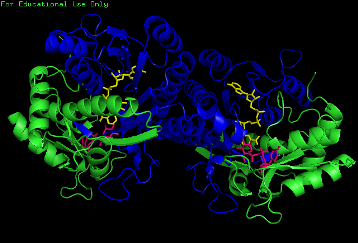
A enzima UDP-glicose 4-epimerase, também conhecida como UDP-galactose 4-epimerase ou GALE, é uma epimerase homodimérica encontrada em células bacterianas, fúngicas, vegetais e de mamíferos. Esta enzima realiza a etapa final da via de Leloir do metabolismo da galactose, catalisando a conversão reversível de UDP-galactose em UDP-glicose. A GALE liga-se fortemente ao nicotinamida adenina dinucleotídeo (NAD+), um cofator necessário para a atividade catalítica.
Introdução
O que você precisa saber de cara
Visão geral
A deficiência de galactose mutarotase é uma doença hereditária rara que afeta o metabolismo da galactose, um açúcar presente no leite e em outros alimentos. Ela é causada por alterações no gene GALM, que fornece instruções para a produção da enzima galactose mutarotase. Essa condição geralmente se manifesta no período neonatal ou na primeira infância, com acúmulo de galactose no sangue (hipergalactosemia) e comprometimento do metabolismo desse açúcar. A prevalência exata ainda é desconhecida.[1][4]
Sinais e sintomas
Os sinais e sintomas da deficiência de galactose mutarotase podem incluir catarata (opacificação do cristalino do olho), função hepática diminuída, aumento do fígado (hepatomegalia), icterícia neonatal prolongada (coloração amarelada da pele e olhos), colestase (redução do fluxo biliar), sepse (infecção generalizada), déficit de crescimento, atraso global do desenvolvimento e anormalidades do sistema nervoso. A hipergalactosemia (níveis elevados de galactose no sangue) é uma característica laboratorial central.[1][4]
Causas genéticas
A doença é herdada de forma autossômica recessiva, o que significa que a pessoa precisa herdar uma cópia alterada do gene GALM de cada um dos pais para desenvolver a condição. O gene GALM (galactose mutarotase) é responsável por codificar a enzima que converte a galactose em uma forma utilizável pelo organismo. Mutações nesse gene levam à atividade anormal da enzima e ao acúmulo de galactose.[1][2][5]
Diagnóstico
O diagnóstico é baseado na identificação de hipergalactosemia e na confirmação por meio de testes genéticos que detectam mutações no gene GALM. Atualmente, existem 30 variantes patogênicas ou provavelmente patogênicas registradas no ClinVar para esse gene, e 4 testes genéticos estão disponíveis para a doença. A análise enzimática também pode mostrar atividade anormal da galactose mutarotase.[1][2][5]
Tratamento e manejo
O manejo da deficiência de galactose mutarotase geralmente envolve a restrição dietética de galactose, especialmente nos primeiros anos de vida, para reduzir os níveis sanguíneos desse açúcar e prevenir complicações como catarata e danos hepáticos. Não há medicamentos específicos aprovados para o tratamento da doença. O acompanhamento deve ser multidisciplinar, incluindo pediatra, geneticista, oftalmologista e nutricionista. No Brasil, a doença não possui cobertura pelo Sistema Único de Saúde (SUS) para procedimentos específicos.[1][2]
Prognóstico e qualidade de vida
O prognóstico depende do diagnóstico precoce e da adesão à restrição dietética de galactose. Com intervenção adequada, muitos dos sintomas iniciais, como catarata e disfunção hepática, podem ser reversíveis ou controlados. No entanto, atrasos no desenvolvimento e anormalidades neurológicas podem persistir em alguns casos. A qualidade de vida pode ser significativamente melhorada com suporte nutricional e acompanhamento médico regular.[1][4]
Conteúdo informativo gerado e mantido automaticamente a partir de fontes oficiais (Orphanet, HPO, OMIM, SUS). Não substitui avaliação médica.
A enzima UDP-glicose 4-epimerase, também conhecida como UDP-galactose 4-epimerase ou GALE, é uma epimerase homodimérica encontrada em células bacterianas, fúngicas, vegetais e de mamíferos. Esta enzima realiza a etapa final da via de Leloir do metabolismo da galactose, catalisando a conversão reversível de UDP-galactose em UDP-glicose. A GALE liga-se fortemente ao nicotinamida adenina dinucleotídeo (NAD+), um cofator necessário para a atividade catalítica.
Escala de raridade
<1/50kMuito rara
1/20kRara
1/10kPouco freq.
1/5kIncomum
1/2k
Encontrou um erro ou informação desatualizada? Sugira uma correção →
Entender a doença
Do básico ao detalhe, leia no seu ritmo
Preparando trilha educativa...
Sinais e sintomas
O que aparece no corpo e com que frequência cada sintoma acontece
Visão geral
A deficiência de galactose mutarotase é uma doença hereditária rara que afeta o metabolismo da galactose, um açúcar presente no leite e em outros alimentos. Ela é causada por alterações no gene GALM, que fornece instruções para a produção da enzima galactose mutarotase. Essa condição geralmente se manifesta no período neonatal ou na primeira infância, com acúmulo de galactose no sangue (hipergalactosemia) e comprometimento do metabolismo desse açúcar. A prevalência exata ainda é desconhecida.[1][4]
Sinais e sintomas
Os sinais e sintomas da deficiência de galactose mutarotase podem incluir catarata (opacificação do cristalino do olho), função hepática diminuída, aumento do fígado (hepatomegalia), icterícia neonatal prolongada (coloração amarelada da pele e olhos), colestase (redução do fluxo biliar), sepse (infecção generalizada), déficit de crescimento, atraso global do desenvolvimento e anormalidades do sistema nervoso. A hipergalactosemia (níveis elevados de galactose no sangue) é uma característica laboratorial central.[1][4]
Causas genéticas
A doença é herdada de forma autossômica recessiva, o que significa que a pessoa precisa herdar uma cópia alterada do gene GALM de cada um dos pais para desenvolver a condição. O gene GALM (galactose mutarotase) é responsável por codificar a enzima que converte a galactose em uma forma utilizável pelo organismo. Mutações nesse gene levam à atividade anormal da enzima e ao acúmulo de galactose.[1][2][5]
Diagnóstico
O diagnóstico é baseado na identificação de hipergalactosemia e na confirmação por meio de testes genéticos que detectam mutações no gene GALM. Atualmente, existem 30 variantes patogênicas ou provavelmente patogênicas registradas no ClinVar para esse gene, e 4 testes genéticos estão disponíveis para a doença. A análise enzimática também pode mostrar atividade anormal da galactose mutarotase.[1][2][5]
Tratamento e manejo
O manejo da deficiência de galactose mutarotase geralmente envolve a restrição dietética de galactose, especialmente nos primeiros anos de vida, para reduzir os níveis sanguíneos desse açúcar e prevenir complicações como catarata e danos hepáticos. Não há medicamentos específicos aprovados para o tratamento da doença. O acompanhamento deve ser multidisciplinar, incluindo pediatra, geneticista, oftalmologista e nutricionista. No Brasil, a doença não possui cobertura pelo Sistema Único de Saúde (SUS) para procedimentos específicos.[1][2]
Prognóstico e qualidade de vida
O prognóstico depende do diagnóstico precoce e da adesão à restrição dietética de galactose. Com intervenção adequada, muitos dos sintomas iniciais, como catarata e disfunção hepática, podem ser reversíveis ou controlados. No entanto, atrasos no desenvolvimento e anormalidades neurológicas podem persistir em alguns casos. A qualidade de vida pode ser significativamente melhorada com suporte nutricional e acompanhamento médico regular.[1][4]
Conteúdo informativo gerado e mantido automaticamente a partir de fontes oficiais (Orphanet, HPO, OMIM, SUS). Não substitui avaliação médica.
Partes do corpo afetadas
+ 8 sintomas em outras categorias
Características mais comuns
Os sintomas variam de pessoa para pessoa. Abaixo estão as 14 características clínicas mais associadas, ordenadas por frequência.
Linha do tempo da pesquisa
Encontrou um erro ou informação desatualizada? Sugira uma correção →
Genética e causas
O que está alterado no DNA e como passa nas famílias
Genes associados
1 gene identificado com associação a esta condição. Padrão de herança: Autosomal recessive.
Curadoria gene-doença
fontes oficiaisMutarotase that catalyzes the interconversion of beta-D-galactose and alpha-D-galactose during galactose metabolism (PubMed:12753898). Beta-D-galactose is metabolized in the liver into glucose 1-phosphate, the primary metabolic fuel, by the action of four enzymes that constitute the Leloir pathway: GALM, GALK1 (galactokinase), GALT (galactose-1-phosphate uridylyltransferase) and GALE (UDP-galactose-4'-epimerase) (PubMed:30451973). Involved in the maintenance of the equilibrium between the beta-
Cytoplasm
Galactosemia 4
A form of galactosemia, an inborn error of galactose metabolism typically manifesting in the neonatal period, after ingestion of galactose, with jaundice, hepatosplenomegaly, hepatocellular insufficiency, food intolerance, hypoglycemia, renal tubular dysfunction, muscle hypotonia, sepsis and cataract. GALAC4 inheritance is autosomal recessive.
Variantes genéticas (ClinVar)
30 variantes patogênicas registradas no ClinVar.
Vias biológicas (Reactome)
2 vias biológicas associadas aos genes desta condição.
Diagnóstico
Os sinais que médicos procuram e os exames que confirmam
Tratamento e manejo
Remédios, cuidados de apoio e o que precisa acompanhar
Onde tratar no SUS
Hospitais de referência no Brasil e o protocolo oficial do SUS (PCDT)
🇧🇷 Atendimento SUS — Deficiência de galactose mutarotase
Selecione um estado ou use sua localização para ver resultados.
Dados de DATASUS/CNES, SBGM, ABNeuro e Ministério da Saúde. Sempre confirme a disponibilidade diretamente com o estabelecimento.
Pesquisa ativa
Ensaios clínicos abertos e novidades científicas recentes
Pesquisa e ensaios clínicos
Nenhum ensaio clínico registrado para esta condição.
Publicações mais relevantes
Galactose mutarotase deficiency as the galactosemia type IV.
Galactose, a monosaccharide, plays diverse biological roles in energy production, especially in the glycolysis and glycosylation of proteins and lipids. Galactose metabolism is mediated by the Leloir pathway, which comprises four key enzymes. Following lactose hydrolysis, galactose mutarotase (GALM) catalyzes the anomerization of β-D-galactose to α-D-galactose, providing a substrate for the downstream pathway. In 2019, GALM deficiency was defined as the fourth type of galactosemia. Affected individuals may develop cataracts similar to those observed in individuals with galactokinase deficiency, disrupting the subsequent steps in the Leloir pathway. However, cataracts generally occur less frequently and tend to be milder in patients with GALM deficiency, likely because of the partial compensation provided by spontaneous galactose mutarotation in aqueous solutions. Because lactose, the primary dietary source of galactose, is the predominant carbohydrate consumed until weaning, the timely initiation of lactose restriction can prevent or even reverse cataract formation. To date, other complications or adverse events, including those in heterozygous carriers of GALM variants, have not been clearly demonstrated. This review aims to synthesize current knowledge and findings of GALM deficiency on molecular mechanisms, clinical presentation, diagnostic approaches, carrier risk, and dietary management, with particular emphasis on cataract prevention and reversibility through early lactose restriction. By consolidating available evidence, we propose future research directions, with broader implications for newborn screening programs, clinical decision-making, and a deeper understanding of galactose metabolism.
Clinical and biochemical evolution after partial dietary liberalization of two cases of galactosemia due to galactose mutarotase deficiency.
The recommended diet attitude in the recently described galactose mutarotase (GALM) deficiency is not yet established. We describe two 9-years twins who remain asymptomatic despite prolonged partial dietary liberalization from 18 months of age, after two periods of galactose-free diet. It represents the second report in Europe of GALM deficiency. Two male monochorionic diamniotic twins were detected through newborn screening by galactosuria and increased total blood galactose. They started galactose dietary restriction with biochemical normalization. After exclusion of the three previously described types of galactosemia, a progressively galactose reintroduction was initiated. The clinical follow-up developed include neurological assessment and intelligence quotient, annual ophthalmological evaluation and biannual abdominal ultrasound; whereas the biochemical assessment comprises quarterly determinations of galactose 1-phosphate and galactosuria and annual determination of liver and renal function, 25-OH-vitamin D and calcium levels. Sanger sequencing of GALM gene was complemented by the study of gene dose using SNPs array and a protein modeling to study the conformational changes induced in GALM protein. In both siblings a novel and complete deletion of exon 4 in GALM gene was detected. Both remained asymptomatic, with normal growth and intellectual development, despite dietary liberalization. Evolutionarily, the biochemical profile in blood remained normal with intermittent galactosuria. The absence of clinical involvement after 7 years of dietary liberalization is interesting to expand the knowledge about the recommended dietary management in this pathology.
Phenotypic and genetic spectra of galactose mutarotase deficiency: A nationwide survey conducted in Japan.
Galactose mutarotase (GALM) deficiency was first reported in 2019 as the fourth type of galactosemia. This study aimed to investigate the clinical and genotypic spectra of GALM deficiency. This was a questionnaire-based retrospective survey conducted in Japan between February 2022 and March 2023. We identified 40 patients with GALM deficiency in Japan (estimated prevalence: 1:181,835). Four of 38 patients (10.5%) developed cataracts, which resolved with lactose restriction in 3 out of 4 patients. Transient transaminitis was the most common symptom (23.1%). All of the patients followed lactose restriction; discontinuation of the restriction after infancy did not cause any complications. Moreover, none of the participants experienced long-term complications. Two variants, GALM NM_138801.3: c.294del and c.424G>A, accounted for 72.5% of the identified pathogenic variants. The patients showed moderately elevated blood galactose levels with lactose intake; however, the elevation was lower than that observed in galactokinase deficiency. GALM deficiency is characterized by a similar but milder phenotype and lower blood galactose elevation than in galactokinase deficiency. Diagnosis and initiation of lactose restriction in early infancy should be essential for prevention of cataracts, especially in cases of irreversible opacity.
β-Galactosidase therapy can mitigate blood galactose elevation after an oral lactose load in galactose mutarotase deficiency.
Galactose mutarotase (GALM) deficiency (MIM# 618881), also known as type IV galactosemia, is caused by biallelic pathogenic variants of GALM. Cataracts are observed in patients with GALM deficiency as well as in other conditions associated with high levels of blood galactose and can be prevented by consuming a galactose-restricted diet or formula. Galactose restriction is the only known treatment for GALM deficiency and other types of galactosemia. We incidentally found that β-galactosidase might reduce blood galactose levels caused by lactose loading in GALM deficiency. Consequently, we investigated the effectiveness of β-galactosidase in decreasing the level of blood galactose in three patients with GALM deficiency. We performed two lactose loading tests per case: one with and one without β-galactosidase. The add-on administration of β-galactosidase significantly mitigated blood galactose elevations after lactose loading. Although urine galactitol was mildly elevated in all patients with GALM deficiency, β-galactosidase did not prevent increased levels of urine galactitol during the loading tests. No adverse events, including cataracts, were observed during or after the tests. Therefore, β-galactosidase could be a potential novel treatment agent for blood galactose elevation caused by lactose in patients with GALM deficiency. The effectiveness of β-galactosidase could possibly result in loosening of the galactose dietary restrictions or treatment for patients with GALM deficiency.
Two siblings with galactose mutarotase deficiency: Clinical differences.
Galactose mutarotase (GALM) deficiency is an inherited metabolic disease caused by the deficiency of the first enzyme in the Leloir pathway. GALM deficiency was first reported in 2018. To date, eight cases have been reported. We are presenting two siblings with GALM deficiency; one patient presented with cataracts and her brother was asymptomatic. We evaluated the first case due to a cataract at 3 months old. She had elevated galactose and galactose-1-phosphate and normal galactose-1-phosphate uridylyltransferase (GALT) activity. Genetic analysis and other laboratory and clinical findings excluded galactokinase-1 (GALK1) and UDP-galactose 4'-epimerase (GALE) deficiencies. She had a homozygous mutation p. Gly277Arg (c.829G>A) in the GALM (NM_138801) gene. She was 3 years old at the last visit, and her physical examination was normal, except for cataracts. The same mutation was found to be homozygous in the patient's asymptomatic sibling during family screening. He had normal blood galactose and galactose-1-phosphate. This study highlights the importance of evaluating the whole galactose metabolism in terms of GALM deficiency in patients with cataracts.
Publicações recentes
Galactose mutarotase deficiency as the galactosemia type IV.
Clinical and biochemical evolution after partial dietary liberalization of two cases of galactosemia due to galactose mutarotase deficiency.
Phenotypic and genetic spectra of galactose mutarotase deficiency: A nationwide survey conducted in Japan.
Two siblings with galactose mutarotase deficiency: Clinical differences.
β-Galactosidase therapy can mitigate blood galactose elevation after an oral lactose load in galactose mutarotase deficiency.
📚 EuropePMC5 artigos no totalmostrando 5
Galactose mutarotase deficiency as the galactosemia type IV.
Journal of human geneticsClinical and biochemical evolution after partial dietary liberalization of two cases of galactosemia due to galactose mutarotase deficiency.
BMC pediatricsPhenotypic and genetic spectra of galactose mutarotase deficiency: A nationwide survey conducted in Japan.
Genetics in medicine : official journal of the American College of Medical GeneticsTwo siblings with galactose mutarotase deficiency: Clinical differences.
JIMD reportsβ-Galactosidase therapy can mitigate blood galactose elevation after an oral lactose load in galactose mutarotase deficiency.
Journal of inherited metabolic diseaseAssociações
Organizações que acompanham esta doença — pra ter apoio e orientação
Ainda não temos associações cadastradas para Deficiência de galactose mutarotase.
É de uma associação que acompanha esta doença? Fale com a gente →
Comunidades
Grupos ativos de quem convive com esta doença aqui no Raras
Ainda não existe comunidade no Raras para Deficiência de galactose mutarotase
Pacientes, familiares e cuidadores se organizam em comunidades pra compartilhar experiências, fazer perguntas e se apoiar. Você pode ser o primeiro.
Tire suas dúvidas
Perguntas, dicas e experiências compartilhadas aqui na página
Participe da discussão
Faça login para postar dúvidas, compartilhar experiências e interagir com especialistas.
Fazer loginDoenças relacionadas
Doenças com sintomas parecidos — ajudam quem ainda está buscando diagnóstico
Referências e fontes
Bases de dados externas citadas neste artigo
Publicações científicas
Artigos indexados no PubMed ligados a esta doença no grafo RarasNet — título, periódico e PMID direto da fonte, sem intermediação de IA.
- Galactose mutarotase deficiency as the galactosemia type IV.
- Clinical and biochemical evolution after partial dietary liberalization of two cases of galactosemia due to galactose mutarotase deficiency.
- Phenotypic and genetic spectra of galactose mutarotase deficiency: A nationwide survey conducted in Japan.Genetics in medicine : official journal of the American College of Medical Genetics· 2024· PMID 38762772mais citado
- β-Galactosidase therapy can mitigate blood galactose elevation after an oral lactose load in galactose mutarotase deficiency.
- Two siblings with galactose mutarotase deficiency: Clinical differences.
Bases de dados e fontes oficiais
Identificadores e referências canônicas usadas para montar este verbete.
- ORPHA:570422(Orphanet)
- OMIM OMIM:618881(OMIM)
- MONDO:0030105(MONDO)
- GARD:18005(GARD (NIH))
- Variantes catalogadas(ClinVar)
- Busca completa no PubMed(PubMed)
Dados compilados pelo RarasNet a partir de fontes abertas (Orphanet, OMIM, MONDO, PubMed/EuropePMC, ClinicalTrials.gov, DATASUS, PCDT/MS). Este conteúdo é informativo e não substitui avaliação médica.
Conteúdo mantido por Agente Raras · Médicos e pesquisadores podem colaborar
Deficiência de galactose mutarotase
📋 Origem dos dados
Esta página agrega dados de fontes públicas e oficiais. Dados sobre cobertura no SUS (PCDT, CEAF) são verificados ativamente por agente proativo (ver badge no infobox). Demais dados têm atribuição de fonte + data da última sincronização — clique para abrir o original.
- Doença rara (ontologia)
- fonte: Orphanet
- Identificador unificado
- fonte: MONDO
- Genética mendeliana
- fonte: OMIM
- Codificação WHO/SUS
- fonte: WHO ICD-10 / DATASUS
- CID-11 (futuro)
- fonte: WHO ICD-11
- NIH/GARD
- fonte: GARD (NIH)