
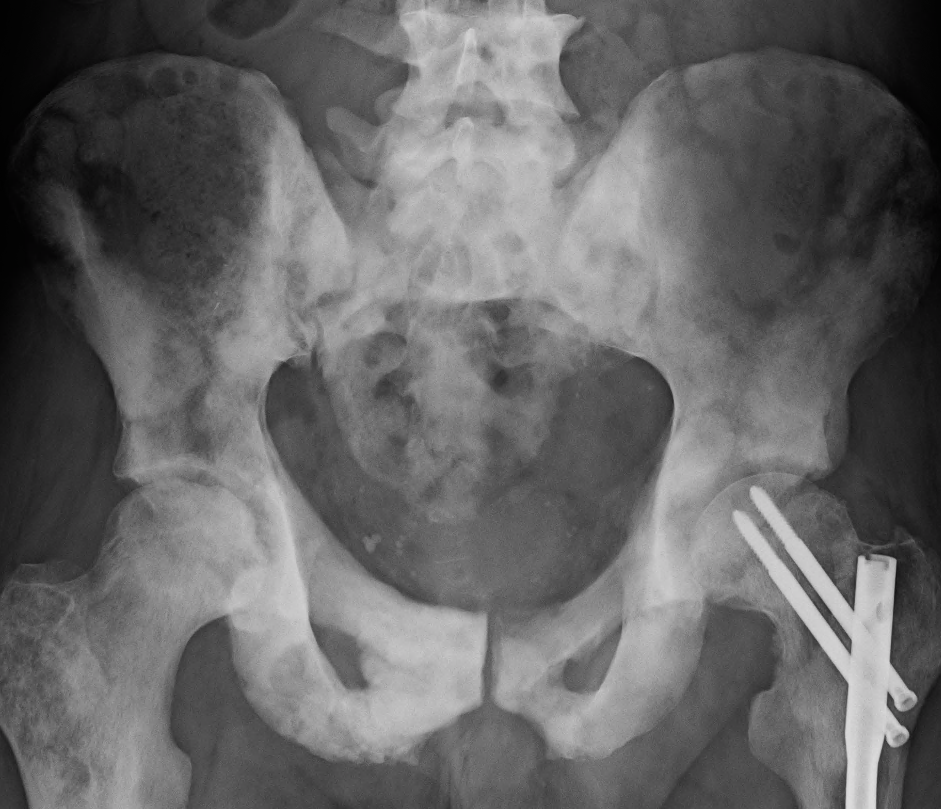
Osteosclerose generalizada com formação óssea periosteal, dismorfismo facial característico, anormalidades cerebrais incluindo calcificações intracerebrais e curso letal neonatal.
Introdução
O que você precisa saber de cara
Osteosclerose generalizada com formação óssea periosteal, dismorfismo facial característico, anormalidades cerebrais incluindo calcificações intracerebrais e curso letal neonatal.
Escala de raridade
<1/50kMuito rara
1/20kRara
1/10kPouco freq.
1/5kIncomum
1/2k
Encontrou um erro ou informação desatualizada? Sugira uma correção →
Entender a doença
Do básico ao detalhe, leia no seu ritmo
Preparando trilha educativa...
Sinais e sintomas
O que aparece no corpo e com que frequência cada sintoma acontece
Partes do corpo afetadas
+ 19 sintomas em outras categorias
Características mais comuns
Os sintomas variam de pessoa para pessoa. Abaixo estão as 61 características clínicas mais associadas, ordenadas por frequência.
Linha do tempo da pesquisa
Encontrou um erro ou informação desatualizada? Sugira uma correção →
Genética e causas
O que está alterado no DNA e como passa nas famílias
Genes associados
1 gene identificado com associação a esta condição. Padrão de herança: Autosomal recessive.
Curadoria gene-doença
fontes oficiaisGolgi serine/threonine protein kinase that phosphorylates secretory pathway proteins within Ser-x-Glu/pSer motifs and plays a key role in biomineralization of bones and teeth (PubMed:22582013, PubMed:23754375, PubMed:25789606). Constitutes the main protein kinase for extracellular proteins, generating the majority of the extracellular phosphoproteome (PubMed:26091039). Mainly phosphorylates proteins within the Ser-x-Glu/pSer motif, but also displays a broader substrate specificity (PubMed:260910
Golgi apparatus membraneSecretedEndoplasmic reticulum
Raine syndrome
An autosomal recessive osteosclerotic bone dysplasia with neonatal lethal outcome, although some patients survive into childhood. Clinical features include generalized increase in the density of all bones and a marked increase in the ossification of the skull, craniofacial dysplasia and microcephaly.
Variantes genéticas (ClinVar)
85 variantes patogênicas registradas no ClinVar.
Classificação de variantes (ClinVar)
Distribuição de 53 variantes classificadas pelo ClinVar.
Vias biológicas (Reactome)
2 vias biológicas associadas aos genes desta condição.
Diagnóstico
Os sinais que médicos procuram e os exames que confirmam
Tratamento e manejo
Remédios, cuidados de apoio e o que precisa acompanhar
Onde tratar no SUS
Hospitais de referência no Brasil e o protocolo oficial do SUS (PCDT)
🇧🇷 Atendimento SUS — Displasia óssea osteosclerótica
Selecione um estado ou use sua localização para ver resultados.
Dados de DATASUS/CNES, SBGM, ABNeuro e Ministério da Saúde. Sempre confirme a disponibilidade diretamente com o estabelecimento.
Pesquisa ativa
Ensaios clínicos abertos e novidades científicas recentes
Pesquisa e ensaios clínicos
Nenhum ensaio clínico registrado para esta condição.
Publicações mais relevantes
A synonymous single nucleotide variant on the FAM20C gene causes non-lethal Raine syndrome.
Raine syndrome (RNS) is an autosomal recessive neonatal osteosclerotic bone dysplasia that usually results in death in the postnatal period. Patients present with abnormal craniofacial features and widespread periosteal osteosclerosis affecting the ribs, skull, and long bones. Nonlethal forms of RNS have recently been reported. Biallelic mutations in the FAM20C gene, which encodes a Golgi serine/threonine protein kinase that phosphorylates secretory pathway proteins, are responsible for RNS. In this study, we examined a Turkish family consisting of three patients by exome sequencing and found that the homozygous c.1071A > G transition at the second-to-last position of the 5' end of exon 5 gave rise to a synonymous variant (p.P357P) in FAM20C. Subsequent mRNA (cDNA) sequencing of FAM20C showed that the c.1071A > G substitution disrupted the splice junction and directed the splicing to a new location in intron 5, resulting in an in-frame 12 amino acid insertion into the protein. FAM20C is a serine/threonine protein kinase that localizes to the Golgi apparatus by forming a homo- or hetero-dimer and/or is secreted from the cell to phosphorylate secretory proteins. Functional analysis showed that the identified insertion did not disrupt either homo- or hetero-dimerization of the FAM20C protein. However, this variant protein failed to localize properly to the Golgi apparatus and exhibited poor secretion from the cell. All these findings suggest that the identified variant causing the 12 amino acid insertion is responsible for the nonlethal form of RNS in the family and provides mechanistic insight into the molecular pathogenesis of RNS.
Altered sulfation status of FAM20C-dependent chondroitin sulfate is associated with osteosclerotic bone dysplasia.
Raine syndrome, a lethal osteosclerotic bone dysplasia in humans, is caused by loss-of-function mutations in FAM20C; however, Fam20c deficiency in mice does not recapitulate the human disorder, so the underlying pathoetiological mechanisms remain poorly understood. Here we show that FAM20C, in addition to the reported casein kinase activity, also fine-tunes the biosynthesis of chondroitin sulfate (CS) chains to impact bone homeostasis. Specifically, FAM20C with Raine-originated mutations loses the ability to interact with chondroitin 4-O-sulfotransferase-1, and is associated with reduced 4-sulfation/6-sulfation (4S/6S) ratio of CS chains and upregulated biomineralization in human osteosarcoma cells. By contrast, overexpressing chondroitin 6-O-sulfotransferase-1 reduces CS 4S/6S ratio, and induces osteoblast differentiation in vitro and higher bone mineral density in transgenic mice. Meanwhile, a potential xylose kinase activity of FAM20C does not impact CS 4S/6S ratio, and is not associated with Raine syndrome mutations. Our results thus implicate CS 4S/6S ratio imbalances caused by FAM20C mutations as a contributor of Raine syndrome etiology.
Recurrent variant c.1680C>A in FAM20C gene and genotype-phenotype correlation in a patient with Raine syndrome: a case report.
Bi-allelic mutations in FAM20C gene are known to cause a rare genetic disorder- Raine syndrome (RS). The FAM20C protein binds calcium and phosphorylates proteins involved in biomineralization of bones and teeth. RS is recognized as an osteosclerotic bone dysplasia. It is characterized by distinctive facial features, generalized osteosclerosis and respiratory insufficiency along with periosteal bone formation. RS is typically described as being an aggressive skeletal dysplasia with death in the neonatal period or early infancy. However, in the recent past an increasing number of individuals having an extended life span along with a highly heterogeneous phenotype has led to classifying RS into short and extended lifespan categories. We report a case of RS with antenatal fractures, facial dysmorphism and osteosclerosis without significant respiratory manifestations. The child has a relatively extended lifespan, whereby she died at 17-months of age. Clinical exome sequencing revealed a previously known, homozygous, nonsense variant c.1680C > A (p.Cys560Ter) in exon 10 of FAM20C. Whilst the variant was initially classified as a variant of uncertain significance (VUS), through the latest release of gnomAD and GTEx data, this was subsequently re-classified as likely pathogenic. Furthermore, segregation analysis showed both parents to be carriers. In contrast, a previously reported case with the same variant had polyhydramnios, complex facial abnormalities and bright echogenic brain parenchyma with oval shaped skull and anterior flattening at 26 weeks of gestation. The variant identified has been previously reported as a VUS. The present case provides further evidence towards the pathogenicity of the variant. A plausible genotype-phenotype correlation based on the location of the variant has been verified, wherein the position of a nonsense variant in the terminal exon of FAM20C gene, could have had a partial effect on the protein function, thereby resulting in a relatively milder phenotype and extended lifespan. Furthermore, the vast phenotypic variation on clinical comparison current case and a previously reported case, despite having the same genotype, could suggest an oligogenic effect and/ or environmental influence.
Hypophosphataemic Rickets Secondary to Raine Syndrome: A Review of the Literature and Case Reports of Three Paediatric Patients' Dental Management.
Raine Syndrome (RS) also referred to as lethal osteosclerotic bone dysplasia describes an exceptionally rare autosomal recessive disorder with an estimated prevalence of <1 in 1,000,000. Endocrinological manifestations such as hypophosphataemic rickets depict a recent finding within the phenotypic spectrum of nonlethal RS. The dental sequelae of hypophosphataemic rickets are significant. Spontaneous recurrent abscesses on noncarious teeth result in significant odontogenic pain and multiple dental interventions. The dental presentations of nonlethal RS are less widely described within the literature. Amelogenesis Imperfecta (AI), however, was recently postulated as a key characteristic. This article presents the dental manifestations and extensive restorative and oral surgical intervention of three siblings with hypophosphataemic rickets secondary to Raine Syndrome treated at Great Ormond Street Hospital for Children, a tertiary referral hospital.
Nonlethal Raine Syndrome in a Newborn Boy Caused by a Novel FAM20C Variant.
Raine syndrome (RS) is a rare genetic disorder characterized by osteosclerotic bone dysplasia caused by a homozygous mutation, compound heterozygous mutation, or microdeletion in the FAM20C gene. In the present study, the MiSeq next-generation sequencing platform was used to perform the FAM20C gene sequence analysis. A novel homozygous variant c.1255T>C (p.W419R) in the FAM20C gene was diagnosed, and a nonlethal RS phenotype was confirmed, thus contributing to the expansion of the nonlethal RS phenotype. Since there is limited information about rare diseases, we believe that these studies will contribute to the literature and to the understanding of how these disorders develop and progress.
Publicações recentes
A synonymous single nucleotide variant on the FAM20C gene causes non-lethal Raine syndrome.
Altered sulfation status of FAM20C-dependent chondroitin sulfate is associated with osteosclerotic bone dysplasia.
Nonlethal Raine Syndrome in a Newborn Boy Caused by a Novel FAM20C Variant.
Recurrent variant c.1680C>A in FAM20C gene and genotype-phenotype correlation in a patient with Raine syndrome: a case report.
Hypophosphataemic Rickets Secondary to Raine Syndrome: A Review of the Literature and Case Reports of Three Paediatric Patients' Dental Management.
📚 EuropePMC8 artigos no totalmostrando 9
A synonymous single nucleotide variant on the FAM20C gene causes non-lethal Raine syndrome.
Human molecular geneticsAltered sulfation status of FAM20C-dependent chondroitin sulfate is associated with osteosclerotic bone dysplasia.
Nature communicationsNonlethal Raine Syndrome in a Newborn Boy Caused by a Novel FAM20C Variant.
Molecular syndromologyRecurrent variant c.1680C>A in FAM20C gene and genotype-phenotype correlation in a patient with Raine syndrome: a case report.
BMC pediatricsHypophosphataemic Rickets Secondary to Raine Syndrome: A Review of the Literature and Case Reports of Three Paediatric Patients' Dental Management.
Case reports in pediatricsRaine Syndrome, a Rare Lethal Osteosclerotic Bone Dysplasia: Prenatal Diagnosis With 3-Dimensional Ultrasound and a Postnatal Clinical Exome Evaluation.
Journal of ultrasound in medicine : official journal of the American Institute of Ultrasound in MedicineA novel FAM20C mutation causes a rare form of neonatal lethal Raine syndrome.
American journal of medical genetics. Part AFetal ultrasonographic findings including cerebral hyperechogenicity in a patient with non-lethal form of Raine syndrome.
American journal of medical genetics. Part ARaine Syndrome (OMIM #259775), Caused By FAM20C Mutation, Is Congenital Sclerosing Osteomalacia With Cerebral Calcification (OMIM 259660).
Journal of bone and mineral research : the official journal of the American Society for Bone and Mineral ResearchAssociações
Organizações que acompanham esta doença — pra ter apoio e orientação
Ainda não temos associações cadastradas para Displasia óssea osteosclerótica.
É de uma associação que acompanha esta doença? Fale com a gente →
Comunidades
Grupos ativos de quem convive com esta doença aqui no Raras
Ainda não existe comunidade no Raras para Displasia óssea osteosclerótica
Pacientes, familiares e cuidadores se organizam em comunidades pra compartilhar experiências, fazer perguntas e se apoiar. Você pode ser o primeiro.
Tire suas dúvidas
Perguntas, dicas e experiências compartilhadas aqui na página
Participe da discussão
Faça login para postar dúvidas, compartilhar experiências e interagir com especialistas.
Fazer loginDoenças relacionadas
Doenças com sintomas parecidos — ajudam quem ainda está buscando diagnóstico
Referências e fontes
Bases de dados externas citadas neste artigo
Publicações científicas
Artigos indexados no PubMed ligados a esta doença no grafo RarasNet — título, periódico e PMID direto da fonte, sem intermediação de IA.
- A synonymous single nucleotide variant on the FAM20C gene causes non-lethal Raine syndrome.
- Altered sulfation status of FAM20C-dependent chondroitin sulfate is associated with osteosclerotic bone dysplasia.
- Recurrent variant c.1680C>A in FAM20C gene and genotype-phenotype correlation in a patient with Raine syndrome: a case report.
- Hypophosphataemic Rickets Secondary to Raine Syndrome: A Review of the Literature and Case Reports of Three Paediatric Patients' Dental Management.
- Nonlethal Raine Syndrome in a Newborn Boy Caused by a Novel FAM20C Variant.
Bases de dados e fontes oficiais
Identificadores e referências canônicas usadas para montar este verbete.
- ORPHA:1832(Orphanet)
- OMIM OMIM:259660(OMIM)
- MONDO:0009821(MONDO)
- GARD:282(GARD (NIH))
- Variantes catalogadas(ClinVar)
- Busca completa no PubMed(PubMed)
- Q7284803(Wikidata)
Dados compilados pelo RarasNet a partir de fontes abertas (Orphanet, OMIM, MONDO, PubMed/EuropePMC, ClinicalTrials.gov, DATASUS, PCDT/MS). Este conteúdo é informativo e não substitui avaliação médica.
Conteúdo mantido por Agente Raras · Médicos e pesquisadores podem colaborar
Displasia óssea osteosclerótica
📋 Origem dos dados
Esta página agrega dados de fontes públicas e oficiais. Dados sobre cobertura no SUS (PCDT, CEAF) são verificados ativamente por agente proativo (ver badge no infobox). Demais dados têm atribuição de fonte + data da última sincronização — clique para abrir o original.
- Doença rara (ontologia)
- fonte: Orphanet
- Identificador unificado
- fonte: MONDO
- Genética mendeliana
- fonte: OMIM
- Codificação WHO/SUS
- fonte: WHO ICD-10 / DATASUS
- CID-11 (futuro)
- fonte: WHO ICD-11
- NIH/GARD
- fonte: GARD (NIH)
- Indexação biomédica
- fonte: MeSH (NLM)
- Dado público estruturado
- fonte: Wikidata