
A displasia de Schneckenbecken (ou condrodisplasia com pelve em forma de caracol) é uma displasia espondilodisplásica letal no período pré-natal.
Introdução
O que você precisa saber de cara
A displasia de Schneckenbecken (ou condrodisplasia com pelve em forma de caracol) é uma displasia espondilodisplásica letal no período pré-natal.
Escala de raridade
<1/50kMuito rara
1/20kRara
1/10kPouco freq.
1/5kIncomum
1/2k
Encontrou um erro ou informação desatualizada? Sugira uma correção →
Entender a doença
Do básico ao detalhe, leia no seu ritmo
Preparando trilha educativa...
Sinais e sintomas
O que aparece no corpo e com que frequência cada sintoma acontece
Partes do corpo afetadas
+ 20 sintomas em outras categorias
Características mais comuns
Os sintomas variam de pessoa para pessoa. Abaixo estão as 47 características clínicas mais associadas, ordenadas por frequência.
Linha do tempo da pesquisa
Encontrou um erro ou informação desatualizada? Sugira uma correção →
Genética e causas
O que está alterado no DNA e como passa nas famílias
Genes associados
2 genes identificados com associação a esta condição. Padrão de herança: Autosomal recessive.
Curadoria gene-doença
fontes oficiaisPhosphatidylinositol (PtdIns) phosphatase that specifically hydrolyzes the 5-phosphate of phosphatidylinositol-3,4,5-trisphosphate (PtdIns(3,4,5)P3) to produce PtdIns(3,4)P2, thereby negatively regulating the PI3K (phosphoinositide 3-kinase) pathways (PubMed:16824732). Required for correct mitotic spindle orientation and therefore progression of mitosis (By similarity). Plays a central role in regulation of PI3K-dependent insulin signaling, although the precise molecular mechanisms and signaling
Cytoplasm, cytosolCytoplasm, cytoskeletonMembraneCell projection, filopodiumCell projection, lamellipodiumBasal cell membraneNucleusNucleus speckleCytoplasm, cytoskeleton, spindle pole
Antiporter that transports nucleotide sugars across the endoplasmic reticulum (ER) membrane in exchange for either their cognate nucleoside monophosphate or another nucleotide sugar (PubMed:16965264, PubMed:17599910, PubMed:31423530). Transports various UDP-sugars including UDP-N-acetyl-alpha-D-glucosamine (UDP-GlcNAc), UDP-N-acetyl-alpha-D-galactosamine (UDP-GalNAc) and UDP-alpha-D-glucuronate (UDP-GlcA), which are used by ER glucosyltransferases as sugar donors for the synthesis of sugar chain
Endoplasmic reticulum membrane
Schneckenbecken dysplasia
A rare, lethal autosomal recessive skeletal dysplasia characterized by snail-like configuration of the hypoplastic iliac bone, short-limbed dwarfism, short ribs, and flattened, hypoplastic vertebral bodies. SHNKND is lethal in the neonatal period.
Variantes genéticas (ClinVar)
139 variantes patogênicas registradas no ClinVar.
Classificação de variantes (ClinVar)
Distribuição de 142 variantes classificadas pelo ClinVar.
Vias biológicas (Reactome)
7 vias biológicas associadas aos genes desta condição.
Diagnóstico
Os sinais que médicos procuram e os exames que confirmam
Tratamento e manejo
Remédios, cuidados de apoio e o que precisa acompanhar
Onde tratar no SUS
Hospitais de referência no Brasil e o protocolo oficial do SUS (PCDT)
🇧🇷 Atendimento SUS — Displasia de Schneckenbecken
Selecione um estado ou use sua localização para ver resultados.
Dados de DATASUS/CNES, SBGM, ABNeuro e Ministério da Saúde. Sempre confirme a disponibilidade diretamente com o estabelecimento.
Pesquisa ativa
Ensaios clínicos abertos e novidades científicas recentes
Pesquisa e ensaios clínicos
Nenhum ensaio clínico registrado para esta condição.
Publicações mais relevantes
A Mild Skeletal Dysplasia Caused by a Biallelic Missense Variant in the SLC35D1 Gene.
Biallelic variants in the SCL35D1 gene have been originally associated with a severe skeletal dysplasia called "Schneckenbecken dysplasia" because of the resemblance of the pelvic shape to a snail. More recently, SLC35D1 variants have been associated with much milder phenotypes of skeletal dysplasia. Our report describes one such individual with a novel SLC35D1 variant. A 17-year-old male with a coarse face and short stature was referred to our clinic. On his radiographic imaging, shortness of the long bones and metaphyseal flaring were detected. Using a clinical exome panel, we discovered a novel homozygous missense variant in the SLC35D1 gene, c.899G>T (p.Gly300Val). We identified a biallelic variant that was causative for a mild skeletal dysplasia and showed its phenotypic effects. Our observation confirms the existence of nonlethal skeletal dysplasias associated with biallelic SLC35D1 variants and suggests the existence of a phenotypic spectrum.
A novel SLC35D1 variant causing milder phenotype of Schneckenbecken dysplasia in a large pedigree.
SLC35D1 gene encodes UDP-glucuronic acid/UDP-n-acetylgalactosamine dual transporter protein and transports organic or inorganic molecules across cellular membranes. SLC35D1 gene pathogenic variants causes Schneckenbecken dysplasia (SHNKND) which is a rare lethal autosomal recessive disorder characterized by the snail-like pelvis, flattening of vertebral bodies, short and broad long bones with a dumbbell-like appearance, thoracic hypoplasia. Only six cases with homozygous SLC35D1 variants have been reported to date, and all of these cases were lost in the perinatal period. Here we report different family members with a novel SLC35D1 variant who presented a milder phenotype of SHNKND. The affected patients have common clinical features such as short stature, mild mesomelia, shortening of the lower extremity, genu valgum, and narrow thorax. Exome sequencing of the proband revealed a homozygous missense variant of SLC35D1 gene, c.401 T > C (p. Met134Thr). The affected siblings, their two cousins, and their paternal uncle with a similar phenotype were also homozygous for the variant. This is the first case report of a family with a novel likely pathogenic variant (p. Met134Thr) and mild phenotypic features. It has the largest family with different ages of patients (ages ranged 4-31 years old) reported to date. The present report supports the evidence that the p. Met134Thr variant is responsible for a milder phenotype than previously reported cases with SLC35D1 pathogenic variants.
Prenatal-onset INPPL1-related skeletal dysplasia in two unrelated families: Diagnosis and prediction of lethality.
This report describes two patients with INPPL1- related skeletal dysplasia diagnosed prenatally. A literature review is conducted to find out if high-lethality is associated with particular pathogenic variants in INPPL1 gene. Prediction of lethality in the prenatal setting has an impact on perinatal management. Some frameshift variants in INPLL1 gene are uniquely observed in lethal cases; however, more patients are needed to confirm the correlation.
A hypomorphic allele of SLC35D1 results in Schneckenbecken-like dysplasia.
We report the case of a consanguineous couple who lost four pregnancies associated with skeletal dysplasia. Radiological examination of one fetus was inconclusive. Parental exome sequencing showed that both parents were heterozygous for a novel missense variant, p.(Pro133Leu), in the SLC35D1 gene encoding a nucleotide sugar transporter. The affected fetus was homozygous for the variant. The radiological features were reviewed, and being similar, but atypical, the phenotype was classified as a 'Schneckenbecken-like dysplasia.' The effect of the missense change was assessed using protein modelling techniques and indicated alterations in the mouth of the solute channel. A detailed biochemical investigation of SLC35D1 transport function and that of the missense variant p.(Pro133Leu) revealed that SLC35D1 acts as a general UDP-sugar transporter and that the p.(Pro133Leu) mutation resulted in a significant decrease in transport activity. The reduced transport activity observed for p.(Pro133Leu) was contrasted with in vitro activity for SLC35D1 p.(Thr65Pro), the loss-of-function mutation was associated with Schneckenbecken dysplasia. The functional classification of SLC35D1 as a general nucleotide sugar transporter of the endoplasmic reticulum suggests an expanded role for this transporter beyond chondroitin sulfate biosynthesis to a variety of important glycosylation reactions occurring in the endoplasmic reticulum.
Molecular asymmetry in the 8-cell stage Xenopus tropicalis embryo described by single blastomere transcript sequencing.
Correct development of the vertebrate body plan requires the early definition of two asymmetric, perpendicular axes. The first axis is established during oocyte maturation, and the second is established by symmetry breaking shortly after fertilization. The physical processes generating the second asymmetric, or dorsal-ventral, axis are well understood, but the specific molecular determinants, presumed to be maternal gene products, are poorly characterized. Whilst enrichment of maternal mRNAs at the animal and vegetal poles in both the oocyte and the early embryo has been studied, little is known about the distribution of maternal mRNAs along either the dorsal-ventral or left-right axes during the early cleavage stages. Here we report an unbiased analysis of the distribution of maternal mRNA on all axes of the Xenopus tropicalis 8-cell stage embryo, based on sequencing of single blastomeres whose positions within the embryo are known. Analysis of pooled data from complete sets of blastomeres from four embryos has identified 908 mRNAs enriched in either the animal or vegetal blastomeres, of which 793 are not previously reported as enriched. In contrast, we find no evidence for asymmetric distribution along either the dorsal-ventral or left-right axes. We confirm that animal pole enrichment is on average distinctly lower than vegetal pole enrichment, and that considerable variation is found between reported enrichment levels in different studies. We use publicly available data to show that there is a significant association between genes with human disease annotation and enrichment at the animal pole. Mutations in the human ortholog of the most animally enriched novel gene, Slc35d1, are causative for Schneckenbecken dysplasia, and we show that a similar phenotype is produced by depletion of the orthologous protein in Xenopus embryos.
Publicações recentes
A Mild Skeletal Dysplasia Caused by a Biallelic Missense Variant in the SLC35D1 Gene.
A novel SLC35D1 variant causing milder phenotype of Schneckenbecken dysplasia in a large pedigree.
Prenatal-onset INPPL1-related skeletal dysplasia in two unrelated families: Diagnosis and prediction of lethality.
A hypomorphic allele of SLC35D1 results in Schneckenbecken-like dysplasia.
Molecular asymmetry in the 8-cell stage Xenopus tropicalis embryo described by single blastomere transcript sequencing.
📚 EuropePMC9 artigos no totalmostrando 6
A Mild Skeletal Dysplasia Caused by a Biallelic Missense Variant in the SLC35D1 Gene.
Molecular syndromologyA novel SLC35D1 variant causing milder phenotype of Schneckenbecken dysplasia in a large pedigree.
American journal of medical genetics. Part APrenatal-onset INPPL1-related skeletal dysplasia in two unrelated families: Diagnosis and prediction of lethality.
Clinical case reportsA hypomorphic allele of SLC35D1 results in Schneckenbecken-like dysplasia.
Human molecular geneticsMolecular asymmetry in the 8-cell stage Xenopus tropicalis embryo described by single blastomere transcript sequencing.
Developmental biologyA second locus for Schneckenbecken dysplasia identified by a mutation in the gene encoding inositol polyphosphate phosphatase-like 1 (INPPL1).
American journal of medical genetics. Part AAssociações
Organizações que acompanham esta doença — pra ter apoio e orientação
Ainda não temos associações cadastradas para Displasia de Schneckenbecken.
É de uma associação que acompanha esta doença? Fale com a gente →
Comunidades
Grupos ativos de quem convive com esta doença aqui no Raras
Ainda não existe comunidade no Raras para Displasia de Schneckenbecken
Pacientes, familiares e cuidadores se organizam em comunidades pra compartilhar experiências, fazer perguntas e se apoiar. Você pode ser o primeiro.
Tire suas dúvidas
Perguntas, dicas e experiências compartilhadas aqui na página
Participe da discussão
Faça login para postar dúvidas, compartilhar experiências e interagir com especialistas.
Fazer loginDoenças relacionadas
Doenças com sintomas parecidos — ajudam quem ainda está buscando diagnóstico
Referências e fontes
Bases de dados externas citadas neste artigo
Publicações científicas
Artigos indexados no PubMed ligados a esta doença no grafo RarasNet — título, periódico e PMID direto da fonte, sem intermediação de IA.
- A Mild Skeletal Dysplasia Caused by a Biallelic Missense Variant in the SLC35D1 Gene.
- A novel SLC35D1 variant causing milder phenotype of Schneckenbecken dysplasia in a large pedigree.
- Prenatal-onset INPPL1-related skeletal dysplasia in two unrelated families: Diagnosis and prediction of lethality.
- A hypomorphic allele of SLC35D1 results in Schneckenbecken-like dysplasia.
- Molecular asymmetry in the 8-cell stage Xenopus tropicalis embryo described by single blastomere transcript sequencing.
Bases de dados e fontes oficiais
Identificadores e referências canônicas usadas para montar este verbete.
- ORPHA:3144(Orphanet)
- OMIM OMIM:269250(OMIM)
- MONDO:0010013(MONDO)
- GARD:169(GARD (NIH))
- Variantes catalogadas(ClinVar)
- Busca completa no PubMed(PubMed)
- Q18553466(Wikidata)
Dados compilados pelo RarasNet a partir de fontes abertas (Orphanet, OMIM, MONDO, PubMed/EuropePMC, ClinicalTrials.gov, DATASUS, PCDT/MS). Este conteúdo é informativo e não substitui avaliação médica.
Conteúdo mantido por Agente Raras · Médicos e pesquisadores podem colaborar
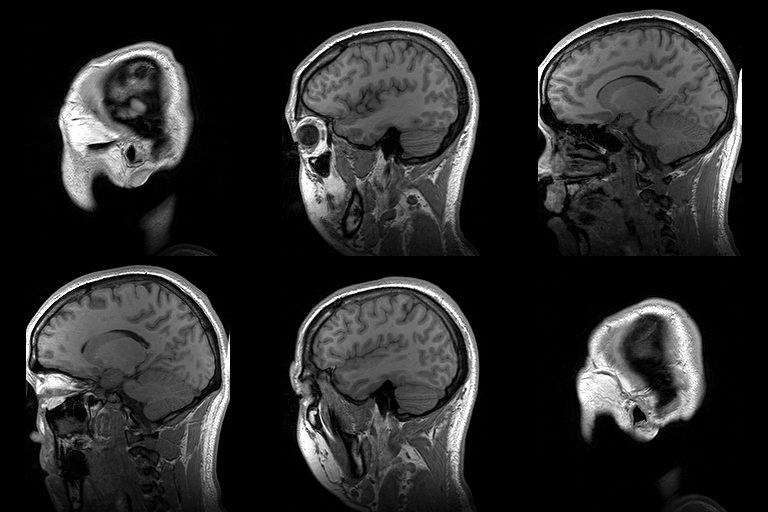
Displasia de Schneckenbecken
📋 Origem dos dados
Esta página agrega dados de fontes públicas e oficiais. Dados sobre cobertura no SUS (PCDT, CEAF) são verificados ativamente por agente proativo (ver badge no infobox). Demais dados têm atribuição de fonte + data da última sincronização — clique para abrir o original.
- Doença rara (ontologia)
- fonte: Orphanet
- Identificador unificado
- fonte: MONDO
- Genética mendeliana
- fonte: OMIM
- Codificação WHO/SUS
- fonte: WHO ICD-10 / DATASUS
- CID-11 (futuro)
- fonte: WHO ICD-11
- NIH/GARD
- fonte: GARD (NIH)
- Indexação biomédica
- fonte: MeSH (NLM)
- Dado público estruturado
- fonte: Wikidata