
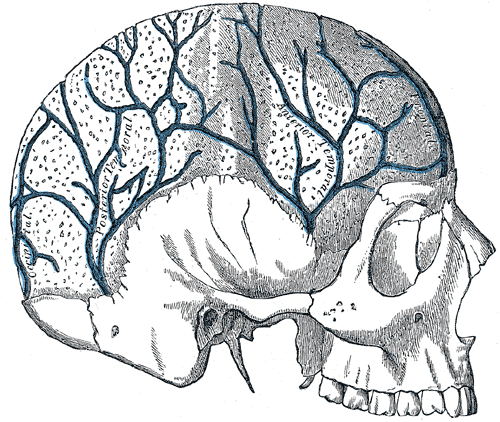
Acalvaria é uma malformação rara caracterizada pela ausência de couro cabeludo e de ossos planos em uma área da parte superior do crânio. O tamanho da área afetada é variável. Em casos raros, a acalvaria afeta toda a parte superior e arredondada do crânio, que inclui os ossos frontal, parietal e occipital. A dura-máter (uma das membranas que envolvem o cérebro) e os músculos associados estão ausentes na área afetada, mas o sistema nervoso central geralmente não é afetado, embora alguma anormalidade neurológica seja frequentemente encontrada (por exemplo, holoprosencefalia ou anomalias nas circunvoluções cerebrais). A base do crânio e os ossos da face são normais.
Introdução
O que você precisa saber de cara
Acalvaria é uma malformação rara caracterizada pela ausência de couro cabeludo e de ossos planos em uma área da parte superior do crânio. O tamanho da área afetada é variável. Em casos raros, a acalvaria afeta toda a parte superior e arredondada do crânio, que inclui os ossos frontal, parietal e occipital. A dura-máter (uma das membranas que envolvem o cérebro) e os músculos associados estão ausentes na área afetada, mas o sistema nervoso central geralmente não é afetado, embora alguma anormalidade neurológica seja frequentemente encontrada (por exemplo, holoprosencefalia ou anomalias nas circunvoluções cerebrais). A base do crânio e os ossos da face são normais.
Escala de raridade
<1/50kMuito rara
1/20kRara
1/10kPouco freq.
1/5kIncomum
1/2k
Encontrou um erro ou informação desatualizada? Sugira uma correção →
Entender a doença
Do básico ao detalhe, leia no seu ritmo
Preparando trilha educativa...
Sinais e sintomas
O que aparece no corpo e com que frequência cada sintoma acontece
Partes do corpo afetadas
+ 5 sintomas em outras categorias
Características mais comuns
Os sintomas variam de pessoa para pessoa. Abaixo estão as 14 características clínicas mais associadas, ordenadas por frequência.
Linha do tempo da pesquisa
Encontrou um erro ou informação desatualizada? Sugira uma correção →
Genética e causas
O que está alterado no DNA e como passa nas famílias
Nenhum gene associado encontrado
Os dados genéticos desta condição ainda estão sendo catalogados.
Diagnóstico
Os sinais que médicos procuram e os exames que confirmam
Tratamento e manejo
Remédios, cuidados de apoio e o que precisa acompanhar
Onde tratar no SUS
Hospitais de referência no Brasil e o protocolo oficial do SUS (PCDT)
🇧🇷 Atendimento SUS — Acalvaria
Selecione um estado ou use sua localização para ver resultados.
Dados de DATASUS/CNES, SBGM, ABNeuro e Ministério da Saúde. Sempre confirme a disponibilidade diretamente com o estabelecimento.
Pesquisa ativa
Ensaios clínicos abertos e novidades científicas recentes
Pesquisa e ensaios clínicos
Nenhum ensaio clínico registrado para esta condição.
Publicações mais relevantes
Acalvaria: First Surviving Case From Egypt-Case Report and Comprehensive Review of the Literature.
Acalvaria is an extremely rare congenital malformation characterized by the absence of calvarial bones, with preservation of the skull base, facial bones, and usually normal brain tissue. Most reported cases are fatal in the neonatal period. The aim of this report was to present the first surviving case from Egypt and provide a comprehensive review of the literature. A detailed clinical, radiological, and imaging evaluation of a full-term male infant diagnosed with acalvaria was conducted. A literature search was performed to identify and summarize previously reported cases worldwide. The patient, now 3-month-old, demonstrates normal growth and neurological development despite the absence of calvarial bones and defective posterior cervical vertebral arches, with no neurological deficits. Imaging confirmed the diagnosis. The literature review highlights the rarity of survival in acalvaria cases. This report adds to the limited literature on acalvaria by demonstrating the possibility of survival and normal development. It underscores the importance of accurate diagnosis, counseling, and follow-up in such rare congenital anomalies.
Anencephaly and palatoschisis in 2 newborn puppies.
Anencephaly is a congenital condition characterized by incomplete brain development and malformations of cranial bones and cerebral hemispheres. Such defects arise from improper neural tube closure during embryogenesis. Although well documented in humans, they are infrequently reported in veterinary medicine. The etiology of anencephaly in dogs is not fully understood, but a strong genetic predisposition has been observed, particularly among brachycephalic breeds. In addition, studies in humans have implicated factors such as folic acid deficiency, hypervitaminosis A, and exposure to teratogens as potential contributors. Using diagnostic imaging techniques, including radiography and ultrasonography, it is possible to detect intrauterine modifications indicative of malformation. Unfortunately, there are no known corrections or treatments for anencephaly, and affected fetuses are typically stillborn or die within hours after birth. This case report presents observations of 2 neonatal puppies with anencephaly, acalvaria, exophthalmia, and palatoschisis, providing further insights into these puzzling brain malformations in canines. Key clinical message: The present report highlights the importance of prenatal monitoring for diagnosis of anencephaly in dogs. It describes radiographic and ultrasonographic findings and compares morphological changes in 2 affected puppies of different breeds and clinical histories. Anencéphalie et palatoschisis chez deux chiots nouveau-nésL’anencéphalie est une maladie congénitale caractérisée par un développement cérébral incomplet et des malformations des os crâniens et des hémisphères cérébraux. Ces anomalies résultent d’une mauvaise fermeture du tube neural pendant l’embryogenèse. Quoique bien documentées chez l’homme, elles sont rarement rapportées en médecine vétérinaire. L’étiologie de l’anencéphalie chez le chien n’est pas entièrement comprise, mais une forte prédisposition génétique a été observée, en particulier chez les races brachycéphales. De plus, des études chez l’homme ont mis en cause des facteurs tels que la carence en acide folique, l’hypervitaminose A et l’exposition à des tératogènes comme facteurs contributifs potentiels. L’imagerie diagnostique, notamment la radiographie et l’échographie, permet de détecter des modifications intra-utérines révélatrices de malformations. Malheureusement, il n’existe aucun traitement ni correctif connus pour l’anencéphalie, et les foetus atteints sont généralement mort-nés ou meurent dans les heures qui suivent la naissance. Ce rapport de cas présente les observations de 2 chiots nouveau-nés atteints d’anencéphalie, d’acalvaria, d’exophtalmie et de palatoschisis, apportant ainsi un éclairage supplémentaire sur ces malformations cérébrales complexes chez les chiens.Message clinique clé:Ce rapport souligne l’importance du suivi prénatal pour le diagnostic de l’anencéphalie canine. Il décrit les résultats radiographiques et échographiques et compare les modifications morphologiques chez 2 chiots atteints de races et d’antécédents cliniques différents.(Traduit par Dr Serge Messier).
Novel presentation of acalvaria with clavicular absence: A case report.
Acalvaria is an exceptionally rare congenital disorder marked by the absence of flat bones of the cranial vault, dura mater, and associated muscles, while the facial bones and base of the skull remain intact. Typically, the central nervous system is unaffected. Due to their extreme rarity, reported cases in the literature are infrequent. This condition often results in fatalities, as newborns with this anomaly generally have short life expectancies. However, there are a few documented cases of prolonged survival. A 1-day-old full-term Palestinian male born to first-cousin parents at 37 + 6 weeks gestational age presented with an excessively soft skull without scalp abnormalities. The mother experienced polyhydramnios during the last 7 weeks of pregnancy. Head ultrasound and X-rays confirmed the absence of skull vault bones and clavicles with normal facial bones. A CT scan showed well-formed brain structures and foci of hemorrhage in the left frontal lobe. Supportive care was the primary management approach. The patient received comprehensive care in the neonatal intensive care unit, with a focus on stabilization and monitoring. After 3 weeks in the neonatal intensive care unit, the patient showed normal feeding and function, but the prognosis remained poor. The patient's family was informed about the poor prognosis. This case reveals a unique combination of acalvaria and absent clavicles. Early antenatal diagnosis is essential but was delayed here. More research is needed to understand and improve the diagnosis of these conditions.
Acalvaria, rare congenital malformation in Palestine: case report and literature review: Retraction.
[This retracts the article DOI: 10.1097/MS9.0000000000002643.].
Primary acalvaria with open-lip schizencephaly in indigenous South Papuan surviving newborn: a rare case report.
Acalvaria, or acrania, is a rare congenital cranial vault defect with neurocranium absences, including complete or part of calvaria flat bones, dura mater, and associated muscles, but with a still present in the central nervous system, skull base, facial bones, and skin-covered the defect. It is a sporadic incidence without apparent genetic factors confirmed. Acalvaria is often misdiagnosed as anencephaly; the distinguishable difference is that anencephaly has an absence (partial or complete) of the brain tissue, including the skull and scalp. Acalvaria is considered a fatal anomaly with a low survival rate, and only a few cases of extended survival have been reported until now. To the best of the author's knowledge, no acalvaria case has been published in Papua, and only one reported case of the coexistence of acalvaria with schizencephaly in Brazil (2018). Herein, we present a case of an indigenous South Papuan living newborn with primary acalvaria and open-lip schizencephaly in a frontoparietal region. A male newborn baby was born from a 39-year-old female Marind-Anim tribe patient with a 38th week of gestation, with no previous history of miscarriage, is not a consanguineous marriage, and had an unremarkable medical history during this pregnancy. Post-natal physical examinations showed an irregularly shaped head with 11.5 cm diameter concave of the right side, with a soft brain-like consistency palpable and the absence of half right frontoparietal calvarium covered with a presence of scalp and hair. Cranial 2-dimension ultrasonography shows an absence of half right frontoparietal calvaria bone with a complete presence of scalp and periosteum covering the defect with a fluid accumulation (anechoic) below the periosteum. A transverse axis view shows a complete structure but hypoplasia of brain cortex with visible slightly dysgenesis of gyrus and sulcus in both hemispheres convincing the acalvaria condition not anencephaly. A fluid accumulation above brain parenchyma of the frontoparietal region happened to be a cerebrospinal fluid coming from a wide-open cleft extending from the left lateral and fourth ventricles to the cerebral cortex, suggesting a typical condition of open-lip schizencephaly. Further health follow-ups until 6 months old showed still normal physical and behavioral development with no sign of complications. No standard acalvaria treatment is being established; conservative and supportive therapy is mostly taken considering their low survival rate. With the advancement of medical technology nowadays, surgical approaches, including scalp defect closure, bone graft, and 3D-printed defect filling, are being performed and have succeeded in a few cases. Long-term follow-up is required to monitor their neuro-psychological development and complication incidences that need further intervention.
Publicações recentes
Acalvaria: First Surviving Case From Egypt-Case Report and Comprehensive Review of the Literature.
Anencephaly and palatoschisis in 2 newborn puppies.
🥉 Relato de casoNovel presentation of acalvaria with clavicular absence: A case report.
🥉 Relato de casoAcalvaria, rare congenital malformation in Palestine: case report and literature review: Retraction.
Primary acalvaria with open-lip schizencephaly in indigenous South Papuan surviving newborn: a rare case report.
🥉 Relato de caso📚 EuropePMC26 artigos no totalmostrando 15
Acalvaria: First Surviving Case From Egypt-Case Report and Comprehensive Review of the Literature.
NeurosurgeryAnencephaly and palatoschisis in 2 newborn puppies.
The Canadian veterinary journal = La revue veterinaire canadienneNovel presentation of acalvaria with clavicular absence: A case report.
MedicineAcalvaria, rare congenital malformation in Palestine: case report and literature review: Retraction.
Annals of medicine and surgery (2012)Primary acalvaria with open-lip schizencephaly in indigenous South Papuan surviving newborn: a rare case report.
Child's nervous system : ChNS : official journal of the International Society for Pediatric NeurosurgeryCorrigendum to "Fetal acalvaria with lateral cleft lip and palate: A rare presentation" [Radiology Case Reports 19 (2024) 374-377].
Radiology case reportsAcalvaria: a case report of a rare congenital malformation and a review of the literature.
Child's nervous system : ChNS : official journal of the International Society for Pediatric NeurosurgeryFetal acalvaria with lateral cleft lip and palate: A rare presentation.
Radiology case reportsAcalvaria: the first case report from Nepal.
Annals of medicine and surgery (2012)A Case of Acalvaria in a Full Term, Live Born Male Infant.
CureusAcalvaria and imperforate anus: an extremely rare association.
Clinical dysmorphologyNovel Surgical Approach to Acalvaria.
The Journal of craniofacial surgeryCentral nervous system pathology in the amniotic rupture sequence.
Clinical neuropathologyAcalvaria with external hydrocephalus: an uncommon case.
Child's nervous system : ChNS : official journal of the International Society for Pediatric NeurosurgeryAcalvaria - report of a case and discussion of the literature.
British journal of neurosurgeryAssociações
Organizações que acompanham esta doença — pra ter apoio e orientação
Ainda não temos associações cadastradas para Acalvaria.
É de uma associação que acompanha esta doença? Fale com a gente →
Comunidades
Grupos ativos de quem convive com esta doença aqui no Raras
Ainda não existe comunidade no Raras para Acalvaria
Pacientes, familiares e cuidadores se organizam em comunidades pra compartilhar experiências, fazer perguntas e se apoiar. Você pode ser o primeiro.
Tire suas dúvidas
Perguntas, dicas e experiências compartilhadas aqui na página
Participe da discussão
Faça login para postar dúvidas, compartilhar experiências e interagir com especialistas.
Fazer loginDoenças relacionadas
Doenças com sintomas parecidos — ajudam quem ainda está buscando diagnóstico
Referências e fontes
Bases de dados externas citadas neste artigo
Publicações científicas
Artigos indexados no PubMed ligados a esta doença no grafo RarasNet — título, periódico e PMID direto da fonte, sem intermediação de IA.
- Acalvaria: First Surviving Case From Egypt-Case Report and Comprehensive Review of the Literature.
- Anencephaly and palatoschisis in 2 newborn puppies.
- Novel presentation of acalvaria with clavicular absence: A case report.
- Acalvaria, rare congenital malformation in Palestine: case report and literature review: Retraction.
- Primary acalvaria with open-lip schizencephaly in indigenous South Papuan surviving newborn: a rare case report.Child's nervous system : ChNS : official journal of the International Society for Pediatric Neurosurgery· 2024· PMID 38822831mais citado
Bases de dados e fontes oficiais
Identificadores e referências canônicas usadas para montar este verbete.
- ORPHA:945(Orphanet)
- MONDO:0019795(MONDO)
- GARD:361(GARD (NIH))
- Busca completa no PubMed(PubMed)
- Artigo Wikipedia(Wikipedia)
- Q48686(Wikidata)
Dados compilados pelo RarasNet a partir de fontes abertas (Orphanet, OMIM, MONDO, PubMed/EuropePMC, ClinicalTrials.gov, DATASUS, PCDT/MS). Este conteúdo é informativo e não substitui avaliação médica.
Conteúdo mantido por Agente Raras · Médicos e pesquisadores podem colaborar
Acalvaria
📋 Origem dos dados
Esta página agrega dados de fontes públicas e oficiais. Dados sobre cobertura no SUS (PCDT, CEAF) são verificados ativamente por agente proativo (ver badge no infobox). Demais dados têm atribuição de fonte + data da última sincronização — clique para abrir o original.
- Doença rara (ontologia)
- fonte: Orphanet
- Identificador unificado
- fonte: MONDO
- Codificação WHO/SUS
- fonte: WHO ICD-10 / DATASUS
- CID-11 (futuro)
- fonte: WHO ICD-11
- NIH/GARD
- fonte: GARD (NIH)
- Indexação biomédica
- fonte: MeSH (NLM)
- Dado público estruturado
- fonte: Wikidata