
Uma condição genética caracterizada pelo endurecimento e espessamento dos ossos longos, baixa estatura e alterações na cabeça e nos olhos. Muitos dos indivíduos afetados têm problemas na glândula paratireoide, o que causa baixos níveis de cálcio no sangue.
Introdução
O que você precisa saber de cara
Uma condição genética caracterizada pelo endurecimento e espessamento dos ossos longos, baixa estatura e alterações na cabeça e nos olhos. Muitos dos indivíduos afetados têm problemas na glândula paratireoide, o que causa baixos níveis de cálcio no sangue.
Escala de raridade
<1/50kMuito rara
1/20kRara
1/10kPouco freq.
1/5kIncomum
1/2k
Encontrou um erro ou informação desatualizada? Sugira uma correção →
Entender a doença
Do básico ao detalhe, leia no seu ritmo
Preparando trilha educativa...
Sinais e sintomas
O que aparece no corpo e com que frequência cada sintoma acontece
Partes do corpo afetadas
+ 24 sintomas em outras categorias
Características mais comuns
Os sintomas variam de pessoa para pessoa. Abaixo estão as 57 características clínicas mais associadas, ordenadas por frequência.
Linha do tempo da pesquisa
Encontrou um erro ou informação desatualizada? Sugira uma correção →
Genética e causas
O que está alterado no DNA e como passa nas famílias
Genes associados
2 genes identificados com associação a esta condição. Padrão de herança: Autosomal dominant, Autosomal recessive.
Tubulin-folding protein; involved in the second step of the tubulin folding pathway and in the regulation of tubulin heterodimer dissociation. Required for correct organization of microtubule cytoskeleton and mitotic splindle, and maintenance of the neuronal microtubule network
CytoplasmCytoplasm, cytoskeleton
Hypoparathyroidism-retardation-dysmorphism syndrome
An autosomal recessive multisystem disorder characterized by hypoparathyroidism, intrauterine and postnatal growth retardation, psychomotor retardation, epilepsy, microcephaly, and facial dysmorphism.
Single-stranded DNA-binding serine protease that mediates the proteolytic cleavage of covalent DNA-protein cross-links (DPCs) during DNA synthesis, thereby playing a key role in maintaining genomic integrity (PubMed:32165630). DPCs are highly toxic DNA lesions that interfere with essential chromatin transactions, such as replication and transcription, and which are induced by reactive agents, such as UV light or formaldehyde (PubMed:32165630). Protects replication fork from stalling by removing
NucleusChromosomeCytoplasm
Kenny-Caffey syndrome 2
A disorder characterized by impaired skeletal development with small and dense bones, short stature, and primary hypoparathyroidism with hypocalcemia. Clinical features include cortical thickening and medullary stenosis of the tubular bones, delayed closure of fontanels, defective dentition, small eyes with hypermetropia, and frontal bossing with a triangular face.
Variantes genéticas (ClinVar)
197 variantes patogênicas registradas no ClinVar.
Classificação de variantes (ClinVar)
Distribuição de 34 variantes classificadas pelo ClinVar.
Vias biológicas (Reactome)
1 via biológica associada aos genes desta condição.
Diagnóstico
Os sinais que médicos procuram e os exames que confirmam
Tratamento e manejo
Remédios, cuidados de apoio e o que precisa acompanhar
Onde tratar no SUS
Hospitais de referência no Brasil e o protocolo oficial do SUS (PCDT)
🇧🇷 Atendimento SUS — Síndrome Kenny-Caffey
Selecione um estado ou use sua localização para ver resultados.
Dados de DATASUS/CNES, SBGM, ABNeuro e Ministério da Saúde. Sempre confirme a disponibilidade diretamente com o estabelecimento.
Pesquisa ativa
Ensaios clínicos abertos e novidades científicas recentes
Pesquisa e ensaios clínicos
Nenhum ensaio clínico registrado para esta condição.
Publicações mais relevantes
A rare case of severe short stature diagnosed after late-onset hypocalcemia: Kenny-Caffey syndrome type 2.
Kenny-Caffey syndrome type 2 (KCS2) is a very rare genetic disorder characterized by growth retardation and hypoparathyroidism, due to autosomal dominantly inherited pathogenic variants in the FAM111A gene. In this report, we presented a pediatric patient diagnosed as KCS2, with severe short stature and late-onset hypocalcemia. A 7-year-old male patient was referred to our clinic for growth retardation. His body weight, height, and body mass index were 13.1 kg [(-4.9) standard deviation (SD) score], 94.8 cm (-5.4 SD score), and 14.6 kg/m2 (-0.8 SD score), respectively. He had dysmorphic features including a triangular face, frontal bossing, low-set ears, and a bulbous nose. His height velocity was 3.97 cm/year (-1.1 SD score), and serum insulin-like growth factor-1 level was low. The peak growth hormone (GH) response during the GH stimulation tests was 8.5 ng/mL. Pituitary magnetic resonance imaging showed a partially empty sella and GH treatment was initiated. At the end of the first year of treatment, routine laboratory tests revealed hypocalcemia, hyperphosphatemia, and inappropriately low parathyroid hormone levels. His skeletal survey demonstrated cortical thickening and medullary stenosis of the long bones. Based on these findings, KCS2 was considered in the differential diagnosis, and genetic testing revealed a heterozygous pathogenic variant (c.1706G>A) in FAM111A. KCS2 should be considered in patients with severe growth retardation and hypoparathyroidism, particularly when cortical thickening and medullary narrowing of long bones are observed. Responses to the GH treatment may vary among those individuals, and hypocalcemia may occur in the form of transient episodes.
Expanding genotype-phenotype correlation of Kenny-Caffey syndrome type 1.
A Case of FAM111A-Associated Kenny-Caffey Syndrome Type 2 with New Clinical Features: Microtia, Lacunar Skull Appearance, and Arnold-Chiari Malformation.
Kenny-Caffey syndrome type 2 (KCS2, #OMIM127000) is an extremely rare skeletal dysplasia characterized by characteristic facial features, relative macrocephaly, short stature, hypoparathyroidism, hypocalcemia, cortical thickening of tubular bones, and medullary stenosis. It is caused by the Family with Sequence Similarity 111 Member A (FAM111A) gene. Herein, we report a 7-year-old boy with microphthalmia, delayed anterior fontanelle closure, short stature, hypoparathyroidism, hypocalcemia, cortical thickening of tubular bones, and medullary stenosis. The presented patient had microcephaly, maculopathy, and craniosynostosis as rare distinct features. Microtia, lacunar skull appearance, and Arnold-Chiari malformation were present only in the reported patient. A diagnosis of KCS2 was considered with the clinical and radiological findings. Whole-exome sequencing identified a heterozygous pathogenic hotspot variant, c.1706G>A p.Arg569His (NM_001312909.2), in the FAM111A gene. Accurate diagnosis plays a critical role in enhancing clinical awareness, improving patient management, and offering appropriate genetic counseling for affected families.
Quantitative hypermorphic FAM111A alleles cause autosomal recessive Kenny-Caffey syndrome type 2 and osteocraniostenosis.
Kenny-Caffey syndrome (KCS) is a rare genetic disorder characterized by extreme short stature, cortical thickening and medullary stenosis of tubular bones, facial dysmorphism, abnormal T cell function, and hypoparathyroidism. Biallelic loss-of-function variants in TBCE cause autosomal recessive type 1 KCS (KCS1). By contrast, heterozygous missense variants in a restricted region of the FAM111A gene have been identified in autosomal dominant type 2 KCS (KCS2) and a more severe lethal phenotype, osteocraniostenosis (OCS); these variants have recently been shown to confer a gain of function. In this study, we describe 2 unrelated children with KCS and OCS who were homozygous for different FAM111A variant alleles that result in replacement of the same residue, Tyr414 (c.1241A>G, p.Y414C and c.1240T>A, p.Y414N), in the mature FAM111A protein. Their heterozygous relatives are asymptomatic. Functional studies of recombinant FAM111AY414C demonstrated normal dimerization and a mild gain-of-function effect. This study provides evidence that both biallelic and monoallelic variants of FAM111A with varying degrees of activation can lead to dominant or recessive KCS2 and OCS.
Key Clinical and X-Ray Characteristics for the Diagnosis of Kenny-Caffey Syndrome Types 1 and 2.
Kenny-Caffey syndrome (KCS) is a rare syndrome characterized by short stature, hypoparathyroidism, eye abnormalities, and skeletal dysplasia. Two types of KCS result from pathogenic variants in the tubulin-specific chaperone E (TBCE) gene and the family with sequence similarity 111 member A (FAM111A) gene, respectively. In this study, we present 4 patients from three different families exhibiting facial dysmorphism, postnatal growth retardation, short stature, delayed bone age, cortical thickening and medullary stenosis of the bones, and hypoparathyroidism. Two of these cases were diagnosed with growth hormone (GH) deficiency and underwent GH therapy, highlighting the response to GH treatment in KCS. Three consanguineous cases of KCS type 1 possess a homozygous variant c.155_166del in the TBCE gene, and 1 patient with KCS type 2 has a de novo pathogenic variant c.1706G>A (p.Arg569His) in the FAM111 gene. Our findings suggest that prenatal and postnatal growth failure is a prominent characteristic of this syndrome, with KCS types 1 and 2 showing overlapping features.
Publicações recentes
The FAM111A Gene: Genetic, Epigenetic, and Pharmacological Targets and Mechanistic Insights with Clinical Relevance.
🥈 ObservacionalFirst Reported Use of Recombinant Parathyroid Hormone in Kenny-Caffey Syndrome Type 2: A Case Report and Literature Review.
A rare case of severe short stature diagnosed after late-onset hypocalcemia: Kenny-Caffey syndrome type 2.
📖 RevisãoA Case of FAM111A-Associated Kenny-Caffey Syndrome Type 2 with New Clinical Features: Microtia, Lacunar Skull Appearance, and Arnold-Chiari Malformation.
Expanding genotype-phenotype correlation of Kenny-Caffey syndrome type 1.
📚 EuropePMC50 artigos no totalmostrando 41
A rare case of severe short stature diagnosed after late-onset hypocalcemia: Kenny-Caffey syndrome type 2.
Journal of pediatric endocrinology & metabolism : JPEMA Case of FAM111A-Associated Kenny-Caffey Syndrome Type 2 with New Clinical Features: Microtia, Lacunar Skull Appearance, and Arnold-Chiari Malformation.
Molecular syndromologyExpanding genotype-phenotype correlation of Kenny-Caffey syndrome type 1.
Clinical and experimental pediatricsQuantitative hypermorphic FAM111A alleles cause autosomal recessive Kenny-Caffey syndrome type 2 and osteocraniostenosis.
JCI insightKey Clinical and X-Ray Characteristics for the Diagnosis of Kenny-Caffey Syndrome Types 1 and 2.
Molecular syndromologyKenny-Caffey Syndrome Type 2 (KCS2): A New Case Report and Patient Follow-Up Optimization.
Journal of clinical medicineOut-of-frame Translation Rescues a Loss-of-function Variant in a Novel TBCE Phenotype.
The Journal of clinical endocrinology and metabolismHomozygous synonymous FAM111A variant underlies an autosomal recessive form of Kenny-Caffey syndrome.
Journal of human geneticsCochlear implantation in a familial rare syndromic ossification-related deafness and literature review.
Acta oto-laryngologicaExpanding TBCE-related phenotype-novel variant causing rigid spine, eosinophilia, neutropenia, and nocturnal hypoxemia.
Journal of applied geneticsMother and daughter with Kenny-Caffey syndrome: the adult phenotype.
European journal of medical geneticsFurther delineation of phenotype and genotype of Kenny-Caffey syndrome type 2 (phenotype and genotype of KCS type 2).
Molecular genetics & genomic medicineUnravelling the Intricate Roles of FAM111A and FAM111B: From Protease-Mediated Cellular Processes to Disease Implications.
International journal of molecular sciencesFAM111A regulates replication origin activation and cell fitness.
Life science allianceClinical and genetic features of Kenny-Caffey syndrome type 2 with multiple electrolyte disturbances: A case report.
World journal of clinical casesWithdrawn as duplicate: Expanding the phenotypic spectrum of Kenny-Caffey syndrome: a case series and systematic literature review.
The Journal of clinical endocrinology and metabolismExpanding the Phenotypic Spectrum of Kenny-Caffey Syndrome.
The Journal of clinical endocrinology and metabolismCase report: Late middle-aged features of FAM111A variant, Kenny-Caffey syndrome type 2-suggestive symptoms during a long follow-up.
Frontiers in endocrinologyFunctions and evolution of FAM111 serine proteases.
Frontiers in molecular biosciencesFAM111A is dispensable for electrolyte homeostasis in mice.
Scientific reportsClinical and Molecular Diagnosis of Osteocraniostenosis in Fetuses and Newborns: Prenatal Ultrasound, Clinical, Radiological and Pathological Features.
GenesCompound Heterozygous Variants in FAM111A Cause Autosomal Recessive Kenny-Caffey Syndrome Type 2.
Journal of clinical research in pediatric endocrinologyOral rehabilitation of a patient with Kenny-Caffey syndrome using telescopic overdenture.
Journal of Indian Prosthodontic SocietyThe role of calcium-sensing receptor signaling in regulating transepithelial calcium transport.
Experimental biology and medicine (Maywood, N.J.)Report of a novel variant in the FAM111A gene in a fetus with multiple anomalies including gracile bones, hypoplastic spleen, and hypomineralized skull.
American journal of medical genetics. Part AFAM111A induces nuclear dysfunction in disease and viral restriction.
EMBO reportsAdult Chinese twins with Kenny-Caffey syndrome type 2: A potential age-dependent phenotype and review of literature.
American journal of medical genetics. Part ATen-year use of recombinant parathyroid hormone for the treatment of hypoparathyroidism in a boy with partial Jacobsen syndrome.
Pediatric endocrinology, diabetes, and metabolismOverlapping phenotype comprising Kenny-Caffey type 2 and Sanjad-Sakati syndromes: The first case report.
American journal of medical genetics. Part AGenotype-phenotype spectrum in isolated and syndromic nanophthalmos.
Acta ophthalmologicaFAM111 protease activity undermines cellular fitness and is amplified by gain-of-function mutations in human disease.
EMBO reportsOphthalmologic Impairment and Intellectual Disability in a Girl Presenting Kenny-Caffey Syndrome Type 2.
Journal of pediatric geneticsKenny-Caffey syndrome type 2.
QJM : monthly journal of the Association of PhysiciansKenny-Caffey Syndrome Type 2: A Unique Presentation and Craniofacial Analysis.
The Journal of craniofacial surgeryGenetic Screening in a Large Chinese Cohort of Childhood Onset Hypoparathyroidism by Next-Generation Sequencing Combined with TBX1-MLPA.
Journal of bone and mineral research : the official journal of the American Society for Bone and Mineral ResearchContribution of DNA Replication to the FAM111A-Mediated Simian Virus 40 Host Range Phenotype.
Journal of virologyShort stature and hypoparathyroidism in a child with Kenny-Caffey syndrome type 2 due to a novel mutation in FAM111A gene.
International journal of pediatric endocrinologyTBCE Mutations Cause Early-Onset Progressive Encephalopathy with Distal Spinal Muscular Atrophy.
American journal of human genetics[Kenny-Caffey syndrome and its related syndromes].
Nihon rinsho. Japanese journal of clinical medicineDiverse genetic aetiologies and clinical outcomes of paediatric hypoparathyroidism.
Clinical endocrinologyKenny Caffey syndrome with severe respiratory and gastrointestinal involvement: expanding the clinical phenotype.
Quantitative imaging in medicine and surgeryAssociações
Organizações que acompanham esta doença — pra ter apoio e orientação
Ainda não temos associações cadastradas para Síndrome Kenny-Caffey.
É de uma associação que acompanha esta doença? Fale com a gente →
Comunidades
Grupos ativos de quem convive com esta doença aqui no Raras
Ainda não existe comunidade no Raras para Síndrome Kenny-Caffey
Pacientes, familiares e cuidadores se organizam em comunidades pra compartilhar experiências, fazer perguntas e se apoiar. Você pode ser o primeiro.
Tire suas dúvidas
Perguntas, dicas e experiências compartilhadas aqui na página
Participe da discussão
Faça login para postar dúvidas, compartilhar experiências e interagir com especialistas.
Fazer loginDoenças relacionadas
Doenças com sintomas parecidos — ajudam quem ainda está buscando diagnóstico
Referências e fontes
Bases de dados externas citadas neste artigo
Publicações científicas
Artigos indexados no PubMed ligados a esta doença no grafo RarasNet — título, periódico e PMID direto da fonte, sem intermediação de IA.
- A rare case of severe short stature diagnosed after late-onset hypocalcemia: Kenny-Caffey syndrome type 2.
- Expanding genotype-phenotype correlation of Kenny-Caffey syndrome type 1.
- A Case of FAM111A-Associated Kenny-Caffey Syndrome Type 2 with New Clinical Features: Microtia, Lacunar Skull Appearance, and Arnold-Chiari Malformation.
- Quantitative hypermorphic FAM111A alleles cause autosomal recessive Kenny-Caffey syndrome type 2 and osteocraniostenosis.
- Key Clinical and X-Ray Characteristics for the Diagnosis of Kenny-Caffey Syndrome Types 1 and 2.
- The FAM111A Gene: Genetic, Epigenetic, and Pharmacological Targets and Mechanistic Insights with Clinical Relevance.
- First Reported Use of Recombinant Parathyroid Hormone in Kenny-Caffey Syndrome Type 2: A Case Report and Literature Review.
Bases de dados e fontes oficiais
Identificadores e referências canônicas usadas para montar este verbete.
- ORPHA:2333(Orphanet)
- MONDO:0016516(MONDO)
- GARD:16594(GARD (NIH))
- Variantes catalogadas(ClinVar)
- Busca completa no PubMed(PubMed)
- Q48989142(Wikidata)
Dados compilados pelo RarasNet a partir de fontes abertas (Orphanet, OMIM, MONDO, PubMed/EuropePMC, ClinicalTrials.gov, DATASUS, PCDT/MS). Este conteúdo é informativo e não substitui avaliação médica.
Conteúdo mantido por Agente Raras · Médicos e pesquisadores podem colaborar
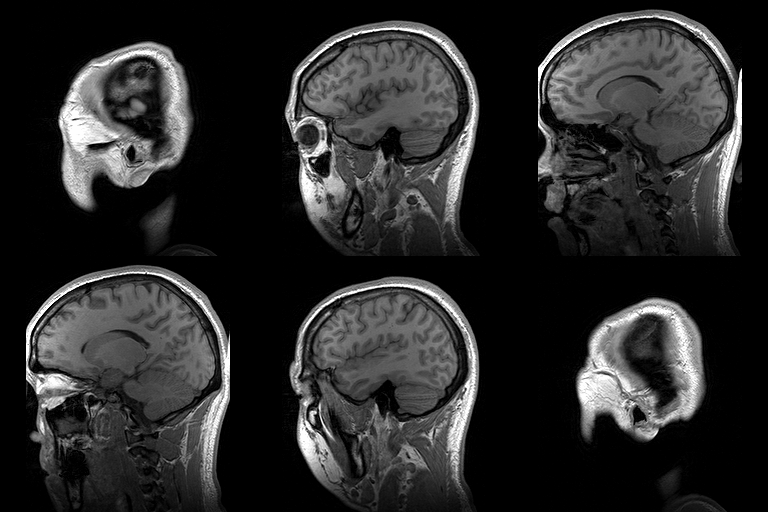
Síndrome Kenny-Caffey
📋 Origem dos dados
Esta página agrega dados de fontes públicas e oficiais. Dados sobre cobertura no SUS (PCDT, CEAF) são verificados ativamente por agente proativo (ver badge no infobox). Demais dados têm atribuição de fonte + data da última sincronização — clique para abrir o original.
- Doença rara (ontologia)
- fonte: Orphanet
- Identificador unificado
- fonte: MONDO
- Codificação WHO/SUS
- fonte: WHO ICD-10 / DATASUS
- CID-11 (futuro)
- fonte: WHO ICD-11
- NIH/GARD
- fonte: GARD (NIH)
- Indexação biomédica
- fonte: MeSH (NLM)
- Dado público estruturado
- fonte: Wikidata