
Síndrome Cohen-Gibson é uma condição autossômica dominante associada ao gene EED, caracterizada por criptorquidia, orelhas de implantação baixa, asa ilíaca hipoplásica, macrotia, maturação esquelética acelerada, pé longo, camptodactilia e polegar largo.
Introdução
O que você precisa saber de cara
Visão geral
A Síndrome Cohen-Gibson é uma doença genética rara, caracterizada por crescimento excessivo (supercrescimento), atraso no desenvolvimento e uma série de alterações físicas e neurológicas. A prevalência estimada é de menos de 1 caso por 1.000.000 de pessoas, sendo considerada uma condição ultrarrara. O início dos sinais pode ocorrer ainda no período pré-natal (antenatal) ou logo após o nascimento (neonatal).[1][4]
Sinais e sintomas
Os sinais e sintomas da Síndrome Cohen-Gibson são variados e podem incluir: supercrescimento (aumento geral do tamanho corporal), testa larga, hipertelorismo (aumento da distância entre os olhos), fissuras palpebrais inclinadas para baixo, epicanto (prega cutânea no canto interno do olho), ptose (queda da pálpebra superior), ponte nasal ampla, miopia e catarata. Também são comuns mãos grandes, dedos longos, unhas pequenas e finas, hipermobilidade articular, contratura em flexão, coxa valga (desalinhamento do quadril), escoliose e distúrbio da marcha. No sistema neurológico, podem ocorrer hipotonia generalizada (tônus muscular baixo), atraso global do desenvolvimento, atraso no desenvolvimento da fala e da linguagem, convulsões e hérnia umbilical. Exames de imagem podem revelar metáfise alargada (alteração óssea) e osteopenia (diminuição da densidade óssea).[1][4]
Causas genéticas
A Síndrome Cohen-Gibson é causada por variantes (mutações) no gene EED (Polycomb protein EED). Este gene fornece instruções para a produção de uma proteína que participa da regulação da expressão de outros genes, especialmente durante o desenvolvimento embrionário. A herança é autossômica dominante, o que significa que uma única cópia alterada do gene EED é suficiente para causar a condição. Na maioria dos casos, a mutação ocorre de forma nova (não herdada dos pais).[1][2][5]
Diagnóstico
O diagnóstico da Síndrome Cohen-Gibson é baseado na avaliação clínica dos sinais e sintomas característicos e confirmado por testes genéticos. Os exames disponíveis no Sistema Único de Saúde (SUS) incluem: cariótipo com bandas G, Q ou R; pesquisa de microdeleções/microduplicações por FISH; sequenciamento completo do exoma (WES); e dosagem de alfa-fetoproteína. O atendimento em reabilitação para doenças raras também está previsto. Atualmente, há 13 testes genéticos disponíveis e 45 variantes reportadas no ClinVar para esta condição.[1][2][5]
Tratamento e manejo
Não existe cura para a Síndrome Cohen-Gibson. O tratamento é multidisciplinar e focado no manejo dos sintomas e na melhora da qualidade de vida. Pode incluir: fisioterapia e terapia ocupacional para contratura em flexão, escoliose e hipermobilidade articular; acompanhamento oftalmológico para catarata e miopia; suporte educacional e fonoaudiológico para atraso no desenvolvimento da fala; e tratamento medicamentoso para convulsões, quando necessário. O acompanhamento regular com uma equipe médica especializada é essencial.[1][2]
Prognóstico e qualidade de vida
O prognóstico varia de acordo com a gravidade dos sintomas e a presença de complicações. Com intervenções precoces e suporte multidisciplinar, muitas pessoas com Síndrome Cohen-Gibson podem alcançar marcos importantes de desenvolvimento e ter uma qualidade de vida significativa. O acompanhamento contínuo é fundamental para monitorar o crescimento, a função motora, a visão e o desenvolvimento neurológico.[1][2]
Conteúdo informativo gerado e mantido automaticamente a partir de fontes oficiais (Orphanet, HPO, OMIM, SUS). Não substitui avaliação médica.
Síndrome Cohen-Gibson é uma condição autossômica dominante associada ao gene EED, caracterizada por criptorquidia, orelhas de implantação baixa, asa ilíaca hipoplásica, macrotia, maturação esquelética acelerada, pé longo, camptodactilia e polegar largo.
Escala de raridade
<1/50kMuito rara
1/20kRara
1/10kPouco freq.
1/5kIncomum
1/2k
Encontrou um erro ou informação desatualizada? Sugira uma correção →
Entender a doença
Do básico ao detalhe, leia no seu ritmo
Preparando trilha educativa...
Sinais e sintomas
O que aparece no corpo e com que frequência cada sintoma acontece
Visão geral
A Síndrome Cohen-Gibson é uma doença genética rara, caracterizada por crescimento excessivo (supercrescimento), atraso no desenvolvimento e uma série de alterações físicas e neurológicas. A prevalência estimada é de menos de 1 caso por 1.000.000 de pessoas, sendo considerada uma condição ultrarrara. O início dos sinais pode ocorrer ainda no período pré-natal (antenatal) ou logo após o nascimento (neonatal).[1][4]
Sinais e sintomas
Os sinais e sintomas da Síndrome Cohen-Gibson são variados e podem incluir: supercrescimento (aumento geral do tamanho corporal), testa larga, hipertelorismo (aumento da distância entre os olhos), fissuras palpebrais inclinadas para baixo, epicanto (prega cutânea no canto interno do olho), ptose (queda da pálpebra superior), ponte nasal ampla, miopia e catarata. Também são comuns mãos grandes, dedos longos, unhas pequenas e finas, hipermobilidade articular, contratura em flexão, coxa valga (desalinhamento do quadril), escoliose e distúrbio da marcha. No sistema neurológico, podem ocorrer hipotonia generalizada (tônus muscular baixo), atraso global do desenvolvimento, atraso no desenvolvimento da fala e da linguagem, convulsões e hérnia umbilical. Exames de imagem podem revelar metáfise alargada (alteração óssea) e osteopenia (diminuição da densidade óssea).[1][4]
Causas genéticas
A Síndrome Cohen-Gibson é causada por variantes (mutações) no gene EED (Polycomb protein EED). Este gene fornece instruções para a produção de uma proteína que participa da regulação da expressão de outros genes, especialmente durante o desenvolvimento embrionário. A herança é autossômica dominante, o que significa que uma única cópia alterada do gene EED é suficiente para causar a condição. Na maioria dos casos, a mutação ocorre de forma nova (não herdada dos pais).[1][2][5]
Diagnóstico
O diagnóstico da Síndrome Cohen-Gibson é baseado na avaliação clínica dos sinais e sintomas característicos e confirmado por testes genéticos. Os exames disponíveis no Sistema Único de Saúde (SUS) incluem: cariótipo com bandas G, Q ou R; pesquisa de microdeleções/microduplicações por FISH; sequenciamento completo do exoma (WES); e dosagem de alfa-fetoproteína. O atendimento em reabilitação para doenças raras também está previsto. Atualmente, há 13 testes genéticos disponíveis e 45 variantes reportadas no ClinVar para esta condição.[1][2][5]
Tratamento e manejo
Não existe cura para a Síndrome Cohen-Gibson. O tratamento é multidisciplinar e focado no manejo dos sintomas e na melhora da qualidade de vida. Pode incluir: fisioterapia e terapia ocupacional para contratura em flexão, escoliose e hipermobilidade articular; acompanhamento oftalmológico para catarata e miopia; suporte educacional e fonoaudiológico para atraso no desenvolvimento da fala; e tratamento medicamentoso para convulsões, quando necessário. O acompanhamento regular com uma equipe médica especializada é essencial.[1][2]
Prognóstico e qualidade de vida
O prognóstico varia de acordo com a gravidade dos sintomas e a presença de complicações. Com intervenções precoces e suporte multidisciplinar, muitas pessoas com Síndrome Cohen-Gibson podem alcançar marcos importantes de desenvolvimento e ter uma qualidade de vida significativa. O acompanhamento contínuo é fundamental para monitorar o crescimento, a função motora, a visão e o desenvolvimento neurológico.[1][2]
Conteúdo informativo gerado e mantido automaticamente a partir de fontes oficiais (Orphanet, HPO, OMIM, SUS). Não substitui avaliação médica.
Partes do corpo afetadas
+ 15 sintomas em outras categorias
Características mais comuns
Os sintomas variam de pessoa para pessoa. Abaixo estão as 47 características clínicas mais associadas, ordenadas por frequência.
Linha do tempo da pesquisa
Encontrou um erro ou informação desatualizada? Sugira uma correção →
Genética e causas
O que está alterado no DNA e como passa nas famílias
Genes associados
1 gene identificado com associação a esta condição. Padrão de herança: Autosomal dominant.
Curadoria gene-doença
fontes oficiaisPolycomb group (PcG) protein. Component of the PRC2/EED-EZH2 complex, which methylates 'Lys-9' and 'Lys-27' of histone H3, leading to transcriptional repression of the affected target gene. Also recognizes 'Lys-26' trimethylated histone H1 with the effect of inhibiting PRC2 complex methyltransferase activity on nucleosomal histone H3 'Lys-27', whereas H3 'Lys-27' recognition has the opposite effect, enabling the propagation of this repressive mark. The PRC2/EED-EZH2 complex may also serve as a r
NucleusChromosome
Cohen-Gibson syndrome
An autosomal dominant overgrowth disorder characterized by accelerated osseous maturation, advanced bone age, skeletal abnormalities including flaring of the metaphyses of the long bones, large hands with long fingers and camptodactyly, scoliosis, cervical spine anomalies, dysmorphic facial features, and variable intellectual disability.
Variantes genéticas (ClinVar)
45 variantes patogênicas registradas no ClinVar.
Classificação de variantes (ClinVar)
Distribuição de 71 variantes classificadas pelo ClinVar.
Vias biológicas (Reactome)
10 vias biológicas associadas aos genes desta condição.
Diagnóstico
Os sinais que médicos procuram e os exames que confirmam
Tratamento e manejo
Remédios, cuidados de apoio e o que precisa acompanhar
Onde tratar no SUS
Hospitais de referência no Brasil e o protocolo oficial do SUS (PCDT)
🇧🇷 Atendimento SUS — Síndrome Cohen-Gibson
Selecione um estado ou use sua localização para ver resultados.
Dados de DATASUS/CNES, SBGM, ABNeuro e Ministério da Saúde. Sempre confirme a disponibilidade diretamente com o estabelecimento.
Pesquisa ativa
Ensaios clínicos abertos e novidades científicas recentes
Pesquisa e ensaios clínicos
Nenhum ensaio clínico registrado para esta condição.
Publicações mais relevantes
Functional analysis of human EED variants using Drosophila.
The Polycomb Repressive Complex 2 is an epigenetic reader/writer that methylates histone H3K27. Rare germline partial loss-of-function (pLoF) variants in core members of the complex (EZH2, EED, and SUZ12) cause overgrowth and intellectual disability syndromes, whereas somatic variants are implicated in cancer. However, up to 1% of the general population will have a rare variant in one of these genes, most of which would be classified as variants of uncertain significance (VUS). Towards screening these VUS for partial LoF alleles that may contribute to disease, here we report functional assays in Drosophila to interrogate Embryonic Ectoderm Development (EED) missense variants. We mimicked the amino acid change(s) of EED variants into its Drosophila ortholog, esc, and tested their function. Known likely benign variants functioned wildtype and known pathogenic variants were LoF. We further demonstrate the utility of this calibrated assay as a scalable approach to assist clinical interpretation of human EED VUS.
EED related overgrowth: First report of multiple members in a single family.
EED is a core component of polycomb repressive complex 2 (PRC2) with EZH2 and SUZ12. PRC2 has H3K27 methyltransferase activity (HMTase) that catalyzes the addition of up to three methyl groups on histone 3 at lysine residue 27 (H3K27). Germline heterozygous variants in EED, SUZ12, and EZH2 have been identified in patients with overgrowth and multiple dysmorphic features. The clinical manifestations of these syndromes significantly overlap: generalized overgrowth, intellectual disability, and scoliosis. To date, 11 unrelated patients have been published with missense variants in EED at highly conserved amino acids. We report three affected members in a family with a previously reported missense variant. All three affected members manifested very similarly, and this represents a homogenous clinical phenotype associated with EED related intellectual disability and overgrowth. This disorder is appropriately called Cohen-Gibson syndrome.
Imagawa-Matsumoto syndrome: SUZ12-related overgrowth disorder.
The SUZ12 gene encodes a subunit of polycomb repressive complex 2 (PRC2) that is essential for development by silencing the expression of multiple genes. Germline heterozygous variants in SUZ12 have been found in Imagawa-Matsumoto syndrome (IMMAS) characterized by overgrowth and multiple dysmorphic features. Similarly, both EZH2 and EED also encode a subunit of PRC2 each and their pathogenic variants cause Weaver syndrome and Cohen-Gibson syndrome, respectively. Clinical manifestations of these syndromes significantly overlap, although their different prevalence rates have recently been noted: generalized overgrowth, intellectual disability, scoliosis, and excessive loose skin appear to be less prevalent in IMMAS than in the other two syndromes. We could not determine any apparent genotype-phenotype correlation in IMMAS. The phenotype of neurofibromatosis type 1 arising from NF1 deletion was also shown to be modified by the deletion of SUZ12, 560 kb away. This review deepens our understanding of the clinical and genetic characteristics of IMMAS together with other overgrowth syndromes related to PRC2. We also report on a novel IMMAS patient carrying a splicing variant (c.1023+1G>C) in SUZ12. This patient had a milder phenotype than other previously reported IMMAS cases, with no macrocephaly or overgrowth phenotypes, highlighting the clinical variation in IMMAS.
Manifestation of epilepsy in a patient with EED-related overgrowth (Cohen-Gibson syndrome).
Cohen-Gibson syndrome is a rare genetic disorder, characterized by fetal or early childhood overgrowth and mild to severe intellectual disability. It is caused by heterozygous aberrations in EED, which encodes an evolutionary conserved polycomb group (PcG) protein that forms the polycomb repressive complex-2 (PRC2) together with EZH2, SUZ12, and RBBP7/4. In total, 11 affected individuals with heterozygous pathogenic variants in EED were reported, so far. All variants affect a few key residues within the EED WD40 repeat domain. By trio exome sequencing, we identified the heterozygous missense variant c.581A > G, p.(Asn194Ser) in exon 6 of the EED-gene in an individual with moderate intellectual disability, overgrowth, and epilepsy. The same pathogenic variant was detected in 2 of the 11 previously reported cases. Epilepsy, however, was only diagnosed in one other individual with Cohen-Gibson syndrome before. Our findings further confirm that the WD40 repeat domain represents a mutational hotspot; they also expand the clinical spectrum of Cohen-Gibson syndrome and highlight the clinical variability even in individuals with the same pathogenic variant. Furthermore, they indicate a possible association between Cohen-Gibson syndrome and epilepsy.
Rare SUZ12 variants commonly cause an overgrowth phenotype.
The Polycomb repressive complex 2 is an epigenetic writer and recruiter with a role in transcriptional silencing. Constitutional pathogenic variants in its component proteins have been found to cause two established overgrowth syndromes: Weaver syndrome (EZH2-related overgrowth) and Cohen-Gibson syndrome (EED-related overgrowth). Imagawa et al. (2017) initially reported a singleton female with a Weaver-like phenotype with a rare coding SUZ12 variant-the same group subsequently reported two additional affected patients. Here we describe a further 10 patients (from nine families) with rare heterozygous SUZ12 variants who present with a Weaver-like phenotype. We report four frameshift, two missense, one nonsense, and two splice site variants. The affected patients demonstrate variable pre- and postnatal overgrowth, dysmorphic features, musculoskeletal abnormalities and developmental delay/intellectual disability. Some patients have genitourinary and structural brain abnormalities, and there may be an association with respiratory issues. The addition of these 10 patients makes a compelling argument that rare pathogenic SUZ12 variants frequently cause overgrowth, physical abnormalities, and abnormal neurodevelopmental outcomes in the heterozygous state. Pathogenic SUZ12 variants may be de novo or inherited, and are sometimes inherited from a mildly-affected parent. Larger samples sizes will be needed to elucidate whether one or more clinically-recognizable syndromes emerge from different variant subtypes.
Publicações recentes
Functional analysis of human EED variants using Drosophila.
EED related overgrowth: First report of multiple members in a single family.
🥉 Relato de casoImagawa-Matsumoto syndrome: SUZ12-related overgrowth disorder.
Manifestation of epilepsy in a patient with EED-related overgrowth (Cohen-Gibson syndrome).
Rare SUZ12 variants commonly cause an overgrowth phenotype.
📚 EuropePMC2 artigos no totalmostrando 7
Functional analysis of human EED variants using Drosophila.
GeneticsEED related overgrowth: First report of multiple members in a single family.
American journal of medical genetics. Part AImagawa-Matsumoto syndrome: SUZ12-related overgrowth disorder.
Clinical geneticsManifestation of epilepsy in a patient with EED-related overgrowth (Cohen-Gibson syndrome).
American journal of medical genetics. Part ARare SUZ12 variants commonly cause an overgrowth phenotype.
American journal of medical genetics. Part C, Seminars in medical geneticsPRC2-complex related dysfunction in overgrowth syndromes: A review of EZH2, EED, and SUZ12 and their syndromic phenotypes.
American journal of medical genetics. Part C, Seminars in medical geneticsEED and EZH2 constitutive variants: A study to expand the Cohen-Gibson syndrome phenotype and contrast it with Weaver syndrome.
American journal of medical genetics. Part AAssociações
Organizações que acompanham esta doença — pra ter apoio e orientação
Ainda não temos associações cadastradas para Síndrome Cohen-Gibson.
É de uma associação que acompanha esta doença? Fale com a gente →
Comunidades
Grupos ativos de quem convive com esta doença aqui no Raras
Ainda não existe comunidade no Raras para Síndrome Cohen-Gibson
Pacientes, familiares e cuidadores se organizam em comunidades pra compartilhar experiências, fazer perguntas e se apoiar. Você pode ser o primeiro.
Tire suas dúvidas
Perguntas, dicas e experiências compartilhadas aqui na página
Participe da discussão
Faça login para postar dúvidas, compartilhar experiências e interagir com especialistas.
Fazer loginDoenças relacionadas
Doenças com sintomas parecidos — ajudam quem ainda está buscando diagnóstico
Referências e fontes
Bases de dados externas citadas neste artigo
Publicações científicas
Artigos indexados no PubMed ligados a esta doença no grafo RarasNet — título, periódico e PMID direto da fonte, sem intermediação de IA.
- Functional analysis of human EED variants using Drosophila.
- EED related overgrowth: First report of multiple members in a single family.
- Imagawa-Matsumoto syndrome: SUZ12-related overgrowth disorder.
- Manifestation of epilepsy in a patient with EED-related overgrowth (Cohen-Gibson syndrome).
- Rare SUZ12 variants commonly cause an overgrowth phenotype.American journal of medical genetics. Part C, Seminars in medical genetics· 2019· PMID 31736240mais citado
Bases de dados e fontes oficiais
Identificadores e referências canônicas usadas para montar este verbete.
- ORPHA:659396(Orphanet)
- OMIM OMIM:617561(OMIM)
- MONDO:0060510(MONDO)
- GARD:16235(GARD (NIH))
- Variantes catalogadas(ClinVar)
- Busca completa no PubMed(PubMed)
- Artigo Wikipedia(Wikipedia)
Dados compilados pelo RarasNet a partir de fontes abertas (Orphanet, OMIM, MONDO, PubMed/EuropePMC, ClinicalTrials.gov, DATASUS, PCDT/MS). Este conteúdo é informativo e não substitui avaliação médica.
Conteúdo mantido por Agente Raras · Médicos e pesquisadores podem colaborar
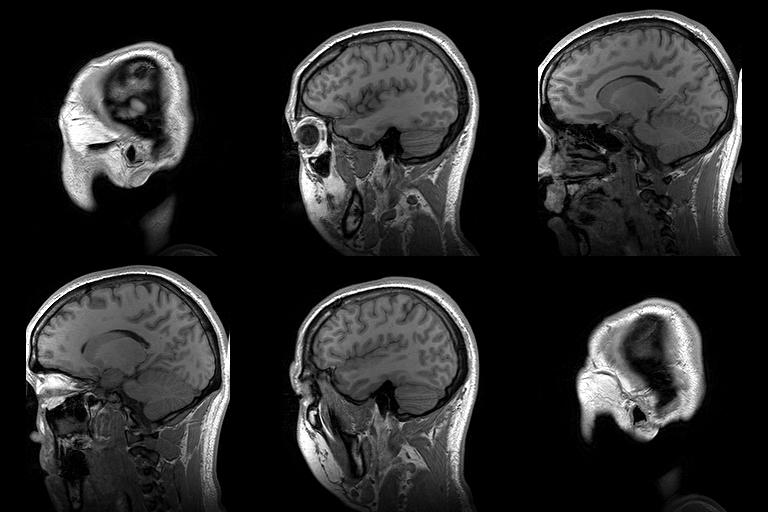
Síndrome Cohen-Gibson
📋 Origem dos dados
Esta página agrega dados de fontes públicas e oficiais. Dados sobre cobertura no SUS (PCDT, CEAF) são verificados ativamente por agente proativo (ver badge no infobox). Demais dados têm atribuição de fonte + data da última sincronização — clique para abrir o original.
- Doença rara (ontologia)
- fonte: Orphanet
- Identificador unificado
- fonte: MONDO
- Genética mendeliana
- fonte: OMIM
- Codificação WHO/SUS
- fonte: WHO ICD-10 / DATASUS
- NIH/GARD
- fonte: GARD (NIH)