
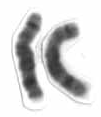
A deleção 8p23.1 envolve uma deleção parcial do braço curto do cromossomo 8, caracterizada por baixo peso ao nascer, deficiência de crescimento pós-natal, déficit intelectual leve, hiperatividade, anomalias craniofaciais e defeitos cardíacos congênitos.
Introdução
O que você precisa saber de cara
A deleção 8p23.1 envolve uma deleção parcial do braço curto do cromossomo 8, caracterizada por baixo peso ao nascer, deficiência de crescimento pós-natal, déficit intelectual leve, hiperatividade, anomalias craniofaciais e defeitos cardíacos congênitos.
Escala de raridade
<1/50kMuito rara
1/20kRara
1/10kPouco freq.
1/5kIncomum
1/2k
Encontrou um erro ou informação desatualizada? Sugira uma correção →
Entender a doença
Do básico ao detalhe, leia no seu ritmo
Preparando trilha educativa...
Sinais e sintomas
O que aparece no corpo e com que frequência cada sintoma acontece
Partes do corpo afetadas
+ 16 sintomas em outras categorias
Características mais comuns
Os sintomas variam de pessoa para pessoa. Abaixo estão as 49 características clínicas mais associadas, ordenadas por frequência.
Linha do tempo da pesquisa
Encontrou um erro ou informação desatualizada? Sugira uma correção →
Genética e causas
O que está alterado no DNA e como passa nas famílias
Genes associados
1 gene identificado com associação a esta condição. Padrão de herança: Not applicable, Unknown.
Transcriptional activator that binds to the consensus sequence 5'-AGATAG-3' and plays a key role in cardiac development and function (PubMed:24000169, PubMed:27984724, PubMed:35182466). In cooperation with TBX5, it binds to cardiac super-enhancers and promotes cardiomyocyte gene expression, while it down-regulates endocardial and endothelial gene expression (PubMed:27984724). Involved in bone morphogenetic protein (BMP)-mediated induction of cardiac-specific gene expression. Binds to BMP respons
Nucleus
Atrial septal defect 2
A congenital heart malformation characterized by incomplete closure of the wall between the atria resulting in blood flow from the left to the right atria. Patients show other heart abnormalities including ventricular and atrioventricular septal defects, pulmonary valve thickening or insufficiency of the cardiac valves. The disease is not associated with defects in the cardiac conduction system or non-cardiac abnormalities.
Variantes genéticas (ClinVar)
315 variantes patogênicas registradas no ClinVar.
Vias biológicas (Reactome)
11 vias biológicas associadas aos genes desta condição.
Diagnóstico
Os sinais que médicos procuram e os exames que confirmam
Tratamento e manejo
Remédios, cuidados de apoio e o que precisa acompanhar
Onde tratar no SUS
Hospitais de referência no Brasil e o protocolo oficial do SUS (PCDT)
🇧🇷 Atendimento SUS — Síndrome de microdeleção 8p23.1
Selecione um estado ou use sua localização para ver resultados.
Dados de DATASUS/CNES, SBGM, ABNeuro e Ministério da Saúde. Sempre confirme a disponibilidade diretamente com o estabelecimento.
Pesquisa ativa
Ensaios clínicos abertos e novidades científicas recentes
Pesquisa e ensaios clínicos
Nenhum ensaio clínico registrado para esta condição.
Publicações mais relevantes
46,XY,r(8)/45,XY,-8 Mosaicism as a Possible Mechanism of the Imprinted Birk-Barel Syndrome: A Case Study.
Ring chromosome 8 (r(8)) is one of the least frequent ring chromosomes. Usually, maternal chromosome 8 forms a ring, which can be lost from cells due to mitotic instability. The 8q24 region contains the imprinted KCNK9 gene, which is expressed from the maternal allele. Heterozygous KCNK9 mutations are associated with the imprinting disorder Birk-Barel syndrome. Here, we report a 2.5-year-old boy with developmental delay, microcephaly, dysmorphic features, diffuse muscle hypotonia, feeding problems, motor alalia and noncoarse neurogenic type of disturbance of muscle electrogenesis, partially overlapping with Birk-Barel syndrome phenotype. Cytogenetic analysis of lymphocytes revealed his karyotype to be 46,XY,r(8)(p23q24.3)[27]/45,XY,-8[3]. A de novo 7.9 Mb terminal 8p23.3p23.1 deletion, a 27.1 Mb 8p23.1p11.22 duplication, and a 4.4 Mb intact segment with a normal copy number located between them, as well as a 154-kb maternal LINGO2 gene deletion (9p21.2) with unknown clinical significance were identified by aCGH + SNP array. These aberrations were confirmed by real-time PCR. According to FISH analysis, the 8p23.1-p11.22 duplication was inverted. The ring chromosome originated from maternal chromosome 8. Targeted massive parallel sequencing did not reveal the KCNK9 mutations associated with Birk-Barel syndrome. Our data allow to assume that autosomal monosomy with inactive allele of imprinted gene arising from the loss of a ring chromosome in some somatic cells may be an etiological mechanism of mosaic imprinting disorders, presumably with less severe phenotype.
Coexistence of Fragile-X Syndrome, 8p23.1 Deletion, and Balanced Translocation t(7;10)(p10;q24) in a Single Family.
Aims: Fragile-X syndrome (FXS) is the most common inherited form of intellectual disability; it is caused by an abnormal CGG-repeat expansion at the FMR1 gene. However, a few cases of girls with mutations in the FMR1 gene have been reported in the literature. In this study, we describe the clinical and genetic assessment of a family who exhibits the unusual coexistence of FXS, an 8p23.1 deletion, and balanced translocation t(7;10)(p10;q24) in multiple members, including a symptomatic girl with FXS. Materials and Methods: All of the family members underwent comprehensive clinical and neurological examinations. All members of the family were also molecularly diagnosed using a combination of fluorescent-polymerase chain reaction (PCR), Triplet Repeat Primed-PCR, capillary electrophoresis, and karyotyping. Results: We identified a male proband and a female patient that presented with the craniofacial characteristics of FXS, neuropsychomotor developmental delay, speech delay, intellectual deficit, and a positive molecular diagnosis of FXS. Interestingly, the female patient presented with a severe phenotype also associated with the presence of 8p23.1 deletion, while the proband patient presented a balanced translocation t(7;10)(p10;q24). Moreover, we detected multiple carriers of the FXS premutation in the family. Conclusions: To our knowledge, we describe for the first time the simultaneous occurrence of FXS and an 8p23.1 deletion and their possible synergistic effects on the phenotype of a female patient. Moreover, we describe the coexistence of FXS, an 8p23.1 deletion, and a balanced translocation t(7;10)(p10;q24) in the same family.
Is interstitial 8p23 microdeletion responsible of 46,XY gonadal dysgenesis? One case report from birth to puberty.
Chromosome 8p deletions are associated with a variety of conditions, including cardiac abnormalities, mental, behavioral problems with variable morphotype and genitourinary anomalies in boys. We describe the follow-up over almost 15 years of a boy who initially presented with perineal hypospadias with a micropenis and cryptorchidism with 46,XY DSD. Imaging, pathology, and hormonal exploration suggested gonadal dysgenesis. Further genetic studies were deemed necessary during follow-up. The child's further development recommended further genetic analyses. High-resolution analysis showed an interstitial deletion on the short arm of a chromosome 8: 46,XY,del(8)(p23.1p23.1). We reviewed the literature and found 102 cases including 54 boys: 62.7% had mental problems, 50.9% a dysmorphic disorder, 55.9% cardiac anomalies, and 46.3% of the boys had genitourinary anomalies. Our patient's genital abnormalities can be explained by the haploinsufficiency of the genes, such as GATA4 (OMIM 600576) that are included in the deleted area. This case of severe 46,XY DSD raises the question of the role played by 8p23 microdeletion in gonadal dysgenesis. Clinicians are encouraged to look for this anomaly on chromosome 8 in cases of unexplained gonadal dysgenesis even when few signs suggestive of this anomaly are present.
Postzygotic telomere capture causes segmental UPD, duplication and deletion of chromosome 8p in a patient with intellectual disability and obesity.
Using SNP array and FISH analysis, a patient with moderate intellectual disability and obesity was found to harbour an atypical 1.6 Mb inverted duplication on 8p23.1, directly flanked by a distally located interstitial deletion of 2.3 Mb and a terminal segmental uniparental disomy. The duplicated and deleted regions lie exactly between the two segmental duplication regions. These segmental duplications on chromosome 8p23.1 are known to be involved in chromosomal rearrangements because of mutual homology and homology to other genomic regions. Genomic instability mediated by these segmental duplications is generally caused by non-allelic homologous recombination, resulting in deletions, reciprocal duplications, inversions and translocations. Additional analysis of the parental origin of the fragments of this atypical inverted duplication/interstitial deletion shows paternal contribution in the maternal derivate chromosome 8. Combined with the finding that the normal chromosome 8 carries an inversion in 8p23.1 we hypothesize that a double strand break in 8p23.1 of the maternal chromosome was postzygotically repaired with the paternal inverted copy resulting in a duplication, deletion and segmental uniparental disomy, with no particular mediation of the 8p23.1 segmental duplication regions in recombination.
De novo 8p23.1 deletion in a patient with absence epilepsy.
The 8p23.1 deletion syndrome is a rare multisystem disorder with high penetrance and a variable phenotypic spectrum that includes congenital heart disease (CHD), intellectual disability, behavioural problems, microcephalia, and sometimes epilepsy. Genomic copy number variations (CNVs) constitute an important genetic risk factor for common genetic generalised epilepsy syndromes (GGEs) and absence seizures. These variations, resulting either from copy loss (microdeletion) or copy gain (duplications), disrupt genes associated with neuronal development. Herein, we report an epilepsy patient who was affected by developmental delay, microcephalia, behavioural problems, CHD, and childhood-onset absence seizures. The patient had a 4-Mb de novo microdeletion at 8p23.1. Some of the genes in this region, particularly XKR6 and MIR597, may be involved in the pathogenesis of absence seizures, suggesting that epilepsy may possibly be part of the phenotypic spectrum of the syndrome rather than a comorbid disorder. Thus, CNV screening for GGE plus patients may have important implications in clinical practice with regards to diagnostic classification, clinical management of the syndromic multisystem disorders, and, potentially, genetic counselling.
Publicações recentes
Hematuria as an Early Sign of Multisystem Inflammatory Syndrome in Children: A Case Report of a Boy With Multiple Comorbidities and Review of Literature.
8p23.1 Microdeletion syndrome and obstructing myxomatous heart valve nodules.
📚 EuropePMC1 artigos no totalmostrando 7
46,XY,r(8)/45,XY,-8 Mosaicism as a Possible Mechanism of the Imprinted Birk-Barel Syndrome: A Case Study.
GenesCoexistence of Fragile-X Syndrome, 8p23.1 Deletion, and Balanced Translocation t(7;10)(p10;q24) in a Single Family.
Genetic testing and molecular biomarkersIs interstitial 8p23 microdeletion responsible of 46,XY gonadal dysgenesis? One case report from birth to puberty.
Molecular genetics & genomic medicinePostzygotic telomere capture causes segmental UPD, duplication and deletion of chromosome 8p in a patient with intellectual disability and obesity.
European journal of medical geneticsDe novo 8p23.1 deletion in a patient with absence epilepsy.
Epileptic disorders : international epilepsy journal with videotapeInterchromosomal core duplicons drive both evolutionary instability and disease susceptibility of the Chromosome 8p23.1 region.
Genome research8p23.1 Interstitial Deletion in a Patient with Congenital Cardiopathy, Neurobehavioral Disorders, and Minor Signs Suggesting 22q11.2 Deletion Syndrome.
Journal of developmental and behavioral pediatrics : JDBPAssociações
Organizações que acompanham esta doença — pra ter apoio e orientação
Ainda não temos associações cadastradas para Síndrome de microdeleção 8p23.1.
É de uma associação que acompanha esta doença? Fale com a gente →
Comunidades
Grupos ativos de quem convive com esta doença aqui no Raras
Ainda não existe comunidade no Raras para Síndrome de microdeleção 8p23.1
Pacientes, familiares e cuidadores se organizam em comunidades pra compartilhar experiências, fazer perguntas e se apoiar. Você pode ser o primeiro.
Tire suas dúvidas
Perguntas, dicas e experiências compartilhadas aqui na página
Participe da discussão
Faça login para postar dúvidas, compartilhar experiências e interagir com especialistas.
Fazer loginDoenças relacionadas
Doenças com sintomas parecidos — ajudam quem ainda está buscando diagnóstico
Referências e fontes
Bases de dados externas citadas neste artigo
Publicações científicas
Artigos indexados no PubMed ligados a esta doença no grafo RarasNet — título, periódico e PMID direto da fonte, sem intermediação de IA.
- 46,XY,r(8)/45,XY,-8 Mosaicism as a Possible Mechanism of the Imprinted Birk-Barel Syndrome: A Case Study.
- Coexistence of Fragile-X Syndrome, 8p23.1 Deletion, and Balanced Translocation t(7;10)(p10;q24) in a Single Family.
- Is interstitial 8p23 microdeletion responsible of 46,XY gonadal dysgenesis? One case report from birth to puberty.
- Postzygotic telomere capture causes segmental UPD, duplication and deletion of chromosome 8p in a patient with intellectual disability and obesity.
- De novo 8p23.1 deletion in a patient with absence epilepsy.
- Hematuria as an Early Sign of Multisystem Inflammatory Syndrome in Children: A Case Report of a Boy With Multiple Comorbidities and Review of Literature.
- 8p23.1 Microdeletion syndrome and obstructing myxomatous heart valve nodules.
Bases de dados e fontes oficiais
Identificadores e referências canônicas usadas para montar este verbete.
- ORPHA:251071(Orphanet)
- MONDO:0016658(MONDO)
- GARD:3769(GARD (NIH))
- Variantes catalogadas(ClinVar)
- Busca completa no PubMed(PubMed)
- Q55786361(Wikidata)
Dados compilados pelo RarasNet a partir de fontes abertas (Orphanet, OMIM, MONDO, PubMed/EuropePMC, ClinicalTrials.gov, DATASUS, PCDT/MS). Este conteúdo é informativo e não substitui avaliação médica.
Conteúdo mantido por Agente Raras · Médicos e pesquisadores podem colaborar
Síndrome de microdeleção 8p23.1
📋 Origem dos dados
Esta página agrega dados de fontes públicas e oficiais. Dados sobre cobertura no SUS (PCDT, CEAF) são verificados ativamente por agente proativo (ver badge no infobox). Demais dados têm atribuição de fonte + data da última sincronização — clique para abrir o original.
- Doença rara (ontologia)
- fonte: Orphanet
- Identificador unificado
- fonte: MONDO
- Codificação WHO/SUS
- fonte: WHO ICD-10 / DATASUS
- CID-11 (futuro)
- fonte: WHO ICD-11
- NIH/GARD
- fonte: GARD (NIH)
- Indexação biomédica
- fonte: MeSH (NLM)
- Dado público estruturado
- fonte: Wikidata